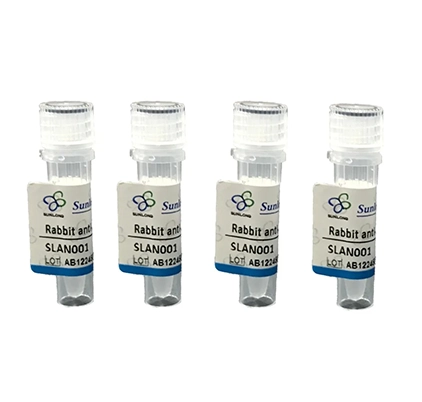
Mouse Anti-HLA-E antibody
View History [Clear]
Details
Product Name HLA-E Immunogen Species Mouse Clonality Monoclonal Clone NO. B6E6 React Species Human Applications WB=1:500-1000,IHC-P=1:100-500,IHC-F=1:100-500,ICC/IF=1:100-500,IF=1:100-500(Paraffin sections need antigen repair)
not yet tested in other applications.
optimal dilutions/concentrations should be determined by the end user.Cellular localization cytoplasmic Extracellular matrix Secretory protein Form Liquid Concentration 1mg/ml Lsotype IgG2A/Kappa Purification Affinity purified by Protein G Buffer Solution 1M TBS(pH7.4) with 1% BSA, 3% Proclin300 and 50% Glycerol. Storage Shipped at 4℃. Store at -20 °C for one year. Avoid repeated freeze/thaw cycles. Attention This product as supplied is intended for research use only, not for use in human, therapeutic or diagnostic applications. PubMed PubMed Product Detail Non-classical major histocompatibility class Ib molecules are involved in immune self-non-self recognition. In complex with B2M/β-2-microglobulin, they bind nonameric self-peptides (VL9 peptides) derived from the signal sequences of classical MHC Ia molecules. The peptide-bound HLA-E-B2M heterotrimeric complex mainly functions as a ligand for the natural killer (NK) cell inhibitory receptor KLRD1-KLRC1, enabling NK cells to monitor the expression of other MHC class I molecules in healthy cells and tolerate autoimmunity. During cellular stress, it preferentially binds signal sequence-derived peptides from stress-induced chaperones and is no longer recognized by the NK cell inhibitory receptor KLRD1-KLRC1, resulting in impaired protection by NK cells. Binding to signal sequence-derived peptides of the non-classical MHC-Ib molecule HLA-G, acting as a ligand for the NK cell activating receptor KLRD1-KLRC2, may play a role in the generation and effector function of adaptive NK cells as well as maternal-fetal tolerance during pregnancy. In addition to self-peptides, it can also bind and present pathogen-derived peptides with a conformation similar to that of VL9 peptides to α-β T cell receptors (TCRs) on unconventional CD8+ cytotoxic T cells, ultimately triggering antibacterial immune responses.
Cartpieces
Totalgoods,subtotals:¥Checkout
Partial purchase records(bought amounts latest0)
No one bought this product
User Comment(Total0User Comment Num)
- No comment


 +86 571 56623320
 SUNLONG BIOTECH

