Rabbit Anti-Cytokeratin 9 antibody
CK 9; CK-9; CK9; Cytokeratin-9; Cytokeratin9; EPPK; K1C9_HUMAN; K9; Keratin 9; Keratin; Keratin type I cytoskeletal 9; Keratin-9; Keratin9; KRT 9; KRT9; type I cytoskeletal 9.
View History [Clear]
Details
Product Name Cytokeratin 9 Chinese Name 细胞角蛋白9Recombinant rabbit monoclonal anti Alias CK 9; CK-9; CK9; Cytokeratin-9; Cytokeratin9; EPPK; K1C9_HUMAN; K9; Keratin 9; Keratin; Keratin type I cytoskeletal 9; Keratin-9; Keratin9; KRT 9; KRT9; type I cytoskeletal 9. Research Area Cell biology Signal transduction Immunogen Species Rabbit Clonality Monoclonal Clone NO. 4F8 React Species Human,Rat(predicted:Mouse) Applications WB=1:500-1000,IHC-P=1:50-200,IHC-F=1:50-200,IF=1:50-200(Paraffin sections need antigen repair)
not yet tested in other applications.
optimal dilutions/concentrations should be determined by the end user.Theoretical molecular weight 62kDa Cellular localization The nucleus cytoplasmic The cell membrane Form Liquid Concentration 1mg/ml immunogen Recombinant human Cytokeratin 9 protein (300-450aa) Lsotype IgG Purification affinity purified by Protein A Buffer Solution 1M TBS(pH7.4) with 1% BSA, 3% Proclin300 and 50% Glycerol. Storage Shipped at 4℃. Store at -20 °C for one year. Avoid repeated freeze/thaw cycles. Attention This product as supplied is intended for research use only, not for use in human, therapeutic or diagnostic applications. PubMed PubMed Product Detail This gene encodes the type I keratin 9, an intermediate filament chain expressed only in the terminally differentiated epidermis of palms and soles. Mutations in this gene cause epidermolytic palmoplantar keratoderma. [provided by RefSeq, Jul 2008]
Function:
May serve an important special function either in the mature palmar and plantar skin tissue or in the morphogenetic program of the formation of these tissues. Plays a role in keratin filament assembly.
Tissue Specificity:
Expressed in the terminally differentiated epidermis of palms and soles.
DISEASE:
Defects in KRT9 are a cause of palmoplantar keratoderma epidermolytic (EPPK) [MIM:144200]; also abbreviated as EHPPK. EPPK is a dermatological disorder characterized by diffuse thickening of the epidermis on the entire surface of palms and soles sharply bordered with erythematous margins. Some patients may present with knuckle pads, thick pads of skin appearing over the proximal phalangeal joints.
Similarity:
Belongs to the intermediate filament family.
SWISS:
P35527
Gene ID:
3857
Database links:Entrez Gene: 3857 Human
Omim: 607606 Human
SwissProt: P35527 Human
Unigene: 654569 Human
Product Picture 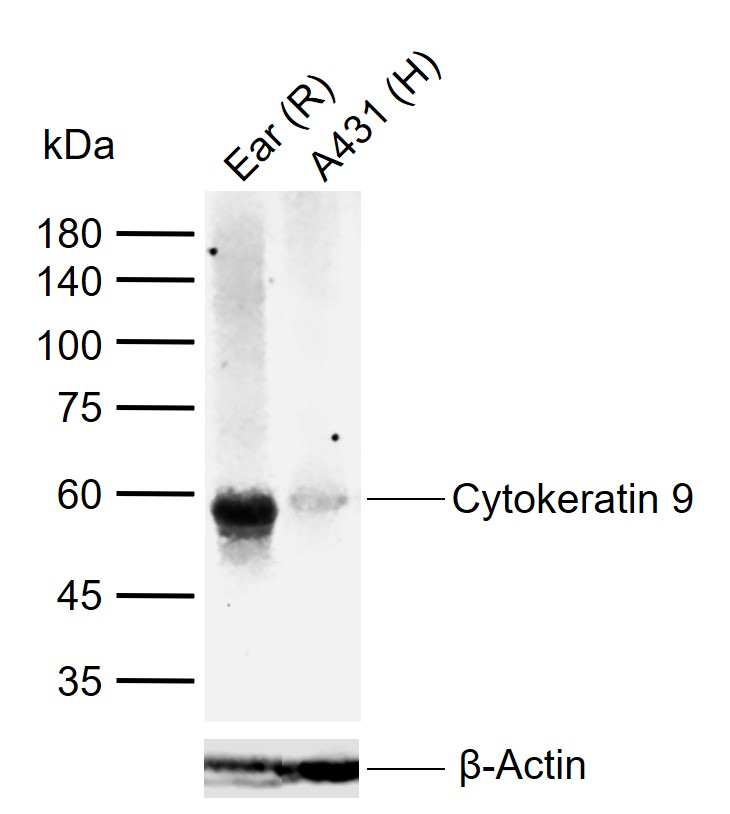 Sample:
Lane 1: Rat Ear tissue lysates
Lane 2: Human A431 cell lysates
Primary: Anti-Cytokeratin 9 (SLM-52066R) at 1/1000 dilution
Secondary: IRDye800CW Goat Anti-Rabbit IgG at 1/20000 dilution
Predicted band size: 62 kDa
Observed band size: 60 kDa
Cartpieces
Totalgoods,subtotals:¥Checkout
Partial purchase records(bought amounts latest0)
No one bought this product
User Comment(Total0User Comment Num)
- No comment


 +86 571 56623320
 SUNLONG BIOTECH

