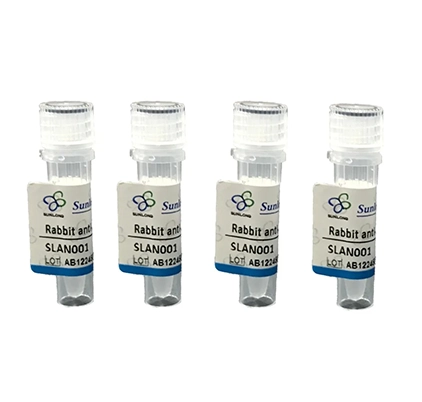
Rabbit Anti-HDAC4 antibody
HDAC4_HUMAN; Histone deacetylase 4; EC:3.5.1.98; KIAA0288; HD4;
View History [Clear]
Details
Product Name HDAC4 Chinese Name 组蛋白去乙酰化酶4Recombinant rabbit monoclonal anti Alias HDAC4_HUMAN; Histone deacetylase 4; EC:3.5.1.98; KIAA0288; HD4; Research Area Tumour Cell biology Developmental biology Signal transduction Stem cells Apoptosis transcriptional regulatory factor Epigenetics Immunogen Species Rabbit Clonality Monoclonal Clone NO. 6B10 React Species Human, Mouse, Rat, Applications WB=1:500-2000,ICC/IF=1:50-200,Flow-Cyt=1:50-100
not yet tested in other applications.
optimal dilutions/concentrations should be determined by the end user.Theoretical molecular weight 140kDa Cellular localization The nucleus cytoplasmic Form Liquid Concentration 1mg/ml immunogen Recombinant human HDAC4 protein Lsotype IgG Purification affinity purified by Protein A Buffer Solution 1M TBS(pH7.4) with 1% BSA, 3% Proclin300 and 50% Glycerol. Storage Shipped at 4℃. Store at -20 °C for one year. Avoid repeated freeze/thaw cycles. Attention This product as supplied is intended for research use only, not for use in human, therapeutic or diagnostic applications. PubMed PubMed Product Detail Histones play a critical role in transcriptional regulation, cell cycle progression, and developmental events. Histone acetylation/deacetylation alters chromosome structure and affects transcription factor access to DNA. The protein encoded by this gene belongs to class II of the histone deacetylase/acuc/apha family. It possesses histone deacetylase activity and represses transcription when tethered to a promoter. This protein does not bind DNA directly, but through transcription factors MEF2C and MEF2D. It seems to interact in a multiprotein complex with RbAp48 and HDAC3. [provided by RefSeq, Jul 2008].
Function:
Responsible for the deacetylation of lysine residues on the N-terminal part of the core histones (H2A, H2B, H3 and H4). Histone deacetylation gives a tag for epigenetic repression and plays an important role in transcriptional regulation, cell cycle progression and developmental events. Histone deacetylases act via the formation of large multiprotein complexes. Involved in muscle maturation via its interaction with the myocyte enhancer factors such as MEF2A, MEF2C and MEF2D.
Subunit:
Interacts with HDAC7. Homodimer. Homodimerization via its N-terminal domain. Interacts with MEF2C, AHRR, and NR2C1. Interacts with a 14-3-3 chaperone protein in a phosphorylation dependent manner. Interacts with BTBD14B. Interacts with KDM5B. Interacts with MYOCD. Interacts with MORC2. Interacts with ANKRA2.
Subcellular Location:
Nucleus. Cytoplasm. Shuttles between the nucleus and the cytoplasm. Upon muscle cells differentiation, it accumulates in the nuclei of myotubes, suggesting a positive role of nuclear HDAC4 in muscle differentiation. The export to cytoplasm depends on the interaction with a 14-3-3 chaperone protein and is due to its phosphorylation at Ser-246, Ser-467 and Ser-632 by CaMK4. The nuclear localization probably depends on sumoylation.
Tissue Specificity:
Ubiquitous.
Post-translational modifications:
Phosphorylated by CaMK4 at Ser-246, Ser-467 and Ser-632. Phosphorylation at other residues by CaMK2D is required for the interaction with 14-3-3. Phosphorylation at Ser-350 impairs the binding of ANKRA2 but generates a high-affinity docking site for 14-3-3.
DISEASE:
Defects in HDAC4 are the cause of brachydactyly-mental retardation syndrome (BDMR) [MIM:600430]. A syndrome resembling the physical anomalies found in Albright hereditary osteodystrophy. Common features are mild facial dysmorphism, congenital heart defects, distinct brachydactyly type E, mental retardation, developmental delay, seizures, autism spectrum disorder, and stocky build. Soft tissue ossification is absent, and there are no abnormalities in parathyroid hormone or calcium metabolism.
Similarity:
Belongs to the histone deacetylase family. HD type 2 subfamily.
SWISS:
P56524
Gene ID:
9759
Database links:Entrez Gene: 9759 Human
Entrez Gene: 208727 Mouse
SwissProt: P56524 Human
SwissProt: Q6NZM9 Mouse
Product Picture 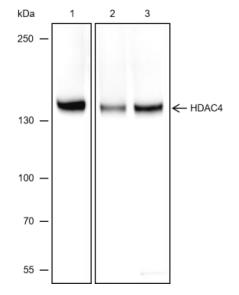 Blocking buffer: 5% NFDM/TBST
Primary ab dilution: 1:1000
Primary ab incubation condition: 2 hours at
room temperature
Secondary ab: Goat Anti-Rabbit IgG H&L
(HRP)
Lysate: 1: HeLa,2: BRL, 3: NIH/3T3
Protein loading quantity: 20 μg
Exposure time: 30 s
Predicted MW: 119kDa
Observed MW: 140 kDa
Cartpieces
Totalgoods,subtotals:¥Checkout
Partial purchase records(bought amounts latest0)
No one bought this product
User Comment(Total0User Comment Num)
- No comment


 +86 571 56623320
 SUNLONG BIOTECH

