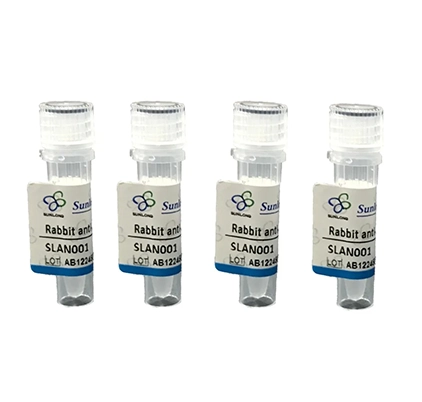
Rabbit Anti-DFNB31 antibody
1110035G07Rik; Autosomal recessive deafness type 31 protein; CASK interacting protein CIP98; CIP 98; CIP98; Deafness autosomal recessive 31; DFNB 31; DKFZp434N014; KIAA1526; RP11 9M16.1; USH 2D; USH2D; Whirlin; WHRN; WHRN_HUMAN; WI.
View History [Clear]
Details
Product Name DFNB31 Chinese Name 常染色体隐性遗传性耳聋型31蛋白抗体 Alias 1110035G07Rik; Autosomal recessive deafness type 31 protein; CASK interacting protein CIP98; CIP 98; CIP98; Deafness autosomal recessive 31; DFNB 31; DKFZp434N014; KIAA1526; RP11 9M16.1; USH 2D; USH2D; Whirlin; WHRN; WHRN_HUMAN; WI. Research Area Cell biology immunology Neurobiology Immunogen Species Rabbit Clonality Polyclonal React Species (predicted: Human, Mouse, Rat, Cow, Horse, Rabbit, Sheep, ) Applications IHC-P=1:100-500,IHC-F=1:100-500,ICC/IF=1:100-500,IF=1:100-500,ELISA=1:5000-10000 (Paraffin sections need antigen repair)
not yet tested in other applications.
optimal dilutions/concentrations should be determined by the end user.Theoretical molecular weight 96kDa Cellular localization The nucleus cytoplasmic Form Liquid Concentration 1mg/ml immunogen KLH conjugated synthetic peptide derived from human DFNB31: 151-250/907 Lsotype IgG Purification affinity purified by Protein A Buffer Solution 1M TBS(pH7.4) with 1% BSA, 3% Proclin300 and 50% Glycerol. Storage Shipped at 4℃. Store at -20 °C for one year. Avoid repeated freeze/thaw cycles. Attention This product as supplied is intended for research use only, not for use in human, therapeutic or diagnostic applications. PubMed PubMed Product Detail This gene is thought to function in the organization and stabilization of sterocilia elongation and actin cystoskeletal assembly, based on studies of the related mouse gene. Mutations in this gene have been associated with autosomal recessive non-syndromic deafness and Usher Syndrome. Alternative splicing of this gene results in multiple transcript variants encoding different isoforms.[provided by RefSeq, Mar 2010]
Function:
Necessary for elongation and maintenance of inner and outer hair cell stereocilia in the organ of Corti in the inner ear.
Subcellular Location:
Cytoplasm. Cell projection > stereocilium. Cell projection > growth cone. Detected at the level of stereocilia in inner outer hair cells of the cochlea and vestibule. Co-localizes with the growing ends of actin filaments (By similarity). Colocalizes with MPP1 in the retina, at the outer limiting membrane (OLM), outer plexifirm layer (OPL), basal bodies and at the connecting cilium.
DISEASE:
Defects in WHRN are the cause of deafness autosomal recessive type 31 (DFNB31) [MIM:607084]. DFNB31 is a form of sensorineural hearing loss. Sensorineural deafness results from damage to the neural receptors of the inner ear, the nerve pathways to the brain, or the area of the brain that receives sound information.
Defects in WHRN are the cause of Usher syndrome type 2D (USH2D) [MIM:611383]. USH is a genetically heterogeneous condition characterized by the association of retinitis pigmentosa and sensorineural deafness. Age at onset and differences in auditory and vestibular function distinguish Usher syndrome type 1 (USH1), Usher syndrome type 2 (USH2) and Usher syndrome type 3 (USH3). USH2 is characterized by congenital mild hearing impairment with normal vestibular responses.
Similarity:
Contains 3 PDZ (DHR) domains.
SWISS:
Q9P202
Gene ID:
25861
Database links:Entrez Gene: 25861 Human
Entrez Gene: 73750 Mouse
Omim: 607928 Human
SwissProt: Q9P202 Human
SwissProt: Q80VW5 Mouse
Unigene: 93836 Human
Unigene: 300397 Mouse
Unigene: 204268 Rat
Cartpieces
Totalgoods,subtotals:¥Checkout
Partial purchase records(bought amounts latest0)
No one bought this product
User Comment(Total0User Comment Num)
- No comment


 +86 571 56623320
 SUNLONG BIOTECH

