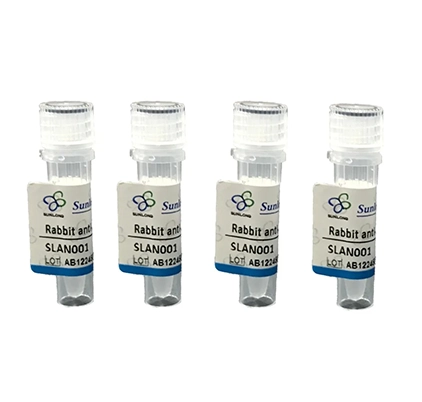
Rabbit Anti-OSBPL9 antibody
FLJ12492; FLJ14629; FLJ14801; OSBL9_HUMAN; FLJ32055; FLJ34384; MGC15035; ORP9; OSBP related protein 9; OSBP4; Oxysterol binding protein like 9; Oxysterol binding protein related protein 9; oxysterol binding protein-like 9; oxysterol binding proteinlike9.
View History [Clear]
Details
Product Name OSBPL9 Chinese Name 氧固醇Binding protein样9抗体 Alias FLJ12492; FLJ14629; FLJ14801; OSBL9_HUMAN; FLJ32055; FLJ34384; MGC15035; ORP9; OSBP related protein 9; OSBP4; Oxysterol binding protein like 9; Oxysterol binding protein related protein 9; oxysterol binding protein-like 9; oxysterol binding proteinlike9. Research Area Tumour Cell biology Developmental biology Signal transduction The new supersedes the old Immunogen Species Rabbit Clonality Polyclonal React Species Human Applications IHC-P=1:100-500,IHC-F=1:100-500,IF=1:100-500 (Paraffin sections need antigen repair)
not yet tested in other applications.
optimal dilutions/concentrations should be determined by the end user.Theoretical molecular weight 83kDa Cellular localization cytoplasmic Form Liquid Concentration 1mg/ml immunogen KLH conjugated synthetic peptide derived from human OSBPL9: 101-200/736 Lsotype IgG Purification affinity purified by Protein A Buffer Solution 1M TBS(pH7.4) with 1% BSA, 3% Proclin300 and 50% Glycerol. Storage Shipped at 4℃. Store at -20 °C for one year. Avoid repeated freeze/thaw cycles. Attention This product as supplied is intended for research use only, not for use in human, therapeutic or diagnostic applications. PubMed PubMed Product Detail This gene encodes a member of the oxysterol-binding protein (OSBP) family, a group of intracellular lipid receptors. Most members contain an N-terminal pleckstrin homology domain and a highly conserved C-terminal OSBP-like sterol-binding domain, although some members contain only the sterol-binding domain. This family member functions as a cholesterol transfer protein that regulates Golgi structure and function. Multiple transcript variants, most of which encode distinct isoforms, have been identified. Related pseudogenes have been identified on chromosomes 3, 11 and 12. [provided by RefSeq, Jul 2010]
Function:
The OSBPL9 gene encodes a member of the oxysterol-binding protein (OSBP) family, a group of intracellular lipid receptors. Most members contain an N-terminal pleckstrin homology domain and a highly conserved C-terminal OSBP-like sterol-binding domain, although some members contain only the sterol-binding domain. OSBPL9 appears to be in a distinct OSBP subfamily and shares relatively little homology in the sterol-binding domain with other OSBPs. Multiple transcript variants have been identified, most of which encode distinct isoforms.
Subunit:
Late endosome membrane. Golgi apparatus, trans-Golgi network membrane. Note=Localizes at the Golgi-late endosome interface.
Subcellular Location:
Golgi Apparatus.
Tissue Specificity:
Widely expressed.
Similarity:
Belongs to the OSBP family.
Contains 1 PH domain.
SWISS:
Q96SU4
Gene ID:
114883
Database links:Entrez Gene: 114883 Human
Entrez Gene: 100273 Mouse
Omim: 606737 Human
SwissProt: Q96SU4 Human
SwissProt: A2A8Z1 Mouse
Unigene: 21938 Human
Unigene: 366315 Mouse
Unigene: 61554 Rat
Product Picture 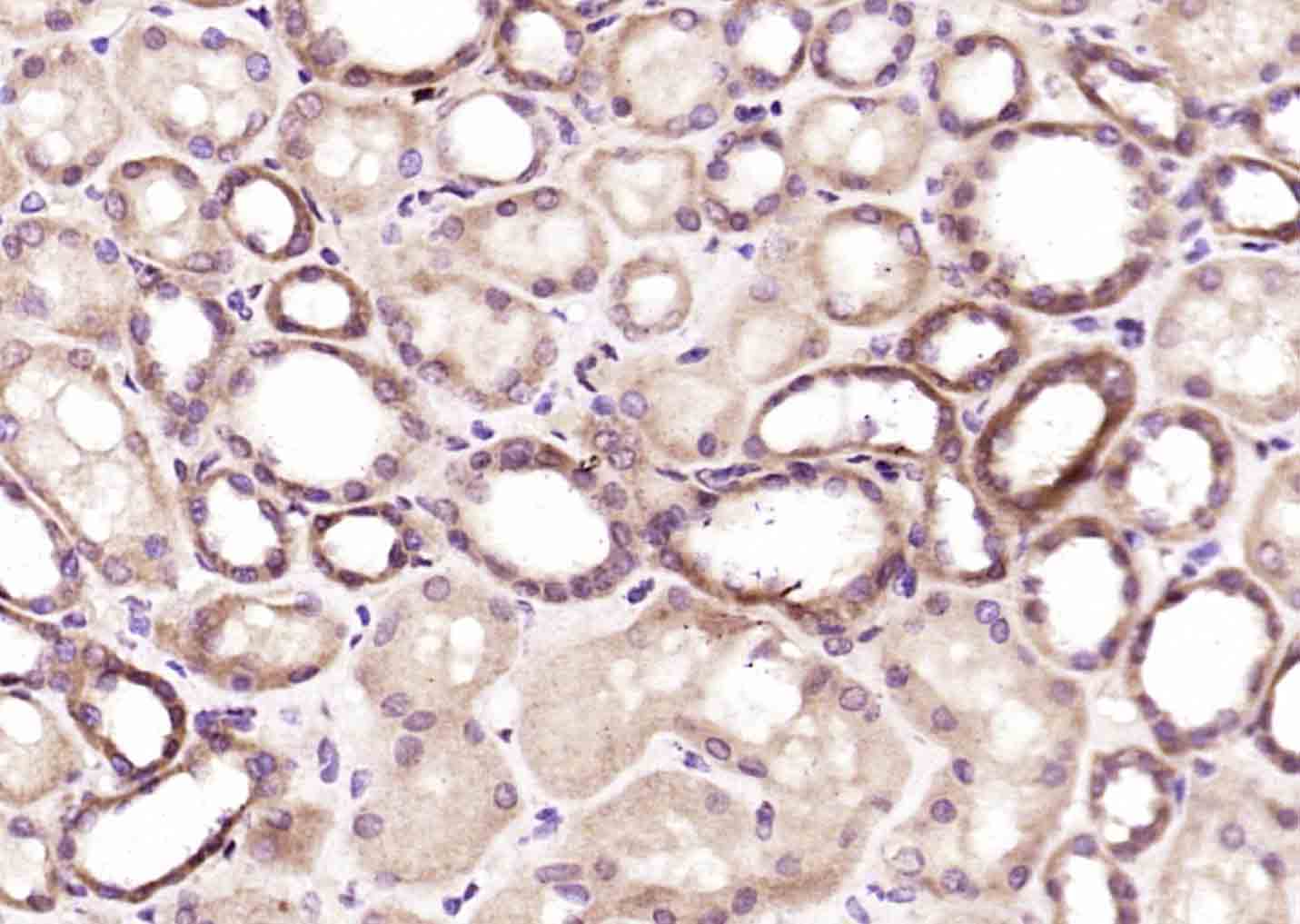 Paraformaldehyde-fixed, paraffin embedded (Human kidney); Antigen retrieval by boiling in sodium citrate buffer (pH6.0) for 15min; Block endogenous peroxidase by 3% hydrogen peroxide for 20 minutes; Blocking buffer (normal goat serum) at 37°C for 30min; Antibody incubation with (OSBPL9) Polyclonal Antibody, Unconjugated (SL17522R) at 1:200 overnight at 4°C, followed by operating according to SP Kit(Rabbit) (sp-0023) instructionsand DAB staining.
Cartpieces
Totalgoods,subtotals:¥Checkout
Partial purchase records(bought amounts latest0)
No one bought this product
User Comment(Total0User Comment Num)
- No comment


 +86 571 56623320
 SUNLONG BIOTECH

