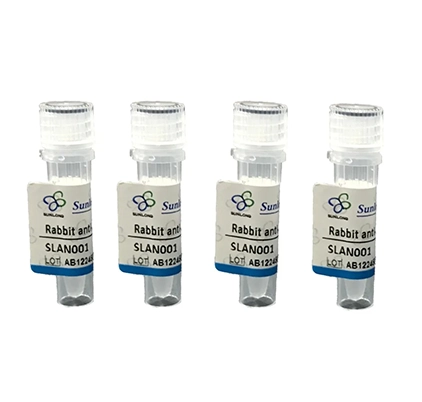
Mouse Anti-PLOD1 antibody
PLOD; PLOD1_HUMAN; 2-oxoglutarate 5-dioxygenase 1; EDS6; LH; LH1; LLH; Lysine hydroxylase; Lysyl hydroxylase 1; Procollagen lysine 1 2 oxoglutarate 5 dioxygenase 1; Procollagen lysine 2 oxoglutarate 5 dioxygenase 1; Procollagen-lysine.
View History [Clear]
Details
Product Name PLOD1 Chinese Name 赖氨酸羟化酶1单克隆抗体 Alias PLOD; PLOD1_HUMAN; 2-oxoglutarate 5-dioxygenase 1; EDS6; LH; LH1; LLH; Lysine hydroxylase; Lysyl hydroxylase 1; Procollagen lysine 1 2 oxoglutarate 5 dioxygenase 1; Procollagen lysine 2 oxoglutarate 5 dioxygenase 1; Procollagen-lysine. Research Area Chromatin and nuclear signals transcriptional regulatory factor Epigenetics Immunogen Species Mouse Clonality Monoclonal Clone NO. M4G1 React Species Human, Applications WB=1:500-2000
not yet tested in other applications.
optimal dilutions/concentrations should be determined by the end user.Theoretical molecular weight 33kDa Cellular localization The nucleus Form Liquid Concentration 1mg/ml immunogen KLH conjugated synthetic peptide derived from human PLOD1: 51-150/727 Lsotype IgG2b,κ Purification affinity purified by Protein G Buffer Solution 1M TBS(pH7.4) with 1% BSA, 3% Proclin300 and 50% Glycerol. Storage Shipped at 4℃. Store at -20 °C for one year. Avoid repeated freeze/thaw cycles. Attention This product as supplied is intended for research use only, not for use in human, therapeutic or diagnostic applications. PubMed PubMed Product Detail Lysyl hydroxylase is a membrane-bound homodimeric protein localized to the cisternae of the endoplasmic reticulum. The enzyme (cofactors iron and ascorbate) catalyzes the hydroxylation of lysyl residues in collagen-like peptides. The resultant hydroxylysyl groups are attachment sites for carbohydrates in collagen and thus are critical for the stability of intermolecular crosslinks. Some patients with Ehlers-Danlos syndrome type VI have deficiencies in lysyl hydroxylase activity. Two transcript variants encoding different isoforms have been found for this gene. [provided by RefSeq, Oct 2015]
Function:
Forms hydroxylysine residues in -Xaa-Lys-Gly- sequences in collagens. These hydroxylysines serve as sites of attachment for carbohydrate units and are essential for the stability of the intermolecular collagen cross-links.
Subcellular Location:
Rough endoplasmic reticulum membrane.
DISEASE:
Defects in PLOD1 are the cause of Ehlers-Danlos syndrome type 6 (EDS6) [MIM:225400]. EDS is a connective tissue disorder characterized by hyperextensible skin, atrophic cutaneous scars due to tissue fragility and joint hyperlaxity. EDS6 is characterized by the presence of ocular complications, particularly retinal detachment.
Defects in PLOD1 are the cause of Nevo syndrome (NEVOS) [MIM:601451]. This is a rare, autosomal recessive disorder characterized by increased perinatal length, kyphosis, muscular hypotonia, and joint laxity. Nevo syndrome and EDS-VI have similar clinical phenotypes. Some authors consider that both syndromes are the same clinical entity.
Similarity:
Contains 1 Fe2OG dioxygenase domain.
SWISS:
Q02809
Gene ID:
5351
Database links:Entrez Gene: 5351 Human
Omim: 153454 Human
SwissProt: Q02809 Human
Unigene: 75093 Human
Product Picture 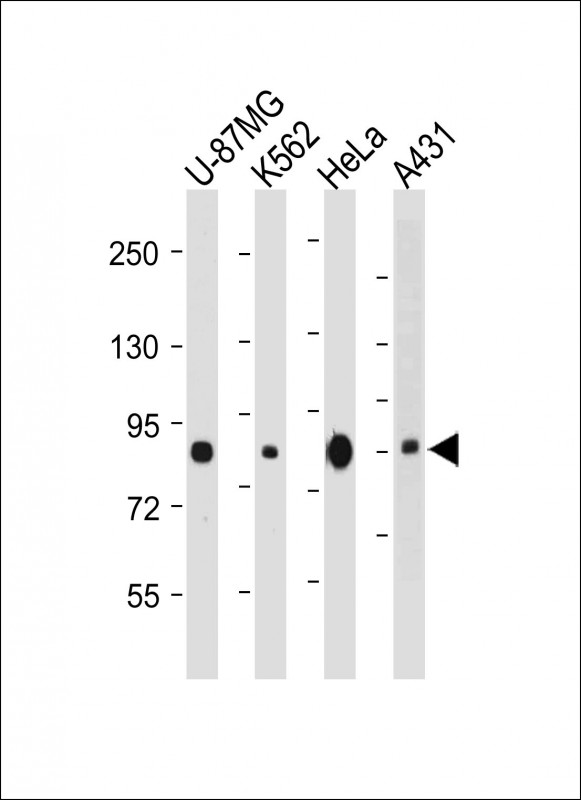 Sample:
Lane 1: U-87MG cell lysates
Lane 2: K562 cell lysates
Lane 3: HeLa cell lysates
Lane 4: A431 cell lysates
Primary: Anti-PLOD1 (SLM-51740M) at 1/4000 dilution
Secondary: IRDye800CW Goat Anti-Mouse IgG at 1/20000 dilution
Predicted band size: 33 kD
Observed band size: 85 kD
Cartpieces
Totalgoods,subtotals:¥Checkout
Partial purchase records(bought amounts latest0)
No one bought this product
User Comment(Total0User Comment Num)
- No comment


 +86 571 56623320
 SUNLONG BIOTECH

