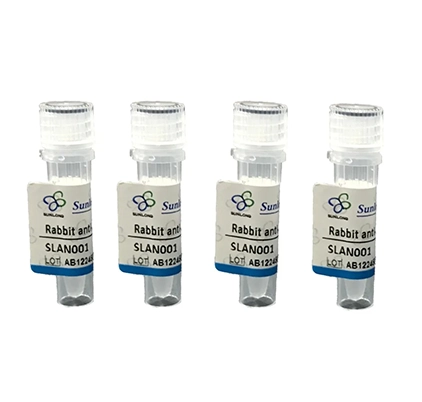
Rabbit Anti-TFEB antibody
View History [Clear]
Details
Product Name TFEB Immunogen Species Rabbit Clonality Monoclonal Clone NO. D11B4 React Species Human Applications WB=1:500-1000,IHC-P=1:100-500,IHC-F=1:100-500,ICC/IF=1:100-500,IF=1:100-500,Flow-Cyt=1:50-100(Paraffin sections need antigen repair)
not yet tested in other applications.
optimal dilutions/concentrations should be determined by the end user.Cellular localization The nucleus cytoplasmic Form Liquid Concentration 1mg/ml Lsotype IgG Purification Affinity purified by Protein A Buffer Solution 1M TBS(pH7.4) with 1% BSA, 3% Proclin300 and 50% Glycerol. Storage Shipped at 4℃. Store at -20 °C for one year. Avoid repeated freeze/thaw cycles. Attention This product as supplied is intended for research use only, not for use in human, therapeutic or diagnostic applications. PubMed PubMed Product Detail Transcription factors of the basic helix-loop-helix zipper (bHLH-ZIP) family contain a basic domain, used for DNA binding, and HLH and ZIP domains, both used for oligomerization. TFEB was isolated from a human B-cell cDNA library using a binding sequence from the adenovirus major late promoter. This transcription factor probably binds to the USF/MLTF site and probably recognizes E-box sequences in the heavy-chain immunoglobulin enhancer.
Function:
Transcription factor that specifically recognizes and binds E-box sequences (3'-CANNTG-5'). Efficient DNA-binding requires dimerization with itself or with another MiT/TFE family member such as TFE3 or MITF. In association with TFE3, activates the expression of CD40L in T-cells, thereby playing a role in T-cell-dependent antibody responses in activated CD4(+) T-cells and thymus-dependent humoral immunity. Specifically recognizes and binds the CLEAR-box sequence (5'-GTCACGTGAC-3') present in the regulatory region of many lysosomal genes, leading to activate their expression. It thereby plays a central role in expression of lysosomal genes. Specifically recognizes the gamma-E3 box, a subset of E-boxes, present in the heavy-chain immunoglobulin enhancer. Plays a role in the signal transduction processes required for normal vascularization of the placenta.
Subunit:
Homodimer and heterodimer; with TFE3 or MITF.
Subcellular Location:
Cytoplasm. Nucleus. Note=Mainly present in the cytoplasm. Under aberrant lysosomal storage conditions, it translocates from the cytoplasm to the nucleus.
Post-translational modifications:
Sumoylated; does not affect dimerization with MITF.
Similarity:
Belongs to the MiT/TFE family. Contains 1 basic helix-loop-helix (bHLH) domain.
SWISS:
P19484
Database links:
Entrez Gene: 7942 Human
Entrez Gene: 21425 Mouse
Omim: 600744 Human
SwissProt: P19484 Human
SwissProt: Q9R210 Mouse
Unigene: 485360 Human
Unigene: 715310 Human
Unigene: 2305 Mouse
Unigene: 22098 Rat
Transcription factors act as major regulators of lysosomal biogenesis, autophagy, lysosomal exocytosis, lipid catabolism, energy metabolism, and immune responses. They specifically recognize and bind to E-box sequences (5'-CANNTG-3'); effective DNA binding requires dimerization with themselves or other MiT/TFE family members (such as TFE3 or MITF). They are involved in the cellular response to amino acid availability by acting downstream of MTOR: in the presence of nutrients, MTOR-mediated phosphorylation of TFEB promotes its cytoplasmic retention and subsequent inactivation. During starvation or lysosomal stress, inhibition of MTOR induces TFEB dephosphorylation, leading to nuclear localization and transcriptional factor activity.
Cartpieces
Totalgoods,subtotals:¥Checkout
Partial purchase records(bought amounts latest0)
No one bought this product
User Comment(Total0User Comment Num)
- No comment


 +86 571 56623320
 SUNLONG BIOTECH

