Rabbit Anti-Clusterin antibody
CLUS_HUMAN; Aging-associated gene 4 protein; Apolipoprotein J (Apo-J); Complement cytolysis inhibitor (CLI); Complement-associated protein SP-40,40; Ku70-binding protein 1; NA1/NA2; Sulfated glycoprotein 2 (SGP-2); Testosterone-repressed prostate message
View History [Clear]
Details
Product Name Clusterin Chinese Name 载LipoproteinJ(APOJ)抗体 Alias CLUS_HUMAN; Aging-associated gene 4 protein; Apolipoprotein J (Apo-J); Complement cytolysis inhibitor (CLI); Complement-associated protein SP-40,40; Ku70-binding protein 1; NA1/NA2; Sulfated glycoprotein 2 (SGP-2); Testosterone-repressed prostate message 2 (TRPM-2); APOJ; CLI; KUB1; AAG4; CLU2; SGP2; SP-40; TRPM2; CLU; Immunogen Species Rabbit Clonality Polyclonal React Species Human, Applications WB=1:500-2000
not yet tested in other applications.
optimal dilutions/concentrations should be determined by the end user.Theoretical molecular weight 51.2kDa Form Lyophilized or Liquid Concentration 1mg/ml Lsotype IgG Purification affinity purified by Protein A Buffer Solution 1M TBS(pH7.4) with 1% BSA, 3% Proclin300 and 50% Glycerol. Storage Shipped at 4℃. Store at -20 °C for one year. Avoid repeated freeze/thaw cycles. Attention This product as supplied is intended for research use only, not for use in human, therapeutic or diagnostic applications. PubMed PubMed Product Detail The protein encoded by this gene is a secreted chaperone that can under some stress conditions also be found in the cell cytosol. It has been suggested to be involved in several basic biological events such as cell death, tumor progression, and neurodegenerative disorders. Alternate splicing results in both coding and non-coding variants.[provided by RefSeq, May 2011]
Function:
Isoform 1 functions as extracellular chaperone that prevents aggregation of nonnative proteins. Prevents stress-induced aggregation of blood plasma proteins. Inhibits formation of amyloid fibrils by APP, APOC2, B2M, CALCA, CSN3, SNCA and aggregation-prone LYZ variants (in vitro). Does not require ATP. Maintains partially unfolded proteins in a state appropriate for subsequent refolding by other chaperones, such as HSPA8/HSC70. Does not refold proteins by itself. Binding to cell surface receptors triggers internalization of the chaperone-client complex and subsequent lysosomal or proteasomal degradation. Secreted isoform 1 protects cells against apoptosis and against cytolysis by complement. Intracellular isoforms interact with ubiquitin and SCF (SKP1-CUL1-F-box protein) E3 ubiquitin-protein ligase complexes and promote the ubiquitination and subsequent proteasomal degradation of target proteins. Promotes proteasomal degradation of COMMD1 and IKBKB. Modulates NF-kappa-B transcriptional activity. Nuclear isoforms promote apoptosis. Mitochondrial isoforms suppress BAX-dependent release of cytochrome c into the cytoplasm and inhibit apoptosis. Plays a role in the regulation of cell proliferation.
Subcellular Location:
Nucleus. Cytoplasm. Mitochondrion membrane. Cytoplasm, cytosol. Microsome. Endoplasmic reticulum. Cytoplasmic vesicle, secretory vesicle, chromaffin granule. Isoforms lacking the N-terminal signal sequence have been shown to be cytoplasmic and/or nuclear. Secreted isoforms can retrotranslocate from the secretory compartments to the cytosol upon cellular stress. Detected in perinuclear foci that may be aggresomes containing misfolded, ubiquitinated proteins. Detected at the mitochondrion membrane upon induction of apoptosis and Secreted. Can retrotranslocate from the secretory compartments to the cytosol upon cellular stress.
Tissue Specificity:
Detected in blood plasma, cerebrospinal fluid, milk, seminal plasma and colon mucosa. Detected in the germinal center of colon lymphoid nodules and in colon parasympathetic ganglia of the Auerbach plexus (at protein level). Ubiquitous. Detected in brain, testis, ovary, liver and pancreas, and at lower levels in kidney, heart, spleen and lung.
Post-translational modifications:
Isoform 1 is proteolytically cleaved on its way through the secretory system, probably within the Golgi lumen. Polyubiquitinated, leading to proteasomal degradation. Heavily N-glycosylated. About 30% of the protein mass is comprised of complex N-linked carbohydrate.
Similarity:
Belongs to the clusterin family.
SWISS:
P10909
Gene ID:
1191
Product Picture 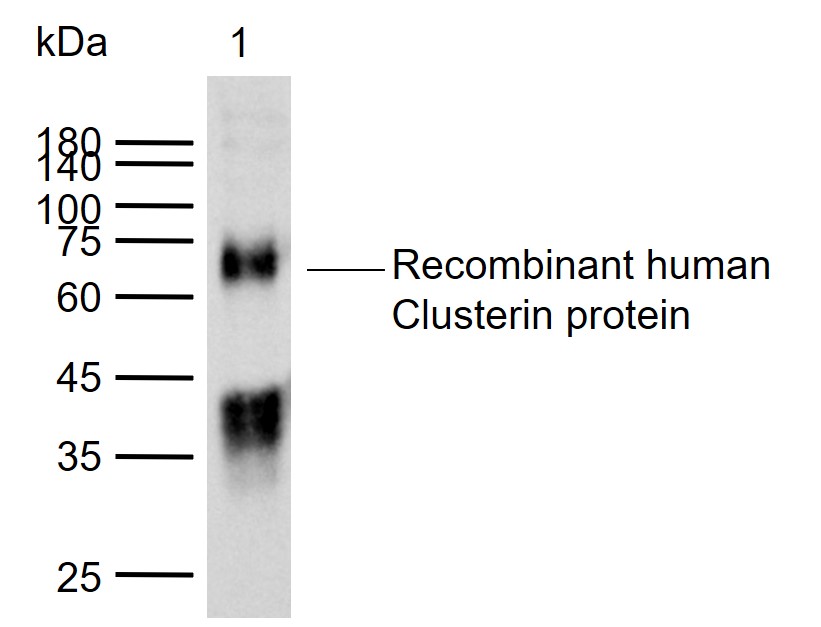 Sample:
Lane 1: Recombinant human Clusterin protein, His(SL43574P -500ng)
Primary: Anti-Clusterin (SL43574R) at 1/1000 dilution
Secondary: IRDye800CW Goat Anti-Rabbit IgG at 1/20000 dilution
Predicted band size: 51.2 kDa
Observed band size: 62 kDa
Cartpieces
Totalgoods,subtotals:¥Checkout
Partial purchase records(bought amounts latest0)
No one bought this product
User Comment(Total0User Comment Num)
- No comment


 +86 571 56623320
 SUNLONG BIOTECH

