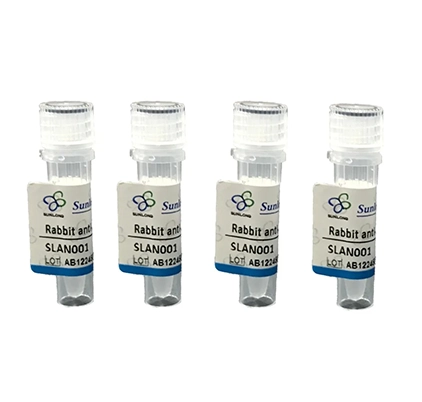
Rabbit Anti-VAV3 antibody
Guanine nucleotide exchange factor VAV3; Protein vav 3; Protein vav3; VAV 3; VVAV-3; av 3 guanine nucleotide exchange factor; VAV 3 oncogene; VAV 3 protein; VAV-3; VAV3 oncogene; VAV3 protein; VAV3_HUMAN.
View History [Clear]
Details
Product Name VAV3 Chinese Name 鸟嘌呤核苷酸交换因子VAV3Recombinant rabbit monoclonal anti Alias Guanine nucleotide exchange factor VAV3; Protein vav 3; Protein vav3; VAV 3; VVAV-3; av 3 guanine nucleotide exchange factor; VAV 3 oncogene; VAV 3 protein; VAV-3; VAV3 oncogene; VAV3 protein; VAV3_HUMAN. Research Area Signal transduction Immunogen Species Rabbit Clonality Monoclonal Clone NO. R2B5 React Species Human(predicted:Mouse,Rat) Applications WB=1:500-1000
not yet tested in other applications.
optimal dilutions/concentrations should be determined by the end user.Theoretical molecular weight 98kDa Cellular localization cytoplasmic Extracellular matrix Form Liquid Concentration 1mg/ml immunogen KLH conjugated synthetic peptide derived from human VAV3 Lsotype IgG Purification affinity purified by Protein A Buffer Solution 1M TBS(pH7.4) with 1% BSA, 3% Proclin300 and 50% Glycerol. Storage Shipped at 4℃. Store at -20 °C for one year. Avoid repeated freeze/thaw cycles. Attention This product as supplied is intended for research use only, not for use in human, therapeutic or diagnostic applications. PubMed PubMed Product Detail This gene encodes a member of the CD1 family of transmembrane glycoproteins, which are structurally related to the major histocompatibility complex (MHC) proteins and form heterodimers with beta-2-microglobulin. The CD1 proteins mediate the presentation of primarily lipid and glycolipid antigens of self or microbial origin to T cells. The human genome contains five CD1 family genes organized in a cluster on chromosome 1. The CD1 family members are thought to differ in their cellular localization and specificity for particular lipid ligands. The protein encoded by this gene is broadly distributed throughout the endocytic system via a tyrosine-based motif in the cytoplasmic tail. Alternatively spliced transcript variants of this gene have been observed, but their full-length nature is not known. [provided by RefSeq, Jul 2008]
Subcellular Location:
Nucleus.
Tissue Specificity:
Isoform 1 and isoform 3 are widely expressed; both are expressed at very low levels in skeletal muscle. In keratinocytes, isoform 1 is less abundant than isoform 3. Isoform 3 is detected at very low levels, if any, in adrenal gland, bone marrow, spleen, fetal brain and spinal chord; in these tissues, isoform 1 is readily detectable.
SWISS:
Q9UKW4
Gene ID:
10451
Database links:
Entrez Gene: 10451 Human
Entrez Gene: 57257 Mouse
SwissProt: Q9UKW4 Human
SwissProt: Q9R0C8 Mouse
Product Picture 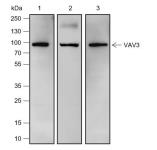 Blocking buffer: 5% NFDM/TBST
Primary Ab dilution: 1:2000
Primary Ab incubation condition: 2 hours at
room temperature
Secondary Ab: Goat Anti-Rabbit IgG H&L
(HRP)
Lysate: 1: Human placenta, 2: Mouse placenta,
3: Rat kidney
Protein loading quantity: 20 μg
Exposure time: 60 s
Predicted MW: 98 kDa
Observed MW: 98 kDa
Cartpieces
Totalgoods,subtotals:¥Checkout
Partial purchase records(bought amounts latest0)
No one bought this product
User Comment(Total0User Comment Num)
- No comment


 +86 571 56623320
 SUNLONG BIOTECH

