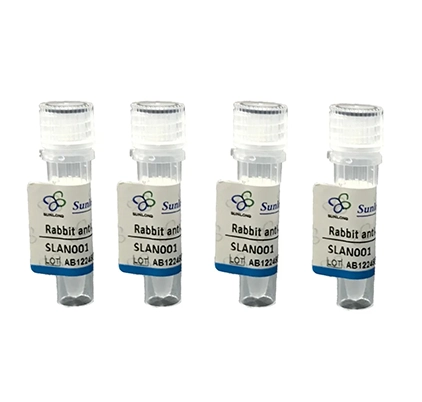
Recombinant Rabbit Anti-TSC1 Monoclonal Antibody
LAM; TSC; TSC1_HUMAN; TSC1; Tuberous sclerosis 1 protein; KIAA0243; TSC1_MOUSE; Tuberous sclerosis 1 protein homolog; TSC1_RAT; TSC complex subunit 1; tuberous sclerosis 1; hamartin
All categories
View History [Clear]
Details
Product Name Recombinant Rabbit Anti-TSC1 Monoclonal Antibody Cat No. SLA0711M Chinese Name 结节性硬化症蛋白1单克隆抗体 Alias LAM; TSC; TSC1_HUMAN; TSC1; Tuberous sclerosis 1 protein; KIAA0243; TSC1_MOUSE; Tuberous sclerosis 1 protein homolog; TSC1_RAT; TSC complex subunit 1; tuberous sclerosis 1; hamartin Host Species Mouse Isotype IgG2b Clonality Monoclonal Clone No. K6F13 React Species Mouse Applications WB (1:500-2000)
Not yet tested in other applications.
Optimal working dilutions must be determined by the end user.Immunogen Recombinant human TSC1 (Fragment) (His-tagged). Purification affinity purified by Protein G Concentration 1mg/ml Predicted MW. 130 kDa Observed MW. 200 kDa Subcellular Location Cytoplasm Gene ID 7248 Swiss-Prot Q92574 Storage 0.01M TBS (pH7.4) with 1% BSA, 0.02% Proclin300 and 50% Glycerol.
Shipped at 4℃. Store at -20℃ for one year. Avoid repeated freeze/thaw cycles.Background Tuberous sclerosis complex (TSC) is an autosomal dominant genetic disorder characterized by mental retardation and the widespread development of distinctive tumors termed hamartomas. Two different genetic loci have been linked to TSC; one of these loci, the tuberous sclerosis-2 gene (TSC2), encodes a protein called tuberin and the other loci, tuberous sclerosis-1 gene (TSC1), encodes a protein called hamartin. Tuberin and hamartin interact with each other forming a cystoplasmic complex. Hamartin interacts with the ezrin-radixin-moesin (ERM) family of actin-binding proteins and inhibition of hamartin activity results in loss of cell adhesion. Hamartin is present in most adult tissues with strong expression in brain, heart, and kidney. Attention This product as supplied is intended for research use only, not for use in human, therapeutic or diagnostic applications.
FOR RESEARCH USE ONLY. Not for use in diagnostic or therapeutic procedures.
Partial purchase records(bought amounts latest0)
No one bought this product
User Comment(Total0User Comment Num)
- No comment


 +86 571 56623320

 SUNLONG BIOTECH


