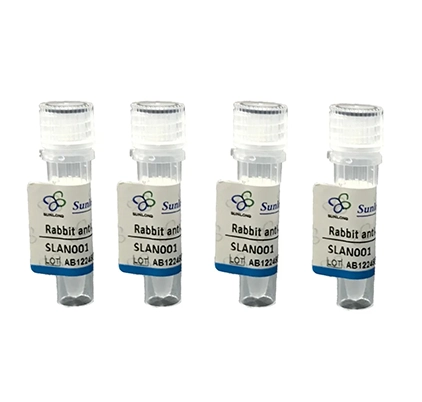
Recombinant Rabbit Anti-ERBB2 Monoclonal Antibody
CD340; HER-2; HER-2/neu; HER2; MLN 19; MLN-19; NEU; NGL; TKR1; VSCN2; c-ERB-2; c-ERB2; p185(erbB2); Erbb-2; c-erbB2; c-neu; l11Jus8; mKIAA3023; HER2/neu; ERBB2_HUMAN; ERBB2; Metastatic lymph node gene 19 protein (MLN 19); Proto-oncogene Neu; Proto-oncogen
All categories
View History [Clear]
Details
Product Name Recombinant Rabbit Anti-ERBB2 Monoclonal Antibody Cat No. SLA0715M Chinese Name ERBB2/HER2单克隆抗体 Alias CD340; HER-2; HER-2/neu; HER2; MLN 19; MLN-19; NEU; NGL; TKR1; VSCN2; c-ERB-2; c-ERB2; p185(erbB2); Erbb-2; c-erbB2; c-neu; l11Jus8; mKIAA3023; HER2/neu; ERBB2_HUMAN; ERBB2; Metastatic lymph node gene 19 protein (MLN 19); Proto-oncogene Neu; Proto-oncogene c-ErbB-2; Tyrosine kinase-type cell surface receptor HER2; p185erbB2; 2.7.10.1; MLN19; ERBB2_MOUSE; Kiaa3023; ERBB2_RAT; Epidermal growth factor receptor-related protein; p185neu; erb-b2 receptor tyrosine kinase 2; v-erb-b2 avian erythroblastic leukemia viral oncogene homolog 2 (neuro/glioblastoma derived oncogene homolog); v-erb-b2 avian erythroblastic leukemia viral oncogene homolog 2; neuro/glioblastoma derived oncogene homolog; human epidermal growth factor receptor 2; metastatic lymph node gene 19 Host Species Mouse Isotype IgG2b,k Clonality Monoclonal Clone No. H2G6 React Species Human Applications WB (1:500-1000)
Not yet tested in other applications.
Optimal working dilutions must be determined by the end user.Immunogen Recombinant human ERBB2. Purification affinity purified by Protein G Concentration 1mg/ml Predicted MW. 185 kDa Observed MW. 185 kDa Subcellular Location Nucleus Gene ID 2064 Swiss-Prot P04626 Storage 0.01M TBS (pH7.4) with 1% BSA, 0.02% Proclin300 and 50% Glycerol.
Shipped at 4℃. Store at -20℃ for one year. Avoid repeated freeze/thaw cycles.Background This gene encodes a member of the epidermal growth factor (EGF) receptor family of receptor tyrosine kinases. This protein has no ligand binding domain of its own and therefore cannot bind growth factors. However, it does bind tightly to other ligand-bound EGF receptor family members to form a heterodimer, stabilizing ligand binding and enhancing kinase-mediated activation of downstream signalling pathways, such as those involving mitogen-activated protein kinase and phosphatidylinositol-3 kinase. Allelic variations at amino acid positions 654 and 655 of isoform a (positions 624 and 625 of isoform b) have been reported, with the most common allele, Ile654/Ile655, shown here. Amplification and/or overexpression of this gene has been reported in numerous cancers, including breast and ovarian tumors. Alternative splicing results in several additional transcript variants, some encoding different isoforms and others that have not been fully characterized. [provided by RefSeq, Jul 2008]. Attention This product as supplied is intended for research use only, not for use in human, therapeutic or diagnostic applications.
FOR RESEARCH USE ONLY. Not for use in diagnostic or therapeutic procedures.
Partial purchase records(bought amounts latest0)
No one bought this product
User Comment(Total0User Comment Num)
- No comment


 +86 571 56623320

 SUNLONG BIOTECH


