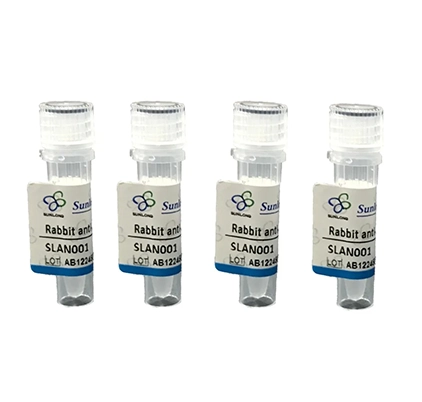
Rabbit Anti-OSBPL2 antibody
FLJ20223; KIAA0772; MGC4307; MGC8342; ORP2; OSBP related protein 2; Oxysterol binding protein like 2; Oxysterol binding protein related protein 2.
View History [Clear]
Details
Product Name OSBPL2 Chinese Name 氧固醇Binding protein样2抗体 Alias FLJ20223; KIAA0772; MGC4307; MGC8342; ORP2; OSBP related protein 2; Oxysterol binding protein like 2; Oxysterol binding protein related protein 2. Research Area Tumour Cell biology Signal transduction The new supersedes the old Immunogen Species Rabbit Clonality Polyclonal React Species Mouse(predicted:Human,Rat,Pig,Cow,Horse,Sheep) Applications WB=1:500-2000
not yet tested in other applications.
optimal dilutions/concentrations should be determined by the end user.Theoretical molecular weight 54kDa Cellular localization cytoplasmic Form Liquid Concentration 1mg/ml immunogen KLH conjugated synthetic peptide derived from human OSBPL2: 361-460/480 Lsotype IgG Purification affinity purified by Protein A Buffer Solution 1M TBS(pH7.4) with 1% BSA, 3% Proclin300 and 50% Glycerol. Storage Shipped at 4℃. Store at -20 °C for one year. Avoid repeated freeze/thaw cycles. Attention This product as supplied is intended for research use only, not for use in human, therapeutic or diagnostic applications. PubMed PubMed Product Detail This gene encodes a member of the oxysterol-binding protein (OSBP) family, a group of intracellular lipid receptors. Most members contain an N-terminal pleckstrin homology domain and a highly conserved C-terminal OSBP-like sterol-binding domain, although some members contain only the sterol-binding domain. This encoded protein contains only the sterol-binding domain. In vitro studies have shown that the encoded protein can bind strongly to phosphatic acid and weakly to phosphatidylinositol 3-phosphate, but cannot bind to 25-hydroxycholesterol. The protein associates with the Golgi apparatus. Transcript variants encoding different isoforms have been described. [provided by RefSeq, Jul 2008]
Function:
This gene encodes a member of the oxysterol binding protein (OSBP) family, a group of intracellular lipid receptors. Most members contain an N terminal pleckstrin homology domain and a highly conserved C terminal OSBP like sterol binding domain, although some members contain only the sterol binding domain. This encoded protein contains only the sterol binding domain. In vitro studies have shown that the encoded protein can bind strongly to phosphatic acid and weakly to phosphatidylinositol 3 phosphate, but cannot bind to 25 hydroxycholesterol. The protein associates with the Golgi apparatus. Transcript variants encoding different isoforms have been described.
SWISS:
Q9H1P3
Gene ID:
9885
Database links:Entrez Gene: 9885 Human
Entrez Gene: 228983 Mouse
Omim: 606731 Human
SwissProt: Q9H1P3 Human
SwissProt: Q8BX94 Mouse
Unigene: 473254 Human
Unigene: 253578 Mouse
Unigene: 12390 Rat
Product Picture 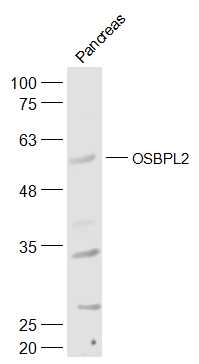 Sample:
Pancreas (Mouse) Lysate at 40 ug
Primary: Anti-OSBPL2 (SL17517R) at 1/300 dilution
Secondary: IRDye800CW Goat Anti-Rabbit IgG at 1/20000 dilution
Predicted band size: 54 kD
Observed band size: 54 kD
Cartpieces
Totalgoods,subtotals:¥Checkout
Partial purchase records(bought amounts latest0)
No one bought this product
User Comment(Total0User Comment Num)
- No comment


 +86 571 56623320
 SUNLONG BIOTECH

