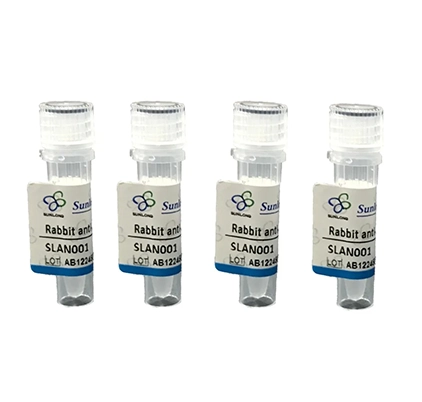
Rabbit Anti-Elastin antibody
alpha Elastin/Tropoelastin; Elastin isoform a; ELN; ELN_HUMAN; elastin isoform m precursor; FLJ38671; FLJ43523; Supravalvular aortic stenosis; Tropoelastin; Williams Beuren syndrome; Williams syndrome region; ADCL1; SVAS; WBS; WS.
View History [Clear]
Details
Product Name Elastin Chinese Name 弹性蛋白抗体 Alias alpha Elastin/Tropoelastin; Elastin isoform a; ELN; ELN_HUMAN; elastin isoform m precursor; FLJ38671; FLJ43523; Supravalvular aortic stenosis; Tropoelastin; Williams Beuren syndrome; Williams syndrome region; ADCL1; SVAS; WBS; WS. literatures Research Area Tumour immunology Neurobiology transcriptional regulatory factor Immunogen Species Rabbit Clonality Polyclonal React Species Human, Mouse, Rat, Applications WB=1:500-2000,IHC-P=1:100-500,IHC-F=1:100-500,IF=1:100-500 (Paraffin sections need antigen repair)
not yet tested in other applications.
optimal dilutions/concentrations should be determined by the end user.Theoretical molecular weight 70kDa Cellular localization Extracellular matrix Secretory protein Form Liquid Concentration 1mg/ml immunogen KLH conjugated synthetic peptide derived from human Elastin: 681-786/786 Lsotype IgG Purification affinity purified by Protein A Buffer Solution 1M TBS(pH7.4) with 1% BSA, 3% Proclin300 and 50% Glycerol. Storage Shipped at 4℃. Store at -20 °C for one year. Avoid repeated freeze/thaw cycles. Attention This product as supplied is intended for research use only, not for use in human, therapeutic or diagnostic applications. PubMed PubMed Product Detail This gene encodes a protein that is one of the two components of elastic fibers. Elastic fibers comprise part of the extracellular matrix and confer elasticity to organs and tissues including the heart, skin, lungs, ligaments, and blood vessels. The encoded protein is rich in hydrophobic amino acids such as glycine and proline, which form mobile hydrophobic regions bounded by crosslinks between lysine residues. Degradation products of the encoded protein, known as elastin-derived peptides or elastokines, bind the elastin receptor complex and other receptors and stimulate migration and proliferation of monocytes and skin fibroblasts. Elastokines can also contribute to cancer progression. Deletions and mutations in this gene are associated with supravalvular aortic stenosis (SVAS) and autosomal dominant cutis laxa. [provided by RefSeq, Aug 2017].
Function:
Major structural protein of tissues such as aorta and nuchal ligament, which must expand rapidly and recover completely. Molecular determinant of the late arterial morphogenesis, stabilizing arterial structure by regulating proliferation and organization of vascular smooth muscle.
Subunit:
The polymeric elastin chains are cross-linked together into an extensible 3D network. Forms a ternary complex with BGN and MFAP2. Interacts with MFAP2 via divalent cations (calcium > magnesium > manganese) in a dose-dependent and saturating manner.
Subcellular Location:
Secreted, extracellular space, extracellular matrix. Note=Extracellular matrix of elastic fibers.
Tissue Specificity:
Expressed within the outer myometrial smooth muscle and throughout the arteriolar tree of uterus (at protein level). Also expressed in the large arteries, lung and skin.
DISEASE:
Defects in ELN are the cause of cutis laxa, autosomal dominant, type 1 (ADCL1) . A connective tissue disorder characterized by loose, hyperextensible skin with decreased resilience and elasticity leading to a premature aged appearance. Face, hands, feet, joints, and torso may be differentially affected. Additional variable clinical features are gastrointestinal diverticula, hernia, and genital prolapse. Rare manifestations are pulmonary artery stenosis, aortic aneurysm, bronchiectasis, and emphysema.
Similarity:
Belongs to the elastin family.
SWISS:
P15502
Gene ID:
2006
Database links:Entrez Gene: 2006 Human
Entrez Gene: 13717 Mouse
Omim: 130160 Human
SwissProt: P15502 Human
SwissProt: P54320 Mouse
Unigene: 647061 Human
Product Picture 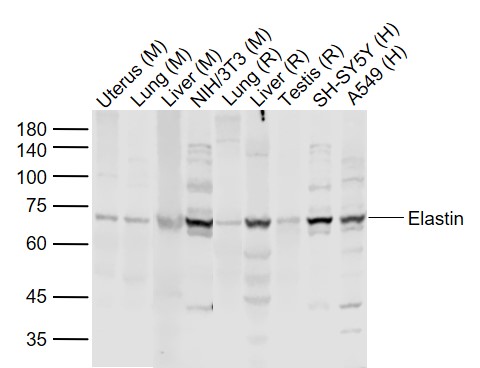 Sample:
Lane 1: Uterus (Mouse) Lysate at 40 ug
Lane 2: Lung (Mouse) Lysate at 40 ug
Lane 3: Liver (Mouse) Lysate at 40 ug
Lane 4: NIH/3T3 (Mouse) Cell Lysate at 30 ug
Lane 5: Lung (Rat) Lysate at 40 ug
Lane 6: Liver (Rat) Lysate at 40 ug
Lane 7: Testis (Rat) Lysate at 40 ug
Lane 8: SH-SY5Y (Human) Cell Lysate at 30 ug
Lane 9: A549 (Human) Cell Lysate at 30 ug
Primary: Anti-Elastin (SL1756R) at 1/1000 dilution
Secondary: IRDye800CW Goat Anti-Rabbit IgG at 1/20000 dilution
Predicted band size: 66 kD
Observed band size: 68 kD
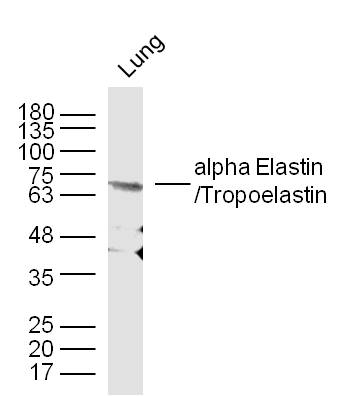 Sample: Lung (Mouse) Lysate at 30 ug
Primary: Anti- alpha Elastin/Tropoelastin (SL1756R) at 1/300 dilution
Secondary: IRDye800CW Goat Anti-Mouse IgG at 1/10000 dilution
Predicted band size: 70 kD
Observed band size: 68 kD
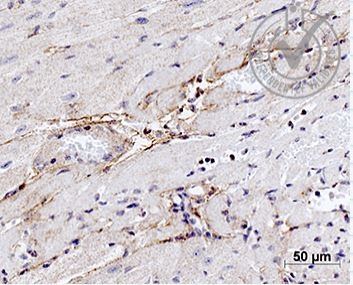 Images provided the Independent Validation Program (badge number 28751): Formalin-fixed and paraffin embedded mouse heart labeled with Rabbit Anti-alpha Elastin Polyclonal Antibody (SL1756R) at 1:1000 4℃ temperature overnight 4℃followed by conjugation to secondary antibody.
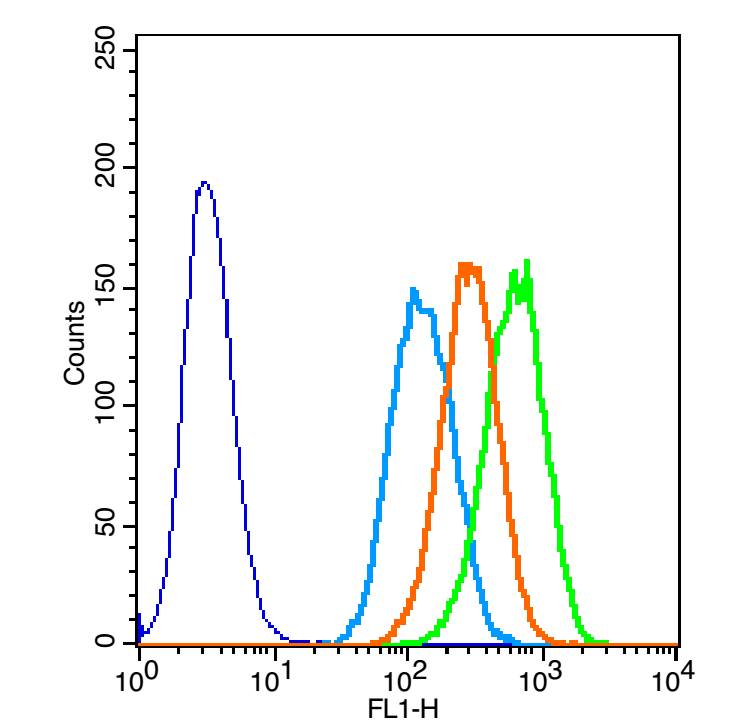 The figure annotation: The blue histogram is unstained cells.The green histogram is cells stained with Rabbit Anti-alpha Elastin/Tropoelastin antibody (SL1756R)plus secondary antibody.
Controls: Positive control: A549 cells .Isotype control: Cell lines treated with rabbit IgG (SL0295P)instead of the primary antibody to confirm that primary antibody binding is specific.Secondary only control: Both cell lines treated with Goat Anti-rabbit IgG/FITC antibody (SL0295G-FITC) to confirm no background signal produced from secondary antibody alone. 1ug in 100uL 1 X PBS containing 0.5% BSA.
Cartpieces
Totalgoods,subtotals:¥Checkout
Partial purchase records(bought amounts latest0)
No one bought this product
User Comment(Total0User Comment Num)
- No comment


 +86 571 56623320
 SUNLONG BIOTECH

