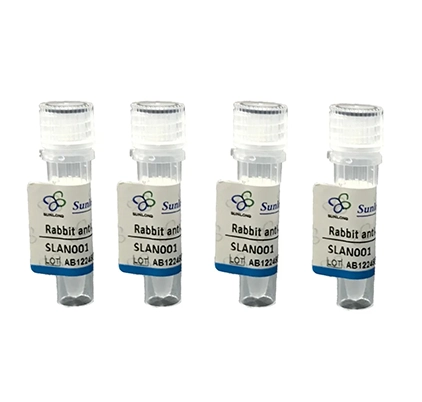
Rabbit Anti-CD163 antibody
Scavenger receptor cysteine-rich type 1 protein M130; CD 163; CD163 antigen; CD163 molecule; Hemoglobin Scavenger Receptor; M130; M130 antigen precursor; Macrophage associated antigen; MM130; C163A_HUMAN.
All categories
View History [Clear]
Details
Product Name CD163 Chinese Name CD163抗体 Alias Scavenger receptor cysteine-rich type 1 protein M130; CD 163; CD163 antigen; CD163 molecule; Hemoglobin Scavenger Receptor; M130; M130 antigen precursor; Macrophage associated antigen; MM130; C163A_HUMAN. Research Area Cardiovascular immunology The cell membraneReceptor Immunogen Species Rabbit Clonality Polyclonal React Species Human,Mouse(predicted:Rat) Applications WB=1:500-2000
not yet tested in other applications.
optimal dilutions/concentrations should be determined by the end user.Theoretical molecular weight 121kDa Cellular localization The cell membrane Secretory protein Form Liquid Concentration 1mg/ml immunogen KLH conjugated synthetic peptide derived from human CD163: 551-650/1156 <Extracellular> Lsotype IgG Purification affinity purified by Protein A Buffer Solution 1M TBS(pH7.4) with 1% BSA, 3% Proclin300 and 50% Glycerol. Storage Shipped at 4℃. Store at -20 °C for one year. Avoid repeated freeze/thaw cycles. Attention This product as supplied is intended for research use only, not for use in human, therapeutic or diagnostic applications. PubMed PubMed Product Detail The protein encoded by this gene is a member of the scavenger receptor cysteine-rich (SRCR) superfamily, and is exclusively expressed in monocytes and macrophages. It functions as an acute phase-regulated receptor involved in the clearance and endocytosis of hemoglobin/haptoglobin complexes by macrophages, and may thereby protect tissues from free hemoglobin-mediated oxidative damage. This protein may also function as an innate immune sensor for bacteria and inducer of local inflammation. Alternatively spliced transcript variants encoding different isoforms have been described for this gene. [provided by RefSeq, Aug 2011]
Function:
Acute phase-regulated receptor involved in clearance and endocytosis of hemoglobin/haptoglobin complexes by macrophages and may thereby protect tissues from free hemoglobin-mediated oxidative damage. May play a role in the uptake and recycling of iron, via endocytosis of hemoglobin/haptoglobin and subsequent breakdown of heme. Binds hemoglobin/haptoglobin complexes in a calcium-dependent and pH-dependent manner. Exhibits a higher affinity for complexes of hemoglobin and multimeric haptoglobin of HP*1F phenotype than for complexes of hemoglobin and dimeric haptoglobin of HP*1S phenotype. Induces a cascade of intracellular signals that involves tyrosine kinase-dependent calcium mobilization, inositol triphosphate production and secretion of IL6 and CSF1. Isoform 3 exhibits the higher capacity for ligand endocytosis and the more pronounced surface expression when expressed in cells.
Subcellular Location:
Secreted and Cell membrane. Isoform 1 and isoform 2 show a lower surface expression when expressed in cells.
Tissue Specificity:
Expressed in monocytes and mature macrophages such as Kupffer cells in the liver, red pulp macrophages in the spleen, cortical macrophages in the thymus, resident bone marrow macrophages and meningeal macrophages of the central nervous system. Expressed also in blood. Isoform 1 is the lowest abundant in the blood. Isoform 2 is the lowest abundant in the liver and the spleen. Isoform 3 is the predominant isoform detected in the blood.
Post-translational modifications:
A soluble form (sCD163) is produced by proteolytic shedding which can be induced by lipopolysaccharide, phorbol ester and Fc region of immunoglobulin gamma. This cleavage is dependent on protein kinase C and tyrosine kinases and can be blocked by protease inhibitors. The shedding is inhibited by the tissue inhibitor of metalloproteinase TIMP3, and thus probably induced by membrane-bound metalloproteinases ADAMs. Phosphorylated.
Similarity:
Contains 9 SRCR domains.
SWISS:
Q86VB7
Gene ID:
9332
Database links:Entrez Gene: 9332 Human
Entrez Gene: 93671 Mouse
Omim: 605545 Human
SwissProt: Q86VB7 Human
SwissProt: Q2VLH6 Mouse
Unigene: 504641 Human
Unigene: 37426 Mouse
Unigene: 203204 Rat
CD163 is a member of the SRCR superfamily, also known as hemoglobin scavenger receptor (HbSR), M130, or p155. The expression level of CD163 is regulated by many factors; glucocorticoids and anti-inflammatory mediators such as IL-10 and IL-6 can upregulate CD163, whereas pro-inflammatory mediators such as lipopolysaccharide (LPS), γ-Interferon (interferon-γ, IFN-γ), and TNF-α inhibit CD163 expression. CD163 is a type I membrane protein, also known as M130 antigen, Ber-Mac3, Ki-M8, or SM4. CD163 is restrictedly expressed in the monocyte/macrophage lineage; all circulating monocytes and macrophages in most tissues (except the mantle zone and germinal center of lymphoid follicles) are positive, and it is mainly used for the detection of monocytes/macrophages.Product Picture 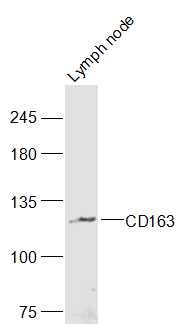 Sample:
Lymph node (Mouse) Lysate at 40 ug
Primary: Anti-CD163 (SL23127R) at 1/300 dilution
Secondary: IRDye800CW Goat Anti-Rabbit IgG at 1/20000 dilution
Predicted band size: 121 kD
Observed band size: 130 kD
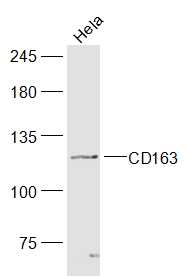 Sample:
Hela(Human) Cell Lysate at 30 ug
Primary: Anti-CD163 (SL23127R) at 1/300 dilution
Secondary: IRDye800CW Goat Anti-Rabbit IgG at 1/20000 dilution
Predicted band size: 121 kD
Observed band size: 130 kD
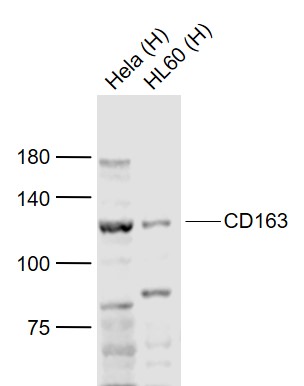 Sample:
Lane 1: Hela (Human) Cell Lysate at 30 ug
Lane 2: HL60 (Human) Cell Lysate at 30 ug
Primary: Anti-CD163 (SL23127R) at 1/1000 dilution
Secondary: IRDye800CW Goat Anti-Rabbit IgG at 1/20000 dilution
Predicted band size: 110 kD
Observed band size: 110 kD
Partial purchase records(bought amounts latest4)
| Username | Quantity | bought time |
| Ja*** | 1 | 2026-08-04 |
| Ma*** | 1 | 2026-06-14 |
| Ge*** | 1 | 2026-05-16 |
| Al*** | 1 | 2026-03-18 |
User Comment(Total0User Comment Num)
- No comment


 +86 571 56623320

 SUNLONG BIOTECH


