Details
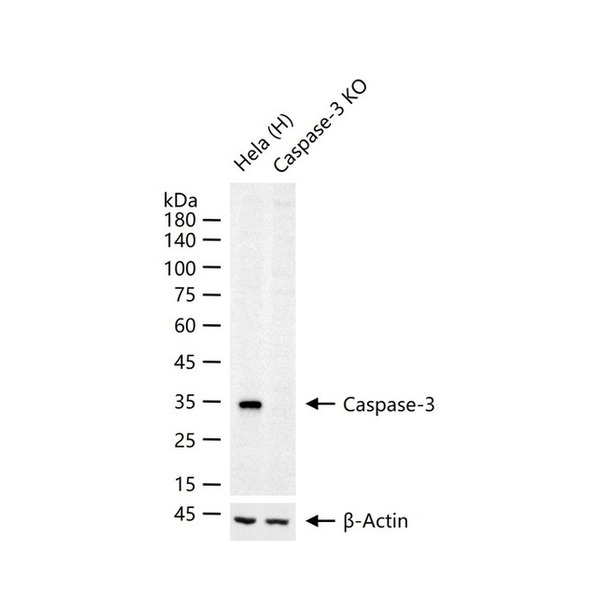
Product Name CASP3 | Caspase-3 Recombinant Rabbit Monoclonal Antibody Cat No. SLA1204M Product Type Recombinant Rabbit Monoclonal Antibody, KO/KD Validated Chinese Name 半胱胺酸蛋白酶蛋白-3重组兔单抗 (for reference only) React Species Human, Mouse, Rat Host Species Rabbit Isotype IgG Form Liquid Clonality Recombinant Clone No. 4D2 Immunogen A synthesized peptide derived from human Caspase 3 (amino acids 176-277 / 277) Purification Affinity purified by Protein A Concentration 1 mg/mL Theoretical MW 32 kDa Observed MW 34 kDa Subcellular Location Cytoplasm Gene ID 836 (Human) Swiss-Prot P42574 (Human) Storage Buffer 0.01 M TBS (pH 7.4) with 1% BSA, 0.02% Proclin300 and 50% Glycerol Storage Shipped at 4 ℃. Store at -20 ℃ for one year. Avoid repeated freeze/thaw cycles. Applications
Application Validated Species Predicted Species Recommended Dilution WB Human, Mouse, Rat – 1:1000 - 1:5000 IHC-P Human, Mouse, Rat – 1:200 - 1:800 IHC-F Human, Mouse, Rat – 1:200 - 1:800 IF Human, Mouse, Rat – 1:200 - 1:800 Not yet tested in other applications. Optimal working dilutions must be determined by the end user.
Research Areas
Cancer > Cell Death > Apoptosis > Apoptosis Markers > Caspases; Cancer > Cell Death > Apoptosis > Metabolism; Cancer > Invasion/microenvironment > Apoptosis > Caspases; Cell Biology > Apoptosis > Intracellular > Caspases; Cell Biology > Proteolysis / Ubiquitin > Proteolytic enzymes > Other proteases; Metabolism > Pathways and Processes > Metabolism processes > Apoptosis.
Background
The caspase family of cysteine proteases play a key role in apoptosis. Caspase 3 is the most extensively studied apoptotic protein among caspase family members. Caspase 3 is synthesized as an inactive proenzyme that is processed in cells undergoing apoptosis by self-proteolysis and/or cleavage by other upstream proteases (e.g. Caspases 8, 9 and 10). The processed form of Caspase 3 consists of large (17 kDa) and small (12 kDa) subunits which associate to form an active enzyme. Caspase 3 is cleaved at Asp28-Ser29 and Asp175-Ser176. The active Caspase 3 proteolytically cleaves and activates other caspases (e.g. Caspases 6, 7 and 9), as well as relevant targets in the cells (e.g. PARP and DFF). Alternative splicing of this gene results in two transcript variants which encode the same protein. In immunohistochemical studies Caspase 3 expression has been shown to be widespread but not present in all cell types (e.g. commonly reported in epithelial cells of skin, renal proximal tubules and collecting ducts). Caspase 3 is the predominant caspase involved in the cleavage of amyloid beta 4A precursor protein, which is associated with neuronal death in Alzheimer's disease.
Database Links
Entrez Gene: 836 (Human), 12367 (Mouse), 397244 (Pig), 100008840 (Rabbit), 25402 (Rat); OMIM: 600636 (Human); SwissProt: P42574 (Human), P70677 (Mouse), Q95ND5 (Pig), Q8MJC3 (Rabbit), P55213 (Rat); UniGene: 141125 (Human), 34405 (Mouse), 10562 (Rat).
Function
Involved in the activation cascade of caspases responsible for apoptosis execution. At the onset of apoptosis it proteolytically cleaves poly(ADP-ribose) polymerase (PARP) at a '216-Asp-|-Gly-217' bond. Cleaves and activates sterol regulatory element binding proteins (SREBPs) between the basic helix-loop-helix leucine zipper domain and the membrane attachment domain. Cleaves and activates caspase-6, -7 and -9. Involved in the cleavage of huntingtin. Triggers cell adhesion in sympathetic neurons through RET cleavage.
Attention
This product as supplied is intended for research use only, not for use in human, therapeutic or diagnostic applications.
Ordering & shipping
- Minimum order: 1 unit
- Lead time: varies with order quantity and specifications. Please consult your local distributor or our sales team for confirmation
- Payment: T/T 100% in advance; PayPal; Alibaba Trade Assurance
- Shipping: FedEx / DHL / UPS express; cold-chain packing available on request
- Price: USD, per unit (25ul / 50ul / 100ul)
Partial purchase records(bought amounts latest0)
User Comment(Total0User Comment Num)
- No comment


 +86 571 56623320

 SUNLONG BIOTECH


