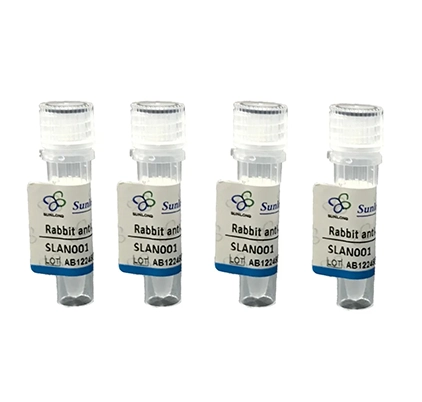
Rabbit Anti-14-3-3 Alpha + Beta + Gamma + Delta + Epsilon/Biotin Conjugated antibody
14 3 3 protein beta; 14 3 3 protein beta/alpha; 14 3 3 protein zeta; KCIP 1; Protein 1054; Protein kinase C inhibitor protein 1; 14 3 3 protein delta; 14 3 3 protein gamma; YWHAB; YWHAZ; 14 3 3 protein Epsilon; 1433Z_HUMAN; 14-3-3ε; 14-3-3 α; 14-3-3 β; 14
All categories
View History [Clear]
Details
Product Name Anti-14-3-3 Alpha + Beta + Gamma + Delta + Epsilon/Biotin Chinese Name 生物素标记的14-3-3蛋白/14-3-3 α/β/γ/δ/ε亚型抗体 Alias 14 3 3 protein beta; 14 3 3 protein beta/alpha; 14 3 3 protein zeta; KCIP 1; Protein 1054; Protein kinase C inhibitor protein 1; 14 3 3 protein delta; 14 3 3 protein gamma; YWHAB; YWHAZ; 14 3 3 protein Epsilon; 1433Z_HUMAN; 14-3-3ε; 14-3-3 α; 14-3-3 β; 14-3-3 γ; 14-3-3 δ. Research Area Apoptosis Immunogen Species Rabbit Clonality Polyclonal React Species Human,Mouse,Rat(predicted:Sheep,Fruit Fly,Yeast) Applications WB=1:50-200 IHC-P=1:50-200 IHC-F=1:50-200 IF=1:50-200
not yet tested in other applications.
optimal dilutions/concentrations should be determined by the end user.Molecular weight 27kDa Form Lyophilized or Liquid Concentration 1mg/ml immunogen KLH conjugated synthetic peptide derived from human 14-3-3 (201-245aa) Lsotype IgG Purification affinity purified by Protein A Storage Buffer 1M TBS(pH7.4) with 1% BSA, 3% Proclin300 and 50% Glycerol. Storage Store at -20 °C for one year. Avoid repeated freeze/thaw cycles. The lyophilized antibody is stable at room temperature for at least one month and for greater than a year when kept at -20°C. When reconstituted in sterile pH 7.4 1M PBS or diluent of antibody the antibody is stable for at least two weeks at 2-4 °C. Product Detail background:
14-3-3 are activates tyrosine and tryptophan hydroxylases in the presence of Ca (2+)/calmodulin-dependent protein kinase II, and strongly activates protein kinase C. Is probably a multifunctional regulator of the cell signaling processes mediated by both kinases. Activates the ADP-ribosyltransferase (exoS) activity of bacterial origin. 14-3-3 proteins are localized in neurons, and are axonally transported to the nerve terminals. They may be also present, at lower levels, in various other eukaryotic tissues. It belongs to the 14-3-3 family.
This antibody is reactive with 14-3-3 Alpha, Beta, Gamma, Delta, Epsilon.
Function:
Adapter protein implicated in the regulation of a large spectrum of both general and specialized signaling pathways. Binds to a large number of partners, usually by recognition of a phosphoserine or phosphothreonine motif. Binding generally results in the modulation of the activity of the binding partner.
Subunit:
Interacts with CDK16 and BSPRY. Interacts with WEE1 (C-terminal). Interacts with SAMSN1. Interacts with MLF1 (phosphorylated form); the interaction retains it in the cytoplasm. Interacts with Thr-phosphorylated ITGB2. Interacts with BCL2L11. Homodimer. Heterodimerizes with YWHAE. Homo- and hetero-dimerization is inhibited by phosphorylation on Ser-58. Interacts with FOXO4, NOXA1, SSH1 and ARHGEF2. Interacts with Pseudomonas aeruginosa exoS (unphosphorylated form). Interacts with BAX; the interaction occurs in the cytoplasm. Under stress conditions, MAPK8-mediated phosphorylation releases BAX to mitochondria. Interacts with phosphorylated RAF1; the interaction is inhibited when YWHAZ is phosphorylated on Thr-232. Interacts with TP53; the interaction enhances p53 transcriptional activity. The Ser-58 phosphorylated form inhibits this interaction and p53 transcriptional activity. Interacts with ABL1 (phosphorylated form); the interaction retains ABL1 in the cytoplasm. Interacts with PKA-phosphorylated AANAT; the interaction modulates AANAT enzymatic activity by increasing affinity for arylalkylamines and acetyl-CoA and protecting the enzyme from dephosphorylation and proteasomal degradation. It may also prevent thiol-dependent inactivation. Interacts with AKT1; the interaction phosphorylates YWHAZ and modulates dimerization. Interacts with GAB2 and TLK2.
Subcellular Location:
Cytoplasm. Melanosome. Note=Located to stage I to stage IV melanosomes.
Post-translational modifications:
The delta, brain-specific form differs from the zeta form in being phosphorylated. Phosphorylation on Ser-184 by MAPK8; promotes dissociation of BAX and translocation of BAX to mitochondria. Phosphorylation on Ser-58 by PKA; disrupts homodimerization and heterodimerization with YHAE and TP53. This phosphorylation appears to be activated by sphingosine. Phosphorylation on Thr-232; inhibits binding of RAF1.
Similarity:
Belongs to the 14-3-3 family.
Database links:Entrez Gene: 7529 Human
Entrez Gene: 54401 Mouse
Omim: 601289 Human
SwissProt: P31946 Human
SwissProt: Q9CQV8 Mouse
Unigene: 643544 Human
Unigene: 34319 Mouse
Unigene: 485025 Mouse
Unigene: 8653 Rat
Important Note:
This product as supplied is intended for research use only, not for use in human, therapeutic or diagnostic applications.
Signaling Intermediates
14-3-3 protein is a family of proteins involved in the regulation of Apoptosis, mitogenic signal transduction and cell cycle checkpoints. It is thought to be a key regulator in signal transduction mediated by binding to proteins phosphorylated on serine residues. Through binding to Bad (Bcl-2-associated death promoter), 14-3-3 protein prevents Apoptosis by sequestering Bad in the cytosol.
The protein is a member of the 14-3-3 family. It is a highly conserved multifunctional protein widely distributed in eukaryotes including mammals, amphibians, Insect, Botany and yeast.
At least 16 members are currently known. This antibody recognizes the 14-3-3 protein αβγδε isoforms with a molecular weight of 30-31 kDa.Ordering & shipping
- Minimum order: 1 unit
- Lead time: varies with order quantity and specifications. Please consult your local distributor or our sales team for confirmation
- Payment: T/T 100% in advance; PayPal; Alibaba Trade Assurance
- Shipping: FedEx / DHL / UPS express; cold-chain packing available on request
- Price: USD, per unit (100ul)
Partial purchase records(bought amounts latest3)
| Username | Quantity | bought time |
| La*** | 2 | 2024-04-18 |
| Ya*** | 1 | 2024-01-08 |
| Ad*** | 1 | 2023-12-12 |
User Comment(Total0User Comment Num)
- No comment


 +86 571 56623320

 SUNLONG BIOTECH


