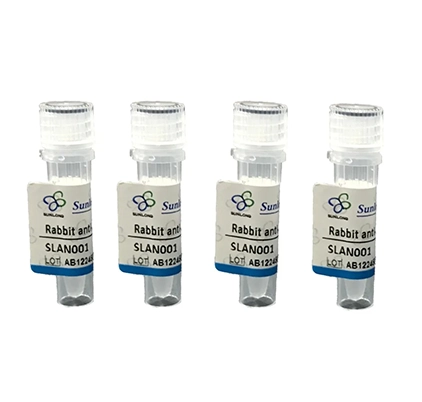
Rabbit Anti-APRT/PE Conjugated antibody
Adenine phosphoribosyltransferase; AMP; AMP diphosphorylase; AMP pyrophosphorylase; APRT; APT_HUMAN; DKFZp686D13177; MGC125856; MGC125857; MGC129961; Transphosphoribosidase.
View History [Clear]
Details
Product Name Anti-APRT/PE Chinese Name PE标记的腺嘌呤磷酸核糖转移酶抗体 Alias Adenine phosphoribosyltransferase; AMP; AMP diphosphorylase; AMP pyrophosphorylase; APRT; APT_HUMAN; DKFZp686D13177; MGC125856; MGC125857; MGC129961; Transphosphoribosidase. Research Area Tumour Cell biology immunology Neurobiology The new supersedes the old Immunogen Species Rabbit Clonality Polyclonal React Species Mouse(predicted:Human,Rat,Dog,Pig,Cow,Sheep) Applications IF=1:100-500
not yet tested in other applications.
optimal dilutions/concentrations should be determined by the end user.Molecular weight 19kDa Form Lyophilized or Liquid Concentration 1mg/ml immunogen KLH conjugated synthetic peptide derived from human APRT Lsotype IgG Purification affinity purified by Protein A Storage Buffer 1M TBS(pH7.4) with 1% BSA, 3% Proclin300 and 50% Glycerol. Storage Store at -20 °C for one year. Avoid repeated freeze/thaw cycles. The lyophilized antibody is stable at room temperature for at least one month and for greater than a year when kept at -20°C. When reconstituted in sterile pH 7.4 1M PBS or diluent of antibody the antibody is stable for at least two weeks at 2-4 °C. Product Detail background:
APRT is a 180 amino acid protein that localizes to the cytoplasm and belongs to the purine/pyrimidine phosphoribosyltransferase family. Existing as a homodimer, APRT functions to catalyze the formation of inorganic pyrophosphate and AMP from adenine and 5-phosphoribosyl-1-pyrophosphate (PRPP), a reaction that is essential for both purine metabolism and AMP biosynthesis. Defects in the gene encoding APRT are the cause of APRT deficiency, also known as 2,8-dihydroxyadenine urolithiasis, which is an autosomal recessive disease that results in renal failure. The gene encoding APRT maps to human chromosome 16, which encodes over 900 genes and comprises nearly 3% of the human genome. The GAN gene is located on chromosome 16 and, with mutation, may lead to giant axonal neuropathy, a nervous system disorder characterized by increasing malfunction with growth. The rare disorder Rubinstein-Taybi syndrome is also associated with chromosome 16, as is Crohn's disease, which is a gastrointestinal inflammatory condition.
Function:
Catalyzes a salvage reaction resulting in the formation of AMP, that is energically less costly than de novo synthesis.
Subunit:
Homodimer.
Subcellular Location:
Cytoplasm.
DISEASE:
Defects in APRT are the cause of adenine phosphoribosyltransferase deficiency (APRTD) [MIM:102600]; also known as 2,8-dihydroxyadenine urolithiasis. An enzymatic deficiency that can lead to urolithiasis and renal failure. Patients have 2,8-dihydroxyadenine (DHA) urinary stones.
Similarity:
Belongs to the purine/pyrimidine phosphoribosyltransferase family.
Database links:Entrez Gene: 353 Human
Omim: 102600 Human
SwissProt: P07741 Human
Unigene: 28914 Human
Unigene: 2498 Rat
Important Note:
This product as supplied is intended for research use only, not for use in human, therapeutic or diagnostic applications.
Cartpieces
Totalgoods,subtotals:¥Checkout
Partial purchase records(bought amounts latest0)
No one bought this product
User Comment(Total0User Comment Num)
- No comment


 +86 571 56623320
 SUNLONG BIOTECH

