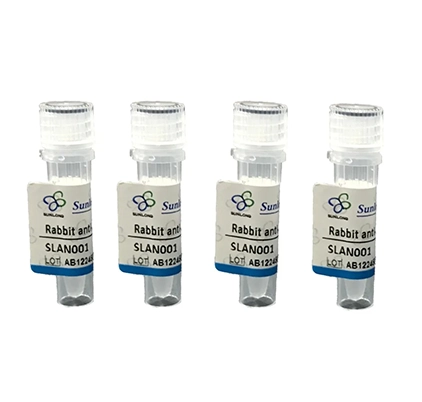
Rabbit Anti-FOXK1/PE Conjugated antibody
A630048H08Rik; AI463295; ENSMUSG00000075577; FHX; Fork head; Forkhead box protein K1; FOXJ2 forkhead factor; FOXK1; FOXK1_HUMAN; Gm10868; MNF; Myocyte nuclear factor.
View History [Clear]
Details
Product Name Anti-FOXK1/PE Chinese Name PE标记的FOXK1蛋白抗体 Alias A630048H08Rik; AI463295; ENSMUSG00000075577; FHX; Fork head; Forkhead box protein K1; FOXJ2 forkhead factor; FOXK1; FOXK1_HUMAN; Gm10868; MNF; Myocyte nuclear factor. Research Area Cell biology immunology transcriptional regulatory factor Epigenetics Immunogen Species Rabbit Clonality Polyclonal React Species Mouse(predicted:Human,Rat,Pig,Cow,Rabbit,Sheep) Applications IF=1:100-500
not yet tested in other applications.
optimal dilutions/concentrations should be determined by the end user.Molecular weight 75kDa Form Lyophilized or Liquid Concentration 1mg/ml immunogen KLH conjugated synthetic peptide derived from human FOXK1 Lsotype IgG Purification affinity purified by Protein A Storage Buffer 1M TBS(pH7.4) with 1% BSA, 3% Proclin300 and 50% Glycerol. Storage Store at -20 °C for one year. Avoid repeated freeze/thaw cycles. The lyophilized antibody is stable at room temperature for at least one month and for greater than a year when kept at -20°C. When reconstituted in sterile pH 7.4 1M PBS or diluent of antibody the antibody is stable for at least two weeks at 2-4 °C. Product Detail background:
The FOX family of transcription factors share a common DIUA binding domain termed a winged-helix or forkhead domain. Many FOX proteins play important roles in development, metabolism, cancer and aging. In skeletal muscles, undifferentiated myogenic stem cells (satellite cells) can mobilize to regenerate myofibers in response to injury. FOXK1 is expressed in these cells and regulates cell cycle progression through an interaction with its downstream target the cyclin-dependent kinase inhibitor p21 (CIP). Loss of FOXK1 in mice results in growth retardation and a severe impairment in skeletal muscle regeneration following injury. FOXK1 also shows expression in immature tissues of brain, eye, heart, lung and thymus. It also is predominantly expressed in many malignant tissues, such as tumors of the brain, colon and lymph node.
Function:
Transcriptional regulator that binds to the upstream enhancer region (CCAC box) of myoglobin gene. Has a role in myogenic differentiation and in remodeling processes of adult muscles that occur in response to physiological stimuli.
Subcellular Location:
Nucleus.
Tissue Specificity:
Expressed both developing and adult tissues. In adults, significant expression is seen in tumors of the brain, colon and lymph node.
Similarity:
Contains 1 FHA domain.
Contains 1 fork-head DNA-binding domain.
Database links:Entrez Gene: 221937 Human
Entrez Gene: 17425 Mouse
SwissProt: P85037 Human
SwissProt: P42128 Mouse
Unigene: 487393 Human
Unigene: 24214 Mouse
Important Note:
This product as supplied is intended for research use only, not for use in human, therapeutic or diagnostic applications.
Cartpieces
Totalgoods,subtotals:¥Checkout
Partial purchase records(bought amounts latest0)
No one bought this product
User Comment(Total0User Comment Num)
- No comment


 +86 571 56623320
 SUNLONG BIOTECH

