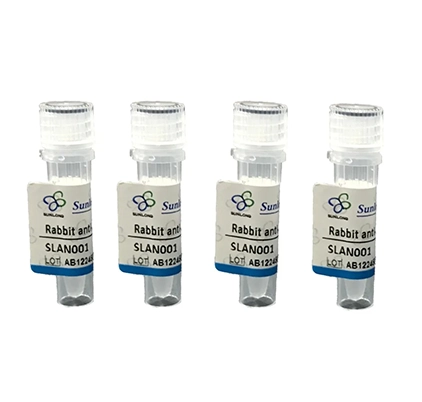
Rabbit Anti-Bovine Serum Albumin antibody
ALB; Albumin; Allergen Bos d 6; BSA; Serum albumin; ALBU_BOVIN.
View History [Clear]
Details
Product Name Bovine Serum Albumin Chinese Name 牛血清白蛋白抗体 Alias ALB; Albumin; Allergen Bos d 6; BSA; Serum albumin; ALBU_BOVIN. literatures Research Area Cardiovascular immunology Immunogen Species Rabbit Clonality Polyclonal React Species Human,Mouse,Rat,Cow,Goat Applications WB=1:500-2000
not yet tested in other applications.
optimal dilutions/concentrations should be determined by the end user.Theoretical molecular weight 69kDa Cellular localization Secretory protein Form Liquid Concentration 1mg/ml immunogen Bovine Serum Albumin: full length Lsotype IgG Purification affinity purified by Protein A Buffer Solution 1M TBS(pH7.4) with 3% Proclin300 and 50% Glycerol. Storage Shipped at 4℃. Store at -20 °C for one year. Avoid repeated freeze/thaw cycles. Attention This product as supplied is intended for research use only, not for use in human, therapeutic or diagnostic applications. PubMed PubMed Product Detail Albumin is a soluble, monomeric protein which comprises about one-half of the blood serum protein. Albumin functions primarily as a carrier protein for steroids, fatty acids, and thyroid hormones and plays a role in stabilizing extracellular fluid volume. Albumin is a globular unglycosylated serum protein of molecular weight 65,000. Albumin is synthesized in the liver as preproalbumin which has an N-terminal peptide that is removed before the nascent protein is released from the rough endoplasmic reticulum. The product, proalbumin, is in turn cleaved in the Golgi vesicles to produce the secreted albumin. [provided by RefSeq, Jul 2008].
Function:
Serum albumin, the main protein of plasma, has a good binding capacity for water, Ca(2+), Na(+), K(+), fatty acids, hormones, bilirubin and drugs. Its main function is the regulation of the colloidal osmotic pressure of blood. Major zinc transporter in plasma, typically binds about 80% of all plasma zinc.
Subcellular Location:
Secreted.
Tissue Specificity:
Plasma.
Post-translational modifications:
Kenitra variant is partially O-glycosylated at Thr-620. It has two new disulfide bonds Cys-600 to Cys-602 and Cys-601 to Cys-606.
Glycated in diabetic patients.
Phosphorylation sites are present in the extracelllular medium.
Acetylated on Lys-223 by acetylsalicylic acid.
DISEASE:
Defects in ALB are a cause of familial dysalbuminemic hyperthyroxinemia (FDH) [MIM:103600]. FDH is a form of euthyroid hyperthyroxinemia that is due to increased affinity of ALB for T(4). It is the most common cause of inherited euthyroid hyperthyroxinemia in Caucasian population.
Similarity:
Belongs to the ALB/AFP/VDB family.
Contains 3 albumin domains.
SWISS:
P02769
Gene ID:
280717
Database links:
Entrez Gene: 213 Human
Entrez Gene: 11657 Mouse
Omim: 103600 Human
SwissProt: P02768 Human
SwissProt: P07724 Mouse
Product Picture 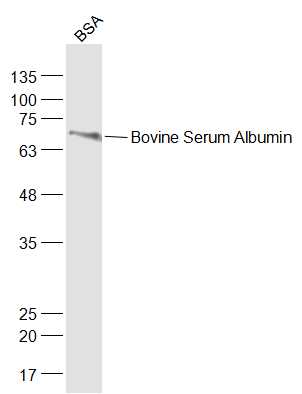 Sample:
BSA (Cow) at 40 ug
Primary: Anti-Bovine Serum Albumin (SL0292R) at 1/1000 dilution
Secondary: IRDye800CW Goat Anti-Rabbit IgG at 1/20000 dilution
Predicted band size: 69 kD
Observed band size: 69 kD
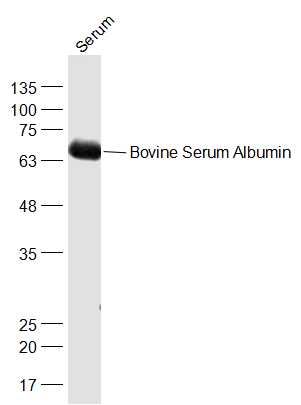 Sample:
Serum (Cow) at 40 ug
Primary: Anti-Bovine Serum Albumin (SL0292R) at 1/1000 dilution
Secondary: IRDye800CW Goat Anti-Rabbit IgG at 1/20000 dilution
Predicted band size: 69 kD
Observed band size: 69 kD
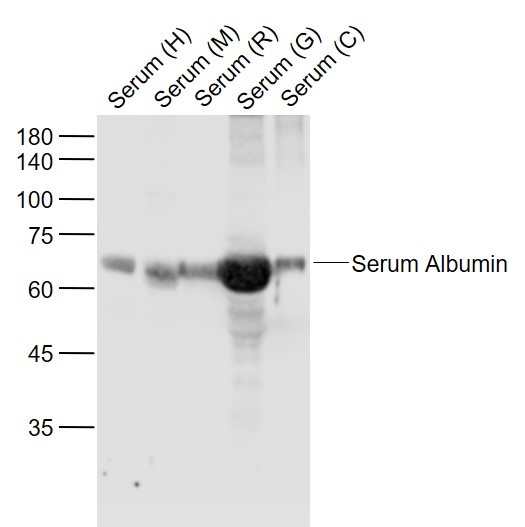 Sample:
Lane 1: Serum (Human) at 20 ug
Lane 2: Serum (Mouse) at 20 ug
Lane 3: Serum (Rat) at 20 ug
Lane 4: Serum (Goat) at 20 ug
Lane 5: Serum (Cow) at 20 ug
Primary: Anti-Bovine Serum Albumin (SL0292R) at 1/1000 dilution
Secondary: IRDye800CW Goat Anti-Rabbit IgG at 1/20000 dilution
Predicted band size: 67 kD
Observed band size: 67 kD
Cartpieces
Totalgoods,subtotals:¥Checkout
Partial purchase records(bought amounts latest0)
No one bought this product
User Comment(Total0User Comment Num)
- No comment


 +86 571 56623320
 SUNLONG BIOTECH

