Rabbit Anti-SLC7A5 antibody
LAT1; 4F2 LC; 4F2 light chain; SLC7A5; 4F2LC; CD98; CD98 light chain; CD98LC; D16S469E; DC49; E16; hLAT1; Integral membrane protein E16; L type amino acid transporter; L type amino acid transporter 1; L-type amino acid transporter 1; Large neutral amino a
All categories
View History [Clear]
Details
Product Name SLC7A5 Chinese Name CD98轻链抗体 Alias LAT1; 4F2 LC; 4F2 light chain; SLC7A5; 4F2LC; CD98; CD98 light chain; CD98LC; D16S469E; DC49; E16; hLAT1; Integral membrane protein E16; L type amino acid transporter; L type amino acid transporter 1; L-type amino acid transporter 1; Large neutral amino acids transporter 1; Large neutral amino acids transporter; Large neutral amino acids transporter small subunit 1; LAT1_HUMAN; Membrane protein E16; MPE16; Slc7a5; Sodium independent neutral amino acid transporter; Sodium independent neutral amino acid transporter LAT1; Solute carrier family 7 (cationic amino acid transporter y+ system) member 5; Solute carrier family 7 member 5; TA1; Tumor associated protein 1; y+ system cationic amino acid transporter. literatures Research Area Tumour Cell biology Signal transduction The new supersedes the old The cell membrane蛋白 Immunogen Species Rabbit Clonality Polyclonal React Species Human (predicted:Mouse,Rat) Applications WB=1:500-2000
not yet tested in other applications.
optimal dilutions/concentrations should be determined by the end user.Theoretical molecular weight 55kDa Cellular localization cytoplasmic The cell membrane Form Liquid Concentration 1mg/ml immunogen KLH conjugated synthetic peptide derived from human SLC7A5: 101-200/507 Lsotype IgG Purification affinity purified by Protein A Buffer Solution 1M TBS(pH7.4) with 1% BSA, 3% Proclin300 and 50% Glycerol. Storage Shipped at 4℃. Store at -20 °C for one year. Avoid repeated freeze/thaw cycles. Attention This product as supplied is intended for research use only, not for use in human, therapeutic or diagnostic applications. PubMed PubMed Product Detail L-type amino acid transporter 1 (LAT1) is a multipass-membrane protein responsible for sodium-independent, high-affinity transport of large neutral amino acids. LAT1 functions as a disulfide-linked heterodimer with the amino acid transport protein CD98. LAT1 is expressed predominantly in adult lung and liver but is also expressed in brain, thymus, retina, testis, placenta, bone marrow and fetal liver. In the retina, LAT1 localizes to the blood-retinal-barrier (BRB) and mediates L-leucine transport from the blood to the retina. The devastating effects on the brain caused by phenylketonuria are due to the increased levels of LAT1 on the blood-brain-barrier in response to high concentrations of phenylalanine in the blood. LAT1 accepts the amino-acid related anticancer agent melphalan and plays a significant role in cell proliferation, differentiation, and invasion in esophageal squamous cell carcinoma.
Function:
Sodium-independent, high-affinity transport of large neutral amino acids such as phenylalanine, tyrosine, leucine, arginine and tryptophan, when associated with SLC3A2/4F2hc. Involved in cellular amino acid uptake. Acts as an amino acid exchanger. Involved in the transport of L-DOPA across the blood-brain barrier, and that of thyroid hormones triiodothyronine (T3) and thyroxine (T4) across the cell membrane in tissues such as placenta. Plays a role in neuronal cell proliferation (neurogenesis) in brain. Involved in the uptake of methylmercury (MeHg) when administered as the L-cysteine or D,L-homocysteine complexes, and hence plays a role in metal ion homeostasis and toxicity. Involved in the cellular activity of small molecular weight nitrosothiols, via the stereoselective transport of L-nitrosocysteine (L-CNSO) across the transmembrane. May play an important role in high-grade gliomas. Mediates blood-to-retina L-leucine transport across the inner blood-retinal barrier which in turn may play a key role in maintaining large neutral amino acids as well as neurotransmitters in the neural retina. Acts as the major transporter of tyrosine in fibroblasts.
Subcellular Location:
Cytoplasm, cytosol. Apical cell membrane. Located to the plasma membrane by SLC3A2/4F2hc. Localized to the apical membrane of placental syncytiophoblastic cells. Expressed in both luminal and abluminal membranes of brain capillary endothelial cells.
Tissue Specificity:
Expressed abundantly in adult lung, liver, brain, skeletal muscle, placenta, bone marrow, testis, resting lymphocytes and monocytes, and in fetal liver. Weaker expression in thymus, cornea, retina, peripheral leukocytes, spleen, kidney, colon and lymph node. During gestation, expression in the placenta was significantly stronger at full-term than at the mid-trimester stage. Also expressed in all human tumor cell lines tested and in the astrocytic process of primary astrocytic gliomas. Expressed in retinal endothelial cells and in the intestinal epithelial cell line Caco-2.
Similarity:
Belongs to the amino acid-polyamine-organocation (APC) superfamily.
L-type amino acid transporter (LAT) (TC 2.A.3.8) family.
SWISS:
Q01650
Gene ID:
8140
Database links:Entrez Gene: 8140 Human
Omim: 600182 Human
SwissProt: Q01650 Human
Unigene: 513797 Human
Product Picture 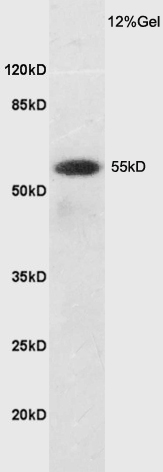 Sample: Brain (Rat) Lysate at 40 ug
Primary: Anti-SLC7A5 (SL10125R) at 1/300 dilution
Secondary: HRP conjugated Goat-Anti-rabbit IgG (SL0295G-HRP) at 1/5000 dilution
Predicted band size: 55 kD
Observed band size: 55 kD
Partial purchase records(bought amounts latest5)
| Username | Quantity | bought time |
| Da*** | 1 | 2026-09-05 |
| Um*** | 1 | 2026-09-04 |
| Br*** | 1 | 2026-08-07 |
| Re*** | 1 | 2026-08-02 |
| We*** | 1 | 2026-07-30 |
User Comment(Total0User Comment Num)
- No comment


 +86 571 56623320

 SUNLONG BIOTECH


