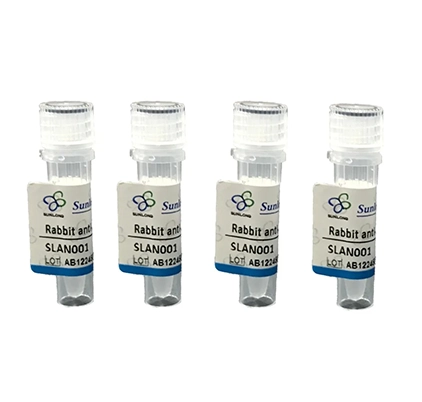
Rabbit Anti-GPR116 antibody
DKFZp564O1923; FLJ90640; G protein coupled receptor 116; G protein coupled receptor 116; GP116_HUMAN; GPR116; Ig Hepta homolog; KIAA0758; KIAA0758; KPG_001; OTTHUMP00000016557; Probable G protein coupled receptor 116; Probable G-protein coupled receptor 1
View History [Clear]
Details
Product Name GPR116 Chinese Name G protein-coupled receptor116抗体 Alias DKFZp564O1923; FLJ90640; G protein coupled receptor 116; G protein coupled receptor 116; GP116_HUMAN; GPR116; Ig Hepta homolog; KIAA0758; KIAA0758; KPG_001; OTTHUMP00000016557; Probable G protein coupled receptor 116; Probable G-protein coupled receptor 116; GPCR GPR116. Research Area Neurobiology Signal transduction The cell membrane受体 G protein-coupled receptor G protein signal Immunogen Species Rabbit Clonality Polyclonal React Species (predicted: Human, Mouse, Rat, Rabbit, ) Applications ELISA=1:5000-10000
not yet tested in other applications.
optimal dilutions/concentrations should be determined by the end user.Theoretical molecular weight 147kDa Cellular localization The cell membrane Form Liquid Concentration 1mg/ml immunogen KLH conjugated synthetic peptide derived from human G protein coupled receptor 116: 501-600/1346 <Extracellular> Lsotype IgG Purification affinity purified by Protein A Buffer Solution 1M TBS(pH7.4) with 1% BSA, 3% Proclin300 and 50% Glycerol. Storage Shipped at 4℃. Store at -20 °C for one year. Avoid repeated freeze/thaw cycles. Attention This product as supplied is intended for research use only, not for use in human, therapeutic or diagnostic applications. PubMed PubMed Product Detail G protein-coupled receptors (GPRs), also known as seven transmembrane receptors, heptahelical receptors or 7TM receptors, comprise a superfamily of proteins that play a role in many different stimulus-response pathways. G protein coupled receptors translate extracellular signals into intracellular signals (G protein activation) and they respond to a variety of signaling molecules, such as hormones and neurotransmitters. GPR116 (G protein-coupled receptor 116) is a 1,346 amino acid multi-pass membrane protein that contains one SEA domain, one GPS domain and three Ig-like domains and belongs to the GPR family. Existing as a dilsulfide-liked homodimer at the cell surface, GPR116 exists as multiple alternatively spliced isoforms and is thought to play a role in regulating and maintaining proper acid-base balance throughout the cell.
Function:
May have a role in the regulation of acid-base balance.
Subunit:
Exists as disulfide-linked dimers at the cell surface
Subcellular Location:
Cell membrane; Multi-pass membrane protein
Post-translational modifications:
Proteolytically cleaved into 2 highly conserved sites: one in the SEA domain and the other in the stalk domain region preceding the first transmembrane. The later 2 subunits, the extracellular subunit and the seven-transmembrane subunit, remain tightly associated and non-covalently linked.
Similarity:
Belongs to the G-protein coupled receptor 2 family. LN-TM7 subfamily.
Contains 1 GPS domain.
Contains 3 Ig-like (immunoglobulin-like) domains.
Contains 1 SEA domain.
SWISS:
Q8IZF2
Gene ID:
221395
Database links:Entrez Gene: 221395 Human
SwissProt: Q8IZF2 Human
Unigene: 362806 Human
Product Picture 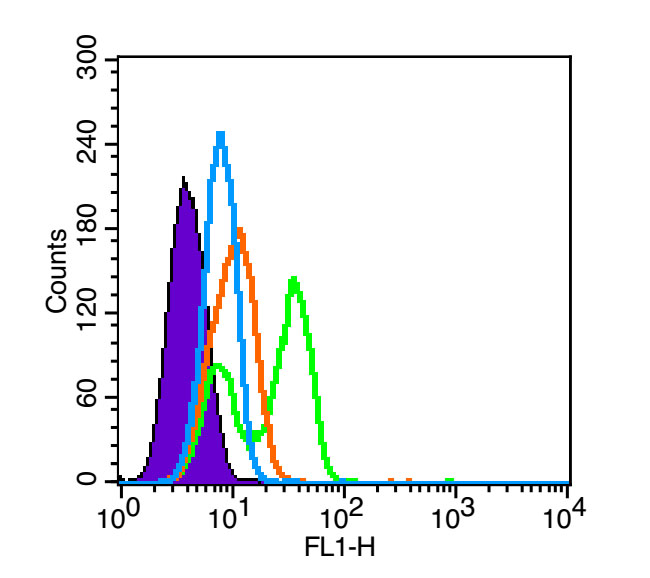 Blank control (blue line): Hela (Black).
Primary Antibody (green line): Rabbit Anti-GPR116 antibody (SL12025R)
Dilution: 1μg /10^6 cells;
Isotype Control Antibody (orange line): Rabbit IgG .
Secondary Antibody (white blue line): Goat anti-rabbit IgG-PE
Dilution: 1μg /test.
Protocol
The cells were fixed with 4% paraformaldehyde for 10 min at room temperature. Cells stained with Primary Antibody for 30 min at room temperature.The cells were then incubated in 1 X PBS/2%BSA/10% goat serum to block non-specific protein-protein interactions followed by the antibody for 30 min at room temperature. The secondary antibody used for 40 min at room temperature. Acquisition of 20,000 events was performed.
Cartpieces
Totalgoods,subtotals:¥Checkout
Partial purchase records(bought amounts latest0)
No one bought this product
User Comment(Total0User Comment Num)
- No comment


 +86 571 56623320
 SUNLONG BIOTECH

