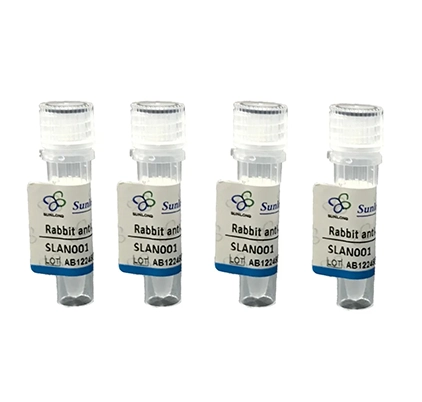
Rabbit Anti-CRALBP antibody
Cellular retinaldehyde binding protein 1; Cellular retinaldehyde binding protein; Cellular retinaldehyde-binding protein; MGC3663; Retinaldehyde binding protein 1; Retinaldehyde-binding protein 1; RLBP 1; RLBP1; RLBP1_HUMAN.
All categories
View History [Clear]
Details
Product Name CRALBP Chinese Name 细胞视黄醛Binding protein1抗体 Alias Cellular retinaldehyde binding protein 1; Cellular retinaldehyde binding protein; Cellular retinaldehyde-binding protein; MGC3663; Retinaldehyde binding protein 1; Retinaldehyde-binding protein 1; RLBP 1; RLBP1; RLBP1_HUMAN. Research Area Cell biology immunology Neurobiology Immunogen Species Rabbit Clonality Polyclonal React Species (predicted: Human, Mouse, Rat, ) Applications WB=1:500-2000,IHC-P=1:100-500,IHC-F=1:100-500,ICC/IF=1:100-500,IF=1:100-500,ELISA=1:5000-10000 (Paraffin sections need antigen repair)
not yet tested in other applications.
optimal dilutions/concentrations should be determined by the end user.Theoretical molecular weight 36kDa Cellular localization cytoplasmic Form Liquid Concentration 1mg/ml immunogen KLH conjugated synthetic peptide derived from human CRALBP: 11-110/317 Lsotype IgG Purification affinity purified by Protein A Buffer Solution 1M TBS(pH7.4) with 1% BSA, 3% Proclin300 and 50% Glycerol. Storage Shipped at 4℃. Store at -20 °C for one year. Avoid repeated freeze/thaw cycles. Attention This product as supplied is intended for research use only, not for use in human, therapeutic or diagnostic applications. PubMed PubMed Product Detail The protein encoded by this gene is a 36-kD water-soluble protein which carries 11-cis-retinaldehyde or 11-cis-retinal as physiologic ligands. It may be a functional component of the visual cycle. Mutations of this gene have been associated with severe rod-cone dystrophy, Bothnia dystrophy (nonsyndromic autosomal recessive retinitis pigmentosa) and retinitis punctata albescens. [provided by RefSeq, Jul 2008]
Function:
Soluble retinoid carrier essential the proper function of both rod and cone photoreceptors. Participates in the regeneration of active 11-cis-retinol and 11-cis-retinaldehyde, from the inactive 11-trans products of the rhodopsin photocycle and in the de novo synthesis of these retinoids from 11-trans metabolic precursors. The cycling of retinoids between photoreceptor and adjacent pigment epithelium cells is known as the 'visual cycle'.
Subcellular Location:
Cytoplasm.
Tissue Specificity:
Retina and pineal gland. Not present in photoreceptor cells but is expressed abundantly in the adjacent retinal pigment epithelium (RPE) and in the Mueller glial cells of the retina.
DISEASE:
Defects in RLBP1 are a cause of retinitis pigmentosa autosomal recessive (ARRP) [MIM:268000]. RP leads to degeneration of retinal photoreceptor cells. Patients typically have night vision blindness and loss of midperipheral visual field. As their condition progresses, they lose their far peripheral visual field and eventually central vision as well.
Defects in RLBP1 are the cause of Bothnia retinal dystrophy (BRD) [MIM:607475]; also known as Vasterbotten dystrophy. Affected individuals show night blindness from early childhood with features consistent with retinitis punctata albescens and macular degeneration.
Defects in RLBP1 are the cause of rod-cone dystrophy Newfoundland (NFRCD) [MIM:607476]. NFRCD is a retinal dystrophy reminiscent of retinitis punctata albescens but with a substantially lower age at onset and more-rapid and distinctive progression. Rod-cone dystrophies results from initial loss of rod photoreceptors, later followed by cone photoreceptors loss.
Defects in RLBP1 are a cause of fundus albipunctatus (FA) [MIM:136880]. FA is a rare form of stationary night blindness characterized by a delay in the regeneration of cone and rod photopigments.
Similarity:
Contains 1 CRAL-TRIO domain.
SWISS:
P12271
Gene ID:
6017
Database links:Entrez Gene: 6017 Human
Entrez Gene: 19771 Mouse
Omim: 180090 Human
SwissProt: P12271 Human
SwissProt: Q9Z275 Mouse
Unigene: 1933 Human
Unigene: 41653 Mouse
Ordering & shipping
- Minimum order: 1 unit
- Lead time: varies with order quantity and specifications. Please consult your local distributor or our sales team for confirmation
- Payment: T/T 100% in advance; PayPal; Alibaba Trade Assurance
- Shipping: FedEx / DHL / UPS express; cold-chain packing available on request
- Price: USD, per unit (50ul / 100ul)
Partial purchase records(bought amounts latest6)
| Username | Quantity | bought time |
| Ya*** | 1 | 2026-08-28 |
| Wi*** | 1 | 2026-06-29 |
| Um*** | 1 | 2026-06-05 |
| Ta*** | 1 | 2026-03-07 |
| No*** | 1 | 2026-02-04 |
User Comment(Total0User Comment Num)
- No comment


 +86 571 56623320

 SUNLONG BIOTECH


