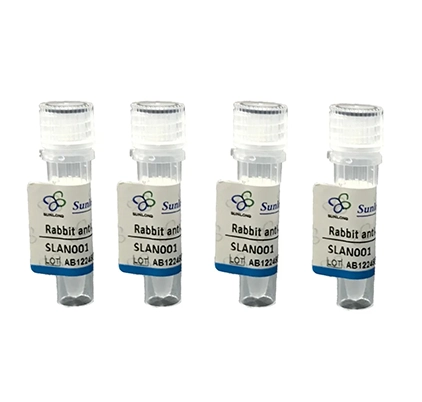
Rabbit Anti-CRB1 antibody
CRB1; CRUM1_HUMAN; Protein crumbs homolog 1.
All categories
View History [Clear]
Details
Product Name CRB1 Chinese Name CRB1蛋白抗体 Alias CRB1; CRUM1_HUMAN; Protein crumbs homolog 1. Research Area Cell biology Neurobiology Cytoskeleton Immunogen Species Rabbit Clonality Polyclonal React Species Human Applications IHC-P=1:100-500,IHC-F=1:100-500,IF=1:100-500 (Paraffin sections need antigen repair)
not yet tested in other applications.
optimal dilutions/concentrations should be determined by the end user.Theoretical molecular weight 151kDa Cellular localization cytoplasmic The cell membrane Form Liquid Concentration 1mg/ml immunogen KLH conjugated synthetic peptide derived from human CRB1: 301-400/1406 <Extracellular> Lsotype IgG Purification affinity purified by Protein A Buffer Solution 1M TBS(pH7.4) with 1% BSA, 3% Proclin300 and 50% Glycerol. Storage Shipped at 4℃. Store at -20 °C for one year. Avoid repeated freeze/thaw cycles. Attention This product as supplied is intended for research use only, not for use in human, therapeutic or diagnostic applications. PubMed PubMed Product Detail This gene encodes a protein which is similar to the Drosophila crumbs protein and localizes to the inner segment of mammalian photoreceptors. In Drosophila crumbs localizes to the stalk of the fly photoreceptor and may be a component of the molecular scaffold that controls proper development of polarity in the eye. Mutations in this gene are associated with a severe form of retinitis pigmentosa, RP12, and with Leber congenital amaurosis. Alternate splicing results in multiple transcript variants, some protein coding and some non-protein coding.[provided by RefSeq, Apr 2012]
Function:
Plays a role in photoreceptor morphogenesis in the retina. May maintain cell polarization and adhesion.
Subcellular Location:
Secreted and Apical cell membrane. Distributed at the apical membrane of all retinal epithelial cells. Located in the apical membrane of the adherens junction in outer limiting membrane (OLM) of the retina.
Tissue Specificity:
Preferential expression in retina, also expressed in brain, testis, fetal brain and fetal eye.
Post-translational modifications:
Extensively glycosylated.
DISEASE:
Note=CRB1 mutations have been found in various retinal dystrophies, chronic and disabling disorders of visual function. They predominantly involve the posterior portion of the ocular fundus, due to degeneration in the sensory layer of the retina, retinal pigment epithelium, Bruch membrane, choroid, or a combination of these tissues. Onset of inherited retinal dystrophies is painless, bilateral and typically progressive. Most people experience gradual peripheral vision loss or tunnel vision, and difficulties with poor illumination and night vision. Central vision is usually unaffected, so the person may still be able to read. However, it can also deteriorate to cause total blindness. Examples of retinal dystrophies are retinitis pigmentosa, Leber congenital amaurosis, cone-rod dystrophy among others.
Defects in CRB1 are the cause of retinitis pigmentosa type 12 (RP12) [MIM:600105]. A retinal dystrophy belonging to the group of pigmentary retinopathies. Retinitis pigmentosa is characterized by retinal pigment deposits visible on fundus examination and primary loss of rod photoreceptor cells, followed by secondary loss of cone photoreceptors. Patients typically have night vision blindness and loss of midperipheral visual field. As their condition progresses, they lose their far peripheral visual field and eventually central vision as well. RP12 is an autosomal recessive severe form oFTen manifesting in early childhood. Patients experiment progressive visual field loss with severe visual impairment before the age of twenty. Some patients have a preserved paraarteriolar retinal pigment epithelium (PPRPE) and hypermetropia.
Defects in CRB1 are the cause of Leber congenital amaurosis type 8 (LCA8) [MIM:613835]. LCA designates a clinically and genetically heterogeneous group of childhood retinal degenerations, generally inherited in an autosomal recessive manner. Affected infants have little or no retinal photoreceptor function as tested by electroretinography. LCA represents the most common genetic cause of congenital visual impairment in infants and children.
Defects in CRB1 are the cause of pigmented paravenous chorioretinal atrophy (PPCRA) [MIM:172870]. PPCRA is an unusual retinal degeneration characterized by accumulation of pigmentation along retinal veins. PPCRA is dominantly inherited, but exhibited variable expressivity. Males are more likely to exhibit a severe phenotype, whereas females may remain virtually asymptomatic even in later years. The PPCRA phenotype is associated with a mutation in CRB1 gene which is likely to affect the structure of the CRB1 protein.
Similarity:
Belongs to the Crumbs protein family.
Contains 19 EGF-like domains.
Contains 3 laminin G-like domains.
SWISS:
P82279
Gene ID:
23418
Database links:Entrez Gene: 23418 Human
SwissProt: P82279 Human
Unigene: 126135 Human
Product Picture 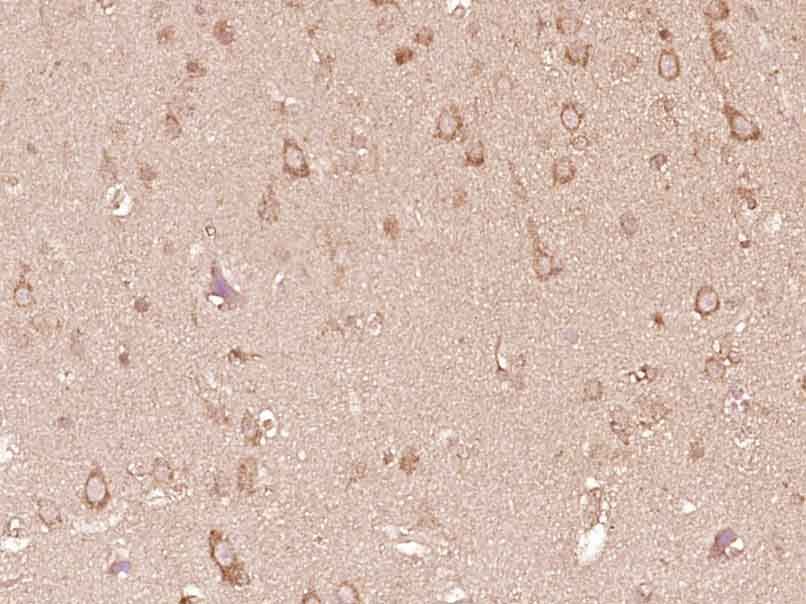 Paraformaldehyde-fixed, paraffin embedded (Human brain glioma); Antigen retrieval by boiling in sodium citrate buffer (pH6.0) for 15min; Block endogenous peroxidase by 3% hydrogen peroxide for 20 minutes; Blocking buffer (normal goat serum) at 37°C for 30min; Antibody incubation with (CRB1) Polyclonal Antibody, Unconjugated (SL14045R) at 1:400 overnight at 4°C, followed by operating according to SP Kit(Rabbit) (sp-0023) instructionsand DAB staining.
Ordering & shipping
- Minimum order: 1 unit
- Lead time: varies with order quantity and specifications. Please consult your local distributor or our sales team for confirmation
- Payment: T/T 100% in advance; PayPal; Alibaba Trade Assurance
- Shipping: FedEx / DHL / UPS express; cold-chain packing available on request
- Price: USD, per unit (50ul / 100ul)
Partial purchase records(bought amounts latest2)
| Username | Quantity | bought time |
| Be*** | 1 | 2026-09-11 |
| Pe*** | 1 | 2026-03-01 |
User Comment(Total0User Comment Num)
- No comment


 +86 571 56623320

 SUNLONG BIOTECH


