Rabbit Anti-MS4A1 Polyclonal Antibody
B1; Bp35; CD20; CVID5; FMC7; LEU-16; S7; CD20_HUMAN; MS4A1; B-lymphocyte surface antigen B1; Leukocyte surface antigen Leu-16; Membrane-spanning 4-domains subfamily A member 1; membrane spanning 4-domains A1; membrane-spanning 4-domains, subfamily A, memb
All categories
View History [Clear]

Details
Product Name Rabbit Anti-MS4A1 Polyclonal Antibody Cat No. SLA0094 Chinese Name CD20抗体 Alias B1; Bp35; CD20; CVID5; FMC7; LEU-16; S7; CD20_HUMAN; MS4A1; B-lymphocyte surface antigen B1; Leukocyte surface antigen Leu-16; Membrane-spanning 4-domains subfamily A member 1; membrane spanning 4-domains A1; membrane-spanning 4-domains, subfamily A, member 1 Host Species Rabbit Isotype IgG Clonality Polyclonal React Species Human Applications ICC/IF (1:50-200)
Not yet tested in other applications.
Optimal working dilutions must be determined by the end user.Immunogen KLH conjugated synthetic peptide derived from human CD20 Purification affinity purified by Protein A Concentration 1mg/ml Predicted MW. 33 kDa Gene ID 931 Swiss-Prot P11836 Storage 0.01M TBS (pH7.4) with 1% BSA, 0.02% Proclin300 and 50% Glycerol.
Shipped at 4℃. Store at -20℃ for one year. Avoid repeated freeze/thaw cycles.Background CD20 is a non glycosylated protein with a molecular weight of 35 or 37 kDa depending on the degree of phosphorylation. Although not a member of the tetraspanin superfamily of cell surface receptors, it crosses the cell membrane four times. The CD20 antigen is present on human pre B lymphocytes and on B lymphocytes at all stages of maturation, except on plasma cells. Low level expression of the CD20 antigen has been detected on normal T lymphocytes. The CD20 molecule is involved in regulation of B cell differentiation, presumably via its reported function as a Ca++ channel subunit. CD20 is a non-glycosylated surface phosphoprotein that has a molecular weight range of 33-37 kDa depending on the degree of phosphorylation. CD20 is expressed on mature and most malignant B cells, in a subpopulation of T lymphocytes and follicular dendritic cells. CD20 expression on B cells is synchronous with the expression of surface IgM and it regulates transmembrane calcium conductance, cell cycle progression and B-cell proliferation. CD20 is also associated with lipid rafts, but the intensity of this association depends on extracellular triggering, employing CD20 conformational change, and/or BCR (B cell antigen receptor) aggregation. After the receptor ligation, BCR and CD20 colocalize and then rapidly dissociate before BCR endocytosis, whereas CD20 remains at the cell surface. CD20 serves as a useful target for antibody-mediated therapeutic depletion of B cells, as it is expressed at high levels on most B-cell malignancies, but does not become internalized or shed from the plasma membrane following monoclonal antibody treatment. Diseases associated with CD20 dysfunction include Ms4a1-related common variable immune deficiency. Attention This product as supplied is intended for research use only, not for use in human, therapeutic or diagnostic applications.
Validation Images
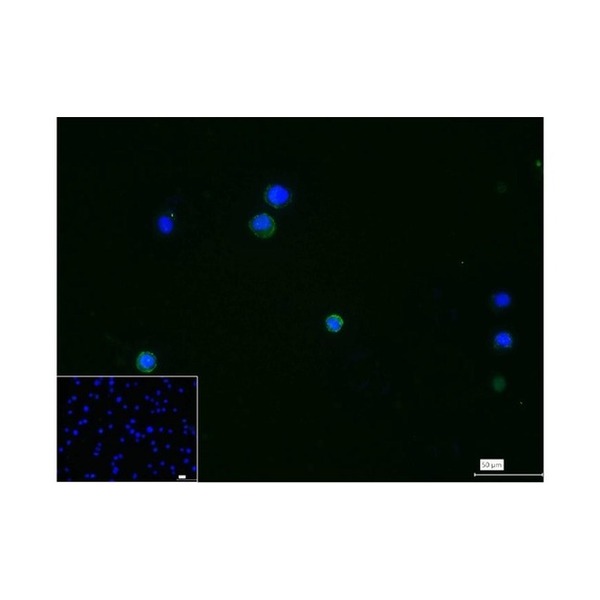
Figure 1. 4% Paraformaldehyde-fixed Raji (H) cell; Triton X-100 at r.t. for 20 min; Antibody incubation with (CD20) polyclonal Antibody, unconjugated (SLA0094) 1:100, 90 min at 37°C; followed by conjugated Goat Anti-Rabbit IgG antibody (green, SL60295G-FITC) at 37°C for 90 min, DAPI (blue, C02-04002) was used to stain the cell nuclei. PBS instead of the primary antibody was used as the blank control.
FOR RESEARCH USE ONLY. Not for use in diagnostic or therapeutic procedures.

Partial purchase records(bought amounts latest0)
No one bought this product
User Comment(Total0User Comment Num)
- No comment


 +86 571 56623320

 SUNLONG BIOTECH


