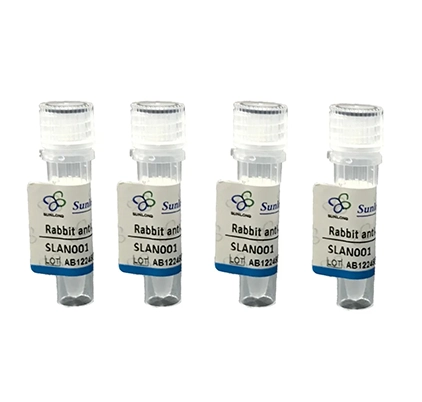
Rabbit Anti-Anei-ENPP2/FITC Conjugated antibody
Autotaxin; Ectonucleotide pyrophosphatase/phosphodiesterase family member 2; ATX; ATX X; ATX-X; Autotaxin; E NPP 2; ENPP2; Ectonucleotide pyrophosphatase/phosphodiesterase 2; Extracellular lysophospholipase D; FLJ26803; LysoPLD; NPP2; PD IALPHA; PD-IALPHA
All categories
View History [Clear]
Details
Product Name Anti-Anei-ENPP2/FITC Chinese Name FITC标记的自分泌运动因子抗体 Alias Autotaxin; Ectonucleotide pyrophosphatase/phosphodiesterase family member 2; ATX; ATX X; ATX-X; Autotaxin; E NPP 2; ENPP2; Ectonucleotide pyrophosphatase/phosphodiesterase 2; Extracellular lysophospholipase D; FLJ26803; LysoPLD; NPP2; PD IALPHA; PD-IALPHA; PDNP2; Phosphodiesterase I alpha; Phosphodiesterase I/nucleotide pyrophosphatase 2; Plasma lysophospholipase D; ENPP2_HUMAN. Research Area Tumour Cell biology immunology Neurobiology Signal transduction Apoptosis Kinases and Phosphatases Immunogen Species Rabbit Clonality Polyclonal React Species Human(predicted:Mouse,Rat,Dog,Pig,Cow,Horse,Rabbit) Applications IF=1:100-500,Flow-Cyt=1ug/test
not yet tested in other applications.
optimal dilutions/concentrations should be determined by the end user.Molecular weight 95kDa Form Lyophilized or Liquid Concentration 1mg/ml immunogen KLH conjugated synthetic peptide derived from human ENPP2 Lsotype IgG Purification affinity purified by Protein A Storage Buffer 1M TBS(pH7.4) with 1% BSA, 3% Proclin300 and 50% Glycerol. Storage Store at -20 °C for one year. Avoid repeated freeze/thaw cycles. The lyophilized antibody is stable at room temperature for at least one month and for greater than a year when kept at -20°C. When reconstituted in sterile pH 7.4 1M PBS or diluent of antibody the antibody is stable for at least two weeks at 2-4 °C. Product Detail background:
The protein encoded by this gene functions as both a phosphodiesterase, which cleaves phosphodiester bonds at the 5' end of oligonucleotides, and a phospholipase, which catalyzes production of lysophosphatidic acid (LPA) in extracellular fluids. LPA evokes growth factor-like responses including stimulation of cell proliferation and chemotaxis. This gene product stimulates the motility of tumor cells and has angiogenic properties, and its expression is upregulated in several kinds of carcinomas. The gene product is secreted and further processed to make the biologically active form. Several alternatively spliced transcript variants encoding different isoforms have been identified. [provided by RefSeq]
Function:
Hydrolyzes lysophospholipids to produce lysophosphatidic acid (LPA) in extracellular fluids. Major substrate is lysophosphatidylcholine. Also can act on sphingosylphosphphorylcholine producing sphingosine-1-phosphate, a modulator of cell motility. Can hydrolyze, in vitro, bis-pNPP, to some extent pNP-TMP, and barely ATP. Involved in several motility-related processes such as angiogenesis and neurite outgrowth. Acts as an angiogenic factor by stimulating migration of smooth muscle cells and microtubule formation. Stimulates migration of melanoma cells, probably via a pertussis toxin-sensitive G protein. May have a role in induction of parturition. Possible involvement in cell proliferation and adipose tissue development. Tumor cell motility-stimulating factor.
Subcellular Location:
Secreted. Note=Secreted by most body fluids including serum and CSF. Also by adipocytes and numerous cancer cells.
Tissue Specificity:
Predominantly expressed in brain, placenta, ovary, and small intestine. Expressed in a number of carcinomas such as hepatocellular and prostate carcinoma, neuroblastoma and non-small-cell lung cancer. Expressed in body fluids such as plasma, cerebral spinal fluid (CSF), saliva, follicular and amniotic fluids. Not detected in leukocytes. Isoform 1 is more highly expressed in peripheral tissues than in the central nervous system (CNS). Adipocytes only express isoform 1. Isoform 3 is more highly expressed in the brain than in peripheral tissues.
Post-translational modifications:
N-glycosylation, but not furin-cleavage, plays a critical role on secretion and on lysoPLD activity (By similarity).
It has been suggested that the active SMB domain may be permitted considerable disulfide bond heterogeneity or variability, thus two alternate disulfide patterns based on 3D structures are described with 1 disulfide bond conserved in both.
Similarity:
Belongs to the nucleotide pyrophosphatase/phosphodiesterase family.
Contains 2 SMB (somatomedin-B) domains.
Database links:Entrez Gene: 5168 Human
Entrez Gene: 18606 Mouse
Omim: 601060 Human
SwissProt: Q13822 Human
SwissProt: Q9R1E6 Mouse
Unigene: 190977 Human
Unigene: 250256 Mouse
Important Note:
This product as supplied is intended for research use only, not for use in human, therapeutic or diagnostic applications.
ATX is a secreted glycoprotein with phosphodiesterase (PDE) activity, and ATX is a member of the extracellular pyrophosphatase/phosphodiesterase (ENPP) family. ATX also has lysophospholipase D (lysoPLD) activity and can catalyze the generation of lysophosphatidic acid (LPA) using lysophosphatidylcholine (LPC) as a substrate.
ATX is highly expressed in many tumour cells and plays an important role in the occurrence and development of tumours. In addition, ATX also plays important roles in the nervous system and immune system.
Ordering & shipping
- Minimum order: 1 unit
- Lead time: varies with order quantity and specifications. Please consult your local distributor or our sales team for confirmation
- Payment: T/T 100% in advance; PayPal; Alibaba Trade Assurance
- Shipping: FedEx / DHL / UPS express; cold-chain packing available on request
- Price: USD, per unit (100ul)
Partial purchase records(bought amounts latest6)
| Username | Quantity | bought time |
| Ja*** | 1 | 2024-07-28 |
| He*** | 2 | 2024-05-12 |
| Zo*** | 2 | 2023-10-26 |
| Ha*** | 1 | 2023-10-24 |
| Ev*** | 2 | 2023-10-04 |
User Comment(Total0User Comment Num)
- No comment


 +86 571 56623320

 SUNLONG BIOTECH


