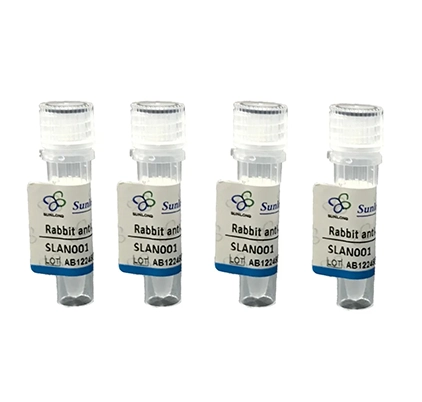
Rabbit Anti-TIMP-4/FITC Conjugated antibody
Metalloproteinase inhibitor 4; TIMP 4; TIMP4; TIMP metallopeptidase inhibitor 4; TIMP-4; Timp4; TIMP4_HUMAN; Tissue inhibitor of metalloproteinase 4.
All categories
View History [Clear]
Details
Product Name Anti-TIMP-4/FITC Chinese Name FITC标记的金属蛋白酶组织抑制因子-4抗体 Alias Metalloproteinase inhibitor 4; TIMP 4; TIMP4; TIMP metallopeptidase inhibitor 4; TIMP-4; Timp4; TIMP4_HUMAN; Tissue inhibitor of metalloproteinase 4. Research Area Tumour Cardiovascular Neurobiology Synthesis and Degradation Immunogen Species Rabbit Clonality Polyclonal React Species Human,Rat(predicted:Mouse,Cow,Horse,Rabbit) Applications IF=1:100-500
not yet tested in other applications.
optimal dilutions/concentrations should be determined by the end user.Molecular weight 22kDa Form Lyophilized or Liquid Concentration 1mg/ml immunogen KLH conjugated synthetic peptide derived from human TIMP-4 Lsotype IgG Purification affinity purified by Protein A Storage Buffer 1M TBS(pH7.4) with 1% BSA, 3% Proclin300 and 50% Glycerol. Storage Store at -20 °C for one year. Avoid repeated freeze/thaw cycles. The lyophilized antibody is stable at room temperature for at least one month and for greater than a year when kept at -20°C. When reconstituted in sterile pH 7.4 1M PBS or diluent of antibody the antibody is stable for at least two weeks at 2-4 °C. Product Detail background:
The tissue inhibitors of metalloproteinases (TIMPs) are naturally occurring proteins that specifically inhibit matrix metalloproteinases and regulate extracellular matrix turnover and tissue remodeling by forming tightbinding inhibitory complexes with the MMPs. Thus, TIMPs maintain the balance between matrix destruction and formation. An imbalance between MMPs and the associated TIMPs may play a significant role in the invasive phenotype of malignant tumors. The TIMP proteins share several structural features including six loops held in place by six disulfide bonds arranged in three knot-like structures. These proteins also contain twelve cysteine residues in conserved regions of the molecule that form six disulfide bonds, essential for the formation of native conformations, and the N terminal region that is necessary for inhibitory activities. The N terminus of each TIMP contains a consensus sequence (VIRAK) and each TIMP is translated with a 29 amino acid leader sequence that is cleaved off to produce the mature protein. The C terminal regions are divergent, which enhances the selectivity of inhibition and binding efficiency. Although the TIMP proteins share high homology, they may either be secreted extracellularly in soluble form (TIMP1, TIMP2 and TIMP4) or bind to extracellular matrix components (TIMP3).
The MMPs and TIMPs can be divided into two groups with respect to gene expression: the majority exhibit inducible expression and a small number are produced constitutively or are expressed at very low levels and are not inducible. Among agents that induce MMP and TIMP production are the inflammatory cytokines TNF alpha and IL1 beta. A marked cell type specificity is a hallmark of both MMP and TIMP gene expression (i.e. a limited number of cell types can be induced to make these proteins). Tissue Inhibitor of Metalloproteinases 4 (TIMP4) was identified by molecular cloning. TIMP4 shows 37 % amino acid identity with TIMP1 and 51 % homology with TIMP2 and TIMP3. TIMP4 is secreted extracellularly, predominantly in heart and brain tissue. It may function in a tissue specific fashion in extracellular matrix (ECM) homeostasis. TIMP4 has a strong inhibitory effect on the invasion of human breast cancer cells across reconstituted basement membranes suggesting that TIMP4 may have an important role in inhibiting primary tumor growth and progression. The human TIMP4 gene has the chromosomal location of 3p25.
Function:
Complexes with metalloproteinases (such as collagenases) and irreversibly inactivates them by binding to their catalytic zinc cofactor. Known to act on MMP-1, MMP-2, MMP-3, MMP-7 and MMP-9.
Subcellular Location:
Secreted.
Tissue Specificity:
Abundant in heart and present at low levels in many other tissues.
Similarity:
Belongs to the protease inhibitor I35 (TIMP) family.
Contains 1 NTR domain.
Database links:Entrez Gene: 7079 Human
Entrez Gene: 110595 Mouse
Omim: 601915 Human
SwissProt: Q99727 Human
SwissProt: Q9JHB3 Mouse
Unigene: 591665 Human
Unigene: 255607 Mouse
Unigene: 155651 Rat
Important Note:
This product as supplied is intended for research use only, not for use in human, therapeutic or diagnostic applications.
Synthesis and Degradation(Synthesis and Degradation)
TIMP-4It is a new member of the TIMP family. TIMP-3, like TIMP-4, has strong pro-apoptotic, anti-angiogenic, and anti-tumour invasion effects.
Ordering & shipping
- Minimum order: 1 unit
- Lead time: varies with order quantity and specifications. Please consult your local distributor or our sales team for confirmation
- Payment: T/T 100% in advance; PayPal; Alibaba Trade Assurance
- Shipping: FedEx / DHL / UPS express; cold-chain packing available on request
- Price: USD, per unit (100ul)
Partial purchase records(bought amounts latest4)
| Username | Quantity | bought time |
| Ed*** | 2 | 2024-09-03 |
| Be*** | 1 | 2024-07-28 |
| Ca*** | 2 | 2024-05-12 |
| Ra*** | 2 | 2023-06-25 |
User Comment(Total0User Comment Num)
- No comment


 +86 571 56623320

 SUNLONG BIOTECH


