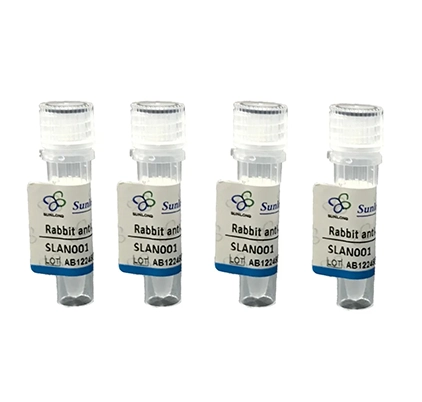
Rabbit Anti-Fibulin 5/FITC Conjugated antibody
ARMD3; Dance; Developmental arteries and neural crest EGF like protein; FBLN5; FIBL 5; Developmental arteries and neural crest EGF-like protein; EVEC; Fbln5; FBLN5_HUMAN; UP50; FIBL 5; FIBL-5; Fibulin-5; FLJ90059; Urine p50 protein.
All categories
View History [Clear]
Details
Product Name Anti-Fibulin 5/FITC Chinese Name FITC标记的衰老关键蛋白抗体 Alias ARMD3; Dance; Developmental arteries and neural crest EGF like protein; FBLN5; FIBL 5; Developmental arteries and neural crest EGF-like protein; EVEC; Fbln5; FBLN5_HUMAN; UP50; FIBL 5; FIBL-5; Fibulin-5; FLJ90059; Urine p50 protein. Research Area Cardiovascular immunology Signal transduction Endocrinopathy Cytoskeleton Extracellular matrix Immunogen Species Rabbit Clonality Polyclonal React Species Human(predicted:Mouse,Rat,Dog,Pig,Cow,Horse,Rabbit,Sheep) Applications
not yet tested in other applications.
optimal dilutions/concentrations should be determined by the end user.Molecular weight 48kDa Form Lyophilized or Liquid Concentration 1mg/ml immunogen KLH conjugated synthetic peptide derived from human Fibulin 5 Lsotype IgG Purification affinity purified by Protein A Storage Buffer 1M TBS(pH7.4) with 1% BSA, 3% Proclin300 and 50% Glycerol. Storage Store at -20 °C for one year. Avoid repeated freeze/thaw cycles. The lyophilized antibody is stable at room temperature for at least one month and for greater than a year when kept at -20°C. When reconstituted in sterile pH 7.4 1M PBS or diluent of antibody the antibody is stable for at least two weeks at 2-4 °C. Product Detail background:
Fibulin 5: A protein that belongs to a family of extracellular proteins expressed in the basement membranes of blood vessels. Fibulin 5 may be essential for the polymerization of elastin. Missense mutations in FBLN5, the gene that encodes fibulin 5, appear responsible for 1-2% of cases of age-related macular degeneration (AMD). FBLN5 is located on chromosome 14 in band 14q32.1. See also: Fibulin 3. May play a role in vascular growth and maturation during development and in lesions of injured vessels.
Function:
Promotes adhesion of endothelial cells through interaction of integrins and the RGD motif. Could be a vascular ligand for integrin receptors and may play a role in vascular development and remodeling.
Subunit:
Homodimer.
Subcellular Location:
Secreted.
Tissue Specificity:
Expressed predominantly in heart, ovary, and colon but also in kidney, pancreas, testis, lung and placenta. Not detectable in brain, liver, thymus, prostate, or peripheral blood leukocytes.
DISEASE:
Cutis laxa, autosomal dominant, 2 (ADCL2) [MIM:614434]: A connective tissue disorder characterized by loose, hyperextensible skin with decreased resilience and elasticity leading to a premature aged appearance. Face, hands, feet, joints, and torso may be differentially affected. Additional variable clinical features are gastrointestinal diverticula, hernia, and genital prolapse. Rare manifestations are pulmonary artery stenosis, aortic aneurysm, bronchiectasis, and emphysema. Note=The disease is caused by mutations affecting the gene represented in this entry.
Cutis laxa, autosomal recessive, 1A (ARCL1A) [MIM:219100]: A connective tissue disorder characterized by loose, hyperextensible skin with decreased resilience and elasticity leading to a premature aged appearance. Face, hands, feet, joints, and torso may be differentially affected. The clinical spectrum of autosomal recessive cutis laxa is highly heterogeneous with respect to organ involvement and severity. Type I autosomal recessive cutis laxa is a specific, life-threatening disorder with organ involvement, lung atelectasis and emphysema, diverticula of the gastrointestinal and genitourinary systems, and vascular anomalies. Associated cranial anomalies, late closure of the fontanel, joint laxity, hip dislocation, and inguinal hernia have been observed but are uncommon. Note=The disease is caused by mutations affecting the gene represented in this entry.
Age-related macular degeneration 3 (ARMD3) [MIM:608895]: A form of age-related macular degeneration, a multifactorial eye disease and the most common cause of irreversible vision loss in the developed world. In most patients, the disease is manifest as ophthalmoscopically visible yellowish accumulations of protein and lipid that lie beneath the retinal pigment epithelium and within an elastin-containing structure known as Bruch membrane. Note=Disease susceptibility is associated with variations affecting the gene represented in this entry.
Similarity:
Belongs to the fibulin family.
Contains 6 EGF-like domains.
Database links:Entrez Gene: 10516 Human
Entrez Gene: 23876 Mouse
Omim: 604580 Human
SwissProt: Q9UBX5 Human
SwissProt: Q9WVH9 Mouse
Unigene: 332708 Human
Unigene: 288381 Mouse
Important Note:
This product as supplied is intended for research use only, not for use in human, therapeutic or diagnostic applications.
Fibulin-5 Fibulin-5Also known as FBLN-5, DANCE or EVEC, it is a member of the Extracellular matrix protein family, plays an important role in tissue and organ development, remodeling and repair, and interacts with endothelial cells. Fibulin-5 is widely distributed in elastin-rich tissues, can directly bind to tropoelastin,and anchor the latter to the cell surface,,which is crucial for the formation of elastic fibers, and plays an important role in vascular development and repair. In addition,Fibuljn-5It can also promote wound healing, 与cells的增殖、运动和侵袭有关
fibulin-5有学者称“Key protein in skin aging" and a protein related to skin elasticity,对于起着固定cells外壁、保持肌肤紧绷、维护kidney部和血管柔韧性作用的弹性纤维的发育十分关键.
还Some scholars believe that:fibulin-5能够抑制血管的形成,该protein质在Tumour转移过程中表达降低或消失,将有可能用于Tumour治疗方面的研究。Ordering & shipping
- Minimum order: 1 unit
- Lead time: varies with order quantity and specifications. Please consult your local distributor or our sales team for confirmation
- Payment: T/T 100% in advance; PayPal; Alibaba Trade Assurance
- Shipping: FedEx / DHL / UPS express; cold-chain packing available on request
- Price: USD, per unit (100ul)
Partial purchase records(bought amounts latest6)
| Username | Quantity | bought time |
| Ia*** | 1 | 2024-04-15 |
| Um*** | 2 | 2023-12-23 |
| Ra*** | 2 | 2023-09-08 |
| Ab*** | 1 | 2023-08-25 |
| Um*** | 1 | 2023-08-23 |
User Comment(Total0User Comment Num)
- No comment


 +86 571 56623320

 SUNLONG BIOTECH


