Details
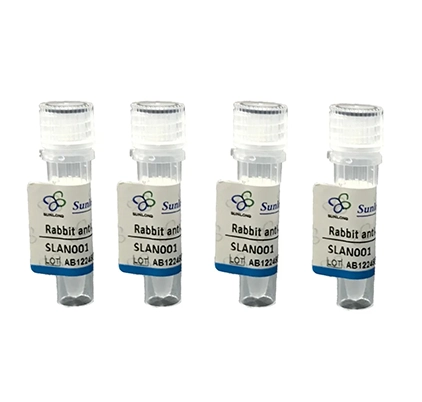
Product Name Anti-bFGF/FITC Chinese Name FITC标记的碱性成纤维细胞生长因子/FGF2抗体 Alias Basic fibroblast growth factor; FGF basic; FGF-basic; BFGF; FGF-2; FGF B; FGF2; FGF2 basic; FGFB; Fibroblast growth factor 2 (basic); HBGF 2; HBGF-2; HBGF2; HBGH 2; HBGH2; Heparin binding growth factor 2 precursor; Prostatropin; FGF2_HUMAN. Research Area Tumour Cardiovascular Cell biology immunology Growth factors and hormones cell factor Immunogen Species Rabbit Clonality Polyclonal React Species Human(predicted:Mouse,Rat,Chicken,Cow,Rabbit,Sheep) Applications Flow-Cyt=1:50-200 IF=1:50-200
not yet tested in other applications.
optimal dilutions/concentrations should be determined by the end user.Molecular weight 18kDa Form Lyophilized or Liquid Concentration 1mg/ml immunogen KLH conjugated synthetic peptide derived from human bFGF Lsotype IgG Purification affinity purified by Protein A Storage Buffer 1M TBS(pH7.4) with 1% BSA, 3% Proclin300 and 50% Glycerol. Storage Store at -20 °C for one year. Avoid repeated freeze/thaw cycles. The lyophilized antibody is stable at room temperature for at least one month and for greater than a year when kept at -20°C. When reconstituted in sterile pH 7.4 1M PBS or diluent of antibody the antibody is stable for at least two weeks at 2-4 °C. Product Detail background:
The protein encoded by this gene is a member of the fibroblast growth factor (FGF) family. FGF family members bind heparin and possess broad mitogenic and angiogenic activities. This protein has been implicated in diverse biological processes, such as limb and nervous system development, wound healing, and tumor growth. The mRNA for this gene contains multiple polyadenylation sites, and is alternatively translated from non-AUG (CUG) and AUG initiation codons, resulting in five different isoforms with distinct properties. The CUG-initiated isoforms are localized in the nucleus and are responsible for the intracrine effect, whereas, the AUG-initiated form is mostly cytosolic and is responsible for the paracrine and autocrine effects of this FGF. [provided by RefSeq, Jul 2008].
Function:
Plays an important role in the regulation of cell survival, cell division, angiogenesis, cell differentiation and cell migration. Functions as potent mitogen in vitro.
Subunit:
Monomer. Homodimer. Interacts with FGFR1, FGFR2, FGFR3 and FGFR4. Affinity between fibroblast growth factors (FGFs) and their receptors is increased by heparan sulfate glycosaminoglycans that function as coreceptors. Interacts with CSPG4, FGFBP1 and TEC. Found in a complex with FGFBP1, FGF1 and FGF2.
Subcellular Location:
Secreted. Nucleus. Note=Exported from cells by an endoplasmic reticulum (ER)/Golgi-independent mechanism. Unconventional secretion of FGF2 occurs by direct translocation across the plasma membrane. Binding of exogenous FGF2 to FGFR facilitates endocytosis followed by translocation of FGF2 across endosomal membrane into the cytosol. Nuclear import from the cytosol requires the classical nuclear import machinery, involving proteins KPNA1 and KPNB1, as well as CEP57.
Tissue Specificity:
Expressed in granulosa and cumulus cells. Expressed in hepatocellular carcinoma cells, but not in non-cancerous liver tissue.
Post-translational modifications:
Phosphorylation at Tyr-215 regulates FGF2 unconventional secretion.
Several N-termini starting at positions 94, 125, 126, 132, 143 and 162 have been identified by direct sequencing.
Similarity:
Belongs to the heparin-binding growth factors family.
Database links:Entrez Gene: 2247 Human
Entrez Gene: 14173 Mouse
Omim: 134920 Human
SwissProt: P09038 Human
SwissProt: P15655 Mouse
Unigene: 284244 Human
Unigene: 473689 Mouse
Unigene: 31808 Rat
Important Note:
This product as supplied is intended for research use only, not for use in human, therapeutic or diagnostic applications.
Growth factors and hormones( Growth Factor and Hormones)(b-FGF)Mainly distributed in the pituitary, brain and neural tissue, retina, adrenal gland, placenta, etc.,With the highest content in the pituitary.。
FGF2(basic fibroblast growth factor)Basic fibroblast growth factor is a polypeptide molecule synthesized by endothelial cells and smooth muscle cells and has a mitogenic effect on the synthesizing cells.,Has a strong angiogenic effect.,Participates in angiogenesis, tissue repair, nervous system development, etc. 。FGF2In vitro,Can stimulate cell proliferation,Cell migration,Induces plasminogen activator and collagenase activity。Is a heparin-binding mitogen。
FGFThe family participates in a series of important physiological functions: embryonic development, cell growth, tissue repair, organ formation, Tumour infiltration and growth, etc.Ordering & shipping
- Minimum order: 1 unit
- Lead time: varies with order quantity and specifications. Please consult your local distributor or our sales team for confirmation
- Payment: T/T 100% in advance; PayPal; Alibaba Trade Assurance
- Shipping: FedEx / DHL / UPS express; cold-chain packing available on request
- Price: USD, per unit (100ul)
Partial purchase records(bought amounts latest4)
| Username | Quantity | bought time |
| Is*** | 1 | 2024-03-01 |
| Ev*** | 1 | 2024-02-20 |
| Wi*** | 2 | 2024-01-26 |
| Qu*** | 2 | 2023-08-11 |
User Comment(Total0User Comment Num)
- No comment


 +86 571 56623320

 SUNLONG BIOTECH


