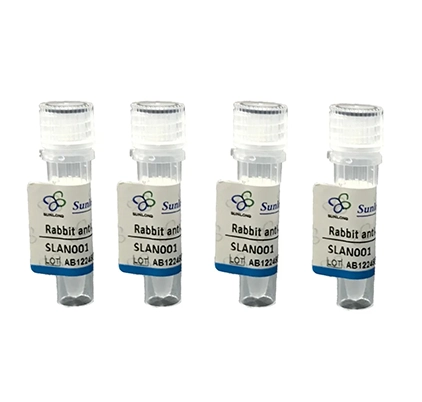
Rabbit Anti-Multicilin/FITC Conjugated antibody
IDAS; Mci; MCI_HUMAN; Multicilin; Protein Idas.
All categories
View History [Clear]
Details
Product Name Anti-Multicilin/FITC Chinese Name FITC标记的多纤毛素蛋白抗体 Alias IDAS; Mci; MCI_HUMAN; Multicilin; Protein Idas. Research Area Cell biology Signal transduction Stem cells Cyclin transcriptional regulatory factor Cell differentiation Epigenetics Immunogen Species Rabbit Clonality Polyclonal React Species Rat(predicted:Human,Mouse,Dog,Horse) Applications IF=1:100-500
not yet tested in other applications.
optimal dilutions/concentrations should be determined by the end user.Molecular weight 42kDa Form Lyophilized or Liquid Concentration 1mg/ml immunogen KLH conjugated synthetic peptide derived from human Multicilin Lsotype IgG Purification affinity purified by Protein A Storage Buffer 1M TBS(pH7.4) with 1% BSA, 3% Proclin300 and 50% Glycerol. Storage Store at -20 °C for one year. Avoid repeated freeze/thaw cycles. The lyophilized antibody is stable at room temperature for at least one month and for greater than a year when kept at -20°C. When reconstituted in sterile pH 7.4 1M PBS or diluent of antibody the antibody is stable for at least two weeks at 2-4 °C. Product Detail background:
Transcription regulator required for multiciliate cell differentiation. Acts by promoting transcription of genes required for multiciliate cell formation. Probably acts in a multiprotein complex (By similarity). Plays a role in mitotic cell cycle progression by promoting cell cycle exit.
Function:
Multiciliate cells function prominently in the respiratory system, brain ependyma and female reproductive tract to produce vigorous fluid flow along epithelial surfaces. These specialized cells form during development when epithelial progenitors undergo an unusual form of ciliogenesis, in which they assemble and project hundreds of motile cilia. Notch inhibits multiciliate cell formation in diverse epithelia, but how progenitors overcome lateral inhibition and initiate multiciliate cell differentiation is unknown. Here we identify a coiled-coil protein, termed multicilin, which is regulated by Notch and highly expressed in developing epithelia where multiciliate cells form. Inhibiting multicilin function specifically blocks multiciliate cell formation in Xenopus skin and kidney, whereas ectopic expression induces the differentiation of multiciliate cells in ectopic locations. Multicilin localizes to the nucleus, where it directly activates the expression of genes required for multiciliate cell formation, including foxj1 and genes mediating centriole assembly. Multicilin is also necessary and sufficient to promote multiciliate cell differentiation in mouse airway epithelial cultures. These findings indicate that multicilin initiates multiciliate cell differentiation in diverse tissues, by coordinately promoting the transcriptional changes required for motile ciliogenesis and centriole assembly.
Subunit:
Homodimer. Interacts with GMNN; targets GMNN to the nucleus, prevents GMNN interaction with CDT1 and competes with IDAS homodimerization.
Subcellular Location:
Nucleus. Excluded from the nucleolus.
DISEASE:
Probable target of the anaphase promoting complex/cyclosome (APC/C) which regulates its level in the cell during the mitotic cell cycle. Highly expressed during interphase and early mitosis. Expression decreases during anaphase to become undetectable during telophase and cytokinesis.
Similarity:
Belongs to the geminin family.
Database links:Entrez Gene: 345643 Human
Omim: 614086 Human
SwissProt: D6RGH6 Human
Unigene: 394578 Human
Important Note:
This product as supplied is intended for research use only, not for use in human, therapeutic or diagnostic applications.
Multicilin can promote cells to grow numerous cilia. When cells are exposed to multicilin, the genetic mechanism for growing numerous cilia is activated. In developing embryos, this protein directs the development of certain stem cells located on the surface of the lungs, kidneys, and skin into multiciliated cells. Patients with respiratory diseases such as chronic asthma, emphysema, and cystic fibrosis often suffer from lung infections, which may be caused by damage to multiciliated cells that remove protective mucus from the trachea. In the future, stem cell therapy may replace these damaged cells with new ciliated cells, but scientists first need to know how to direct stem cells along the developmental pathway to grow into multiciliated cells.Ordering & shipping
- Minimum order: 1 unit
- Lead time: varies with order quantity and specifications. Please consult your local distributor or our sales team for confirmation
- Payment: T/T 100% in advance; PayPal; Alibaba Trade Assurance
- Shipping: FedEx / DHL / UPS express; cold-chain packing available on request
- Price: USD, per unit (100ul)
Partial purchase records(bought amounts latest4)
| Username | Quantity | bought time |
| Gr*** | 1 | 2024-09-19 |
| Ja*** | 2 | 2024-07-31 |
| Ca*** | 1 | 2024-03-28 |
| Pe*** | 1 | 2023-09-23 |
User Comment(Total0User Comment Num)
- No comment


 +86 571 56623320

 SUNLONG BIOTECH


