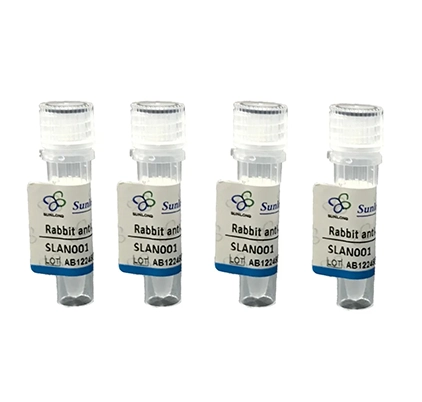
Rabbit Anti-RSPH4A/HRP Conjugated antibody
CILD11; dJ412I7.1; Radial spoke head protein 4 homolog A; Radial spoke head-like protein 3; RSH4A_HUMAN; RSHL3; Rsph4a; RSPH6B; A230081C05.
All categories
View History [Clear]
Details
Product Name Anti-RSPH4A/HRP Chinese Name 辣根过氧化物酶标记的Kartagener综合征相关蛋白RSHL3抗体 Alias CILD11; dJ412I7.1; Radial spoke head protein 4 homolog A; Radial spoke head-like protein 3; RSH4A_HUMAN; RSHL3; Rsph4a; RSPH6B; A230081C05. Research Area Cell biology Developmental biology Neurobiology Signal transduction Cytoskeleton Extracellular matrix Immunogen Species Rabbit Clonality Polyclonal React Species Human,Mouse(predicted:Rat,Chicken,Dog,Pig,Cow,Horse,Sheep) Applications WB=1:500-2000
not yet tested in other applications.
optimal dilutions/concentrations should be determined by the end user.Molecular weight 81kDa Form Lyophilized or Liquid Concentration 1mg/ml immunogen KLH conjugated synthetic peptide derived from human RSPH4A/RSHL3 (435-482aa) Lsotype IgG Purification affinity purified by Protein A Storage Buffer 1M TBS(pH7.4) with 1% BSA, 3% Proclin300 and 50% Glycerol. Storage Store at -20 °C for one year. Avoid repeated freeze/thaw cycles. The lyophilized antibody is stable at room temperature for at least one month and for greater than a year when kept at -20°C. When reconstituted in sterile pH 7.4 1M PBS or diluent of antibody the antibody is stable for at least two weeks at 2-4 °C. Product Detail background:
RSHL3 is predicted to be a component of the radial spoke head based on homology with proteins in the biflagellate alga Chlamydomonas reinhardtii and other ciliates. RSHL3 (radial spoke head-like protein 3), also known as radial spoke head protein 4 homolog A, is a 716 amino acid protein that belongs to the flagellar radial spoke RSP4/6 family. Mutations in the RSHL3 gene cause primary ciliary dyskinesia 1, a disease arising from dysmotility of motile cilia and sperm. Existing as three alternatively spliced isoforms, the RSHL3 gene contains 6 exons, is conserved in chimpanzee, dog, cow, mouse, rat, chicken, zebrafish, fruit fly and P.falciparum, and maps to human chromosome 6q22.1.
Function:
Probable component of the axonemal radial spoke head. Radial spokes are regularly spaced along cilia, sperm and flagella axonemes. They consist of a thin stalk which is attached to a subfiber of the outer doublet microtubule, and a bulbous head which is attached to the stalk and appears to interact with the projections from the central pair of microtubules.
Subcellular Location:
Cytoplasm; cytoskeleton; cilium axoneme. Radial spoke.
Tissue Specificity:
Defects in RSPH4A are the cause of primary ciliary dyskinesia type 11 (CILD11) [MIM:612649]. CILD is an autosomal recessive disorder characterized by axonemal abnormalities of motile cilia. Respiratory infections leading to chronic inflammation and bronchiectasis are recurrent, due to defects in the respiratory cilia; reduced fertility is often observed in male patients due to abnormalities of sperm tails. Half of the patients exhibit situs inversus, due to dysfunction of monocilia at the embryonic node and randomization of left-right body asymmetry. Primary ciliary dyskinesia associated with situs inversus is referred to as Kartagener syndrome.
DISEASE:
Defects in RSPH4A are the cause of primary ciliary dyskinesia type 11 (CILD11) [MIM:612649]. CILD is an autosomal recessive disorder characterized by axonemal abnormalities of motile cilia. Respiratory infections leading to chronic inflammation and bronchiectasis are recurrent, due to defects in the respiratory cilia; reduced fertility is often observed in male patients due to abnormalities of sperm tails. Half of the patients exhibit situs inversus, due to dysfunction of monocilia at the embryonic node and randomization of left-right body asymmetry. Primary ciliary dyskinesia associated with situs inversus is referred to as Kartagener syndrome.
Similarity:
Belongs to the flagellar radial spoke RSP4/6 family.
Database links:Entrez Gene: 345895 Human
Omim: 612647 Human
SwissProt: Q5TD94 Human
Unigene: 160380 Human
Important Note:
This product as supplied is intended for research use only, not for use in human, therapeutic or diagnostic applications.
KartagenerSyndrome: composed of the following triad,bronchiectasis, sinusitis or nasal polyps, and situs inversus (mainly dextrocardia)。If only situs inversus and bronchiectasis are present,then it is incomplete Kartagener syndrome. It is often combined with other congenital malformations. Its etiology is due to congenital deficiency of the axonemal arms of cilia throughout the body, causing loss of ciliary motility, mucociliary transport dysfunction, and persistent infection due to retention of secretions and bacteria. It occurs mostly in school-age children and adolescents, and there is a family history. The main symptoms are cough, sputum production, and hemoptysis that worsen with age, more obvious in the morning, and susceptibility to colds and pneumonia. Common signs are cyanosis and clubbing of the fingers.Ordering & shipping
- Minimum order: 1 unit
- Lead time: varies with order quantity and specifications. Please consult your local distributor or our sales team for confirmation
- Payment: T/T 100% in advance; PayPal; Alibaba Trade Assurance
- Shipping: FedEx / DHL / UPS express; cold-chain packing available on request
- Price: USD, per unit (100ul)
Partial purchase records(bought amounts latest6)
| Username | Quantity | bought time |
| Sa*** | 1 | 2024-07-10 |
| Ga*** | 1 | 2024-05-08 |
| Sa*** | 1 | 2024-04-23 |
| Ya*** | 1 | 2024-01-24 |
| Wi*** | 1 | 2023-11-24 |
User Comment(Total0User Comment Num)
- No comment


 +86 571 56623320

 SUNLONG BIOTECH


