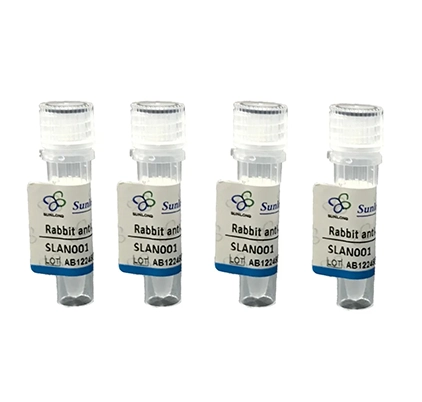
Rabbit Anti-Phospho-CHEK1 (Ser296)/HRP Conjugated antibody
Chk1 (Phospho-Ser296); Chk1 (phospho S296);Phospho-Chk1 (Ser296); p-Chk1 (phospho S296); Phospho-Chk1(S296); Cell cycle checkpoint kinase; Checkpoint, S. pombe, homolog of, 1; Checkpoint kinase 1; Checkpoint kinase 1 homolog (S. pombe); CHEK 1; CHEK-1; CH
All categories
View History [Clear]
Details
Product Name Anti-Phospho-CHEK1 (Ser296)/HRP Chinese Name 辣根过氧化物酶标记的磷酸化细胞周期检测点激酶1抗体 Alias Chk1 (Phospho-Ser296); Chk1 (phospho S296);Phospho-Chk1 (Ser296); p-Chk1 (phospho S296); Phospho-Chk1(S296); Cell cycle checkpoint kinase; Checkpoint, S. pombe, homolog of, 1; Checkpoint kinase 1; Checkpoint kinase 1 homolog (S. pombe); CHEK 1; CHEK-1; CHEK1; Chk 1; Chk1; CHK1 checkpoint homolog (S. pombe); EC 2.7.11.1; rad27; Serine/threonine protein kinase Chk1; Serine/threonine-protein kinase CHK1; STT3, subunit of the oligosaccharyltransferase complex, homolog A (S. cerevisiae); C85740; CHK1_HUMAN. Product Type Phosphorylated anti Research Area Tumour Kinases and Phosphatases Epigenetics Immunogen Species Rabbit Clonality Polyclonal React Species Human(predicted:Dog,Pig,Cow,Horse,Rabbit,Sheep) Applications IHC-P=1:100-500,IHC-F=1:100-500
not yet tested in other applications.
optimal dilutions/concentrations should be determined by the end user.Molecular weight 54kDa Form Lyophilized or Liquid Concentration 1mg/ml immunogen KLH conjugated Synthesised phosphopeptide derived from human CHEK1 isoform b around the phosphorylation site of Ser296 Lsotype IgG Purification affinity purified by Protein A Storage Buffer 1M TBS(pH7.4) with 1% BSA, 3% Proclin300 and 50% Glycerol. Storage Store at -20 °C for one year. Avoid repeated freeze/thaw cycles. The lyophilized antibody is stable at room temperature for at least one month and for greater than a year when kept at -20°C. When reconstituted in sterile pH 7.4 1M PBS or diluent of antibody the antibody is stable for at least two weeks at 2-4 °C. Product Detail background:
The protein encoded by this gene belongs to the Ser/Thr protein kinase family. It is required for checkpoint mediated cell cycle arrest in response to DNA damage or the presence of unreplicated DNA. This protein acts to integrate signals from ATM and ATR, two cell cycle proteins involved in DNA damage responses, that also associate with chromatin in meiotic prophase I. Phosphorylation of CDC25A protein phosphatase by this protein is required for cells to delay cell cycle progression in response to double-strand DNA breaks. Several alternatively spliced transcript variants have been found for this gene. [provided by RefSeq, Oct 2011].
Function:
Serine/threonine-protein kinase which is required for checkpoint-mediated cell cycle arrest and activation of DNA repair in response to the presence of DNA damage or unreplicated DNA. May also negatively regulate cell cycle progression during unperturbed cell cycles. This regulation is achieved by a number of mechanisms that together help to preserve the integrity of the genome. Recognizes the substrate consensus sequence [R-X-X-S/T]. Binds to and phosphorylates CDC25A, CDC25B and CDC25C. Phosphorylation of CDC25A at 'Ser-178' and 'Thr-507' and phosphorylation of CDC25C at 'Ser-216' creates binding sites for 14-3-3 proteins which inhibit CDC25A and CDC25C. Phosphorylation of CDC25A at 'Ser-76', 'Ser-124', 'Ser-178', 'Ser-279' and 'Ser-293' promotes proteolysis of CDC25A. Phosphorylation of CDC25A at 'Ser-76' primes the protein for subsequent phosphorylation at 'Ser-79', 'Ser-82' and 'Ser-88' by NEK11, which is required for polyubiquitination and degradation of CDCD25A. Inhibition of CDC25 leads to increased inhibitory tyrosine phosphorylation of CDK-cyclin complexes and blocks cell cycle progression. Also phosphorylates NEK6. Binds to and phosphorylates RAD51 at 'Thr-309', which promotes the release of RAD51 from BRCA2 and enhances the association of RAD51 with chromatin, thereby promoting DNA repair by homologous recombination. Phosphorylates multiple sites within the C-terminus of TP53, which promotes activation of TP53 by acetylation and promotes cell cycle arrest and suppression of cellular proliferation. Also promotes repair of DNA cross-links through phosphorylation of FANCE. Binds to and phosphorylates TLK1 at 'Ser-743', which prevents the TLK1-dependent phosphorylation of the chromatin assembly factor ASF1A. This may enhance chromatin assembly both in the presence or absence of DNA damage. May also play a role in replication fork maintenance through regulation of PCNA. May regulate the transcription of genes that regulate cell-cycle progression through the phosphorylation of histones. Phosphorylates histone H3.1 (to form H3T11ph), which leads to epigenetic inhibition of a subset of genes. May also phosphorylate RB1 to promote its interaction with the E2F family of transcription factors and subsequent cell cycle arrest.
Isoform 2: Endogenous repressor of isoform 1, interacts with, and antagonizes CHK1 to promote the S to G2/M phase transition.
Subunit:
Interacts (phosphorylated by ATR) with RAD51. Interacts with and phosphorylates CLSPN, an adapter protein that regulates the ATR-dependent phosphorylation of CHEK1. Interacts with BRCA1. Interacts with and phosphorylates CDC25A, CDC25B and CDC25C. Interacts with FBXO6, which regulates CHEK1. Interacts with PPM1D, which regulates CHEK1 through dephosphorylation. Interacts with TIMELESS; DNA damage-dependent. Interacts with FEM1B; activates CHEK1 in response to stress. Interacts with TLK1. Interacts with XPO1 and YWHAZ. Isoform 1 associates with isoform 2, the interaction is disrupted upon phosphorylation by ATR.
Subcellular Location:
Nucleus. Cytoplasm. Cytoplasm, cytoskeleton, centrosome. Note=Nuclear export is mediated at least in part by XPO1/CRM1. Also localizes to the centrosome specifically during interphase, where it may protect centrosomal CDC2 kinase from inappropriate activation by cytoplasmic CDC25B.
Tissue Specificity:
Expressed ubiquitously with the most abundant expression in thymus, testis, small intestine and colon.
Post-translational modifications:
Phosphorylated by ATR in a RAD17-dependent manner in response to ultraviolet irradiation and inhibition of DNA replication. Phosphorylated by ATM in response to ionizing irradiation. ATM and ATR can both phosphorylate Ser-317 and Ser-345 and this results in enhanced kinase activity. Phosphorylation at Ser-345 induces a change in the conformation of the protein, activates the kinase activity and is a prerequisite for interaction with FBXO6 and subsequent ubiquitination at Lys-436. Phosphorylation at Ser-345 also increases binding to 14-3-3 proteins and promotes nuclear retention. Conversely, dephosphorylation at Ser-345 by PPM1D may contribute to exit from checkpoint mediated cell cycle arrest. Phosphorylation at Ser-280 by AKT1/PKB, may promote mono and/or diubiquitination. Also phosphorylated at undefined residues during mitotic arrest, resulting in decreased activity.
Ubiquitinated. Mono or diubiquitination promotes nuclear exclusion (By similarity). The activated form (phosphorylated on Ser-345) is polyubiquitinated at Lys-436 by some SCF-type E3 ubiquitin ligase complex containing FBXO6 promoting its degradation. Ubiquitination and degradation are required to terminate the checkpoint and ensure that activated CHEK1 does not accumulate as cells progress through S phase, when replication forks encounter transient impediments during normal DNA replication.
Similarity:
Belongs to the protein kinase superfamily. CAMK Ser/Thr protein kinase family. NIM1 subfamily.
Contains 1 protein kinase domain.
Database links:Entrez Gene: 1111 Human
Entrez Gene: 12649 Mouse
Omim: 603078 Human
SwissProt: O14757 Human
SwissProt: O35280 Mouse
Unigene: 24529 Human
Unigene: 16753 Mouse
Unigene: 33267 Rat
Important Note:
This product as supplied is intended for research use only, not for use in human, therapeutic or diagnostic applications.
Chk1, as a regulator of Cdks, participates in the cell cycle regulation process. It is a highly conserved protein kinase in biological evolution and plays a very important role in the regulation of cell cycle checkpoints induced by DNA damage. In the cell cycle checkpoint signal transduction pathway, Chk1 and Chk2 play important roles, mainly participating in G2/M phase cell cycle checkpoint signal transduction.Ordering & shipping
- Minimum order: 1 unit
- Lead time: varies with order quantity and specifications. Please consult your local distributor or our sales team for confirmation
- Payment: T/T 100% in advance; PayPal; Alibaba Trade Assurance
- Shipping: FedEx / DHL / UPS express; cold-chain packing available on request
- Price: USD, per unit (100ul)
Partial purchase records(bought amounts latest5)
| Username | Quantity | bought time |
| Ol*** | 2 | 2024-05-05 |
| Mo*** | 2 | 2024-03-04 |
| Za*** | 1 | 2023-08-09 |
| So*** | 1 | 2023-06-12 |
| Gr*** | 1 | 2023-05-23 |
User Comment(Total0User Comment Num)
- No comment


 +86 571 56623320

 SUNLONG BIOTECH


