Rabbit Anti-CRYBB3 antibody
Beta B3 crystallin; Beta crystallin B3; Beta-B3 crystallin; Beta-crystallin B3; CRBB3_HUMAN; CRYB3; Crybb3.βB3-crystallin; β B3-crystallin.
All categories
View History [Clear]
Details
Product Name CRYBB3 Chinese Name β晶状体蛋白B3抗体 Alias Beta B3 crystallin; Beta crystallin B3; Beta-B3 crystallin; Beta-crystallin B3; CRBB3_HUMAN; CRYB3; Crybb3. βB3-crystallin; β B3-crystallin. Research Area Cell biology Neurobiology Immunogen Species Rabbit Clonality Polyclonal React Species Rat(predicted:Human,Mouse,Dog,Pig,Cow,Horse,Rabbit,Sheep) Applications IHC-P=1:100-500,IHC-F=1:100-500,IF=1:100-500 (Paraffin sections need antigen repair)
not yet tested in other applications.
optimal dilutions/concentrations should be determined by the end user.Theoretical molecular weight 24kDa Cellular localization The nucleus Form Liquid Concentration 1mg/ml immunogen KLH conjugated synthetic peptide derived from human CRYBB3: 131-211/211 Lsotype IgG Purification affinity purified by Protein A Buffer Solution 1M TBS(pH7.4) with 1% BSA, 3% Proclin300 and 50% Glycerol. Storage Shipped at 4℃. Store at -20 °C for one year. Avoid repeated freeze/thaw cycles. Attention This product as supplied is intended for research use only, not for use in human, therapeutic or diagnostic applications. PubMed PubMed Product Detail Crystallins are separated into two classes: taxon-specific, or enzyme, and ubiquitous. The latter class constitutes the major proteins of vertebrate eye lens and maintains the transparency and refractive index of the lens. Since lens central fiber cells lose their nuclei during development, these crystallins are made and then retained throughout life, making them extremely stable proteins. Mammalian lens crystallins are divided into alpha, beta, and gamma families; beta and gamma crystallins are also considered as a superfamily. Alpha and beta families are further divided into acidic and basic groups. Seven protein regions exist in crystallins: four homologous motifs, a connecting peptide, and N- and C-terminal extensions. Beta-crystallins, the most heterogeneous, differ by the presence of the C-terminal extension (present in the basic group, none in the acidic group). Beta-crystallins form aggregates of different sizes and are able to self-associate to form dimers or to form heterodimers with other beta-crystallins. This gene, a beta basic group member, is part of a gene cluster with beta-A4, beta-B1, and beta-B2. Mutations in this gene result in cataract congenital nuclear autosomal recessive type 2. [provided by RefSeq, Feb 2013]
Function:
Crystallins are the dominant structural components of the vertebrate eye lens.
DISEASE:
Defects in CRYBB3 are the cause of cataract congenital nuclear autosomal recessive type 2 (CATCN2) [MIM:609741]. A congenital cataract affecting the central nucleus of the eye. Nuclear cataracts are often not highly visually significant. The density of the opacities varies greatly from fine dots to a dense, white and chalk-like, central cataract. The condition is usually bilateral. Nuclear cataracts are often combined with opacified cortical fibers encircling the nuclear opacity, which are referred to as cortical riders.
Similarity:
Belongs to the beta/gamma-crystallin family.
Contains 4 beta/gamma crystallin 'Greek key' domains.
SWISS:
P26998
Gene ID:
1417
Database links:Entrez Gene: 1417 Human
Omim: 123630 Human
SwissProt: P26998 Human
Unigene: 533022 Human
Product Picture 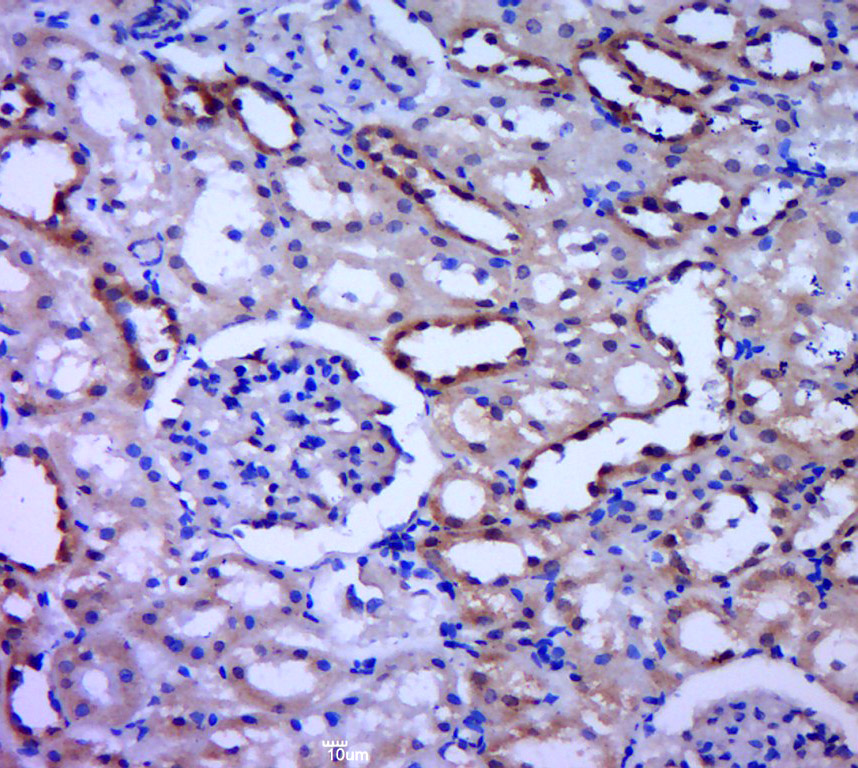 Paraformaldehyde-fixed, paraffin embedded (rat kidney tissue); Antigen retrieval by boiling in sodium citrate buffer (pH6.0) for 15min; Block endogenous peroxidase by 3% hydrogen peroxide for 20 minutes; Blocking buffer (normal goat serum) at 37°C for 30min; Antibody incubation with (CRYBB3) Polyclonal Antibody, Unconjugated (SL14074R) at 1:400 overnight at 4°C, followed by a conjugated secondary (sp-0023) for 20 minutes and DAB staining.
Ordering & shipping
- Minimum order: 1 unit
- Lead time: varies with order quantity and specifications. Please consult your local distributor or our sales team for confirmation
- Payment: T/T 100% in advance; PayPal; Alibaba Trade Assurance
- Shipping: FedEx / DHL / UPS express; cold-chain packing available on request
- Price: USD, per unit (50ul / 100ul)
Partial purchase records(bought amounts latest3)
| Username | Quantity | bought time |
| Gr*** | 1 | 2026-09-15 |
| Xa*** | 1 | 2026-07-23 |
| Ja*** | 1 | 2026-07-06 |
User Comment(Total0User Comment Num)
- No comment


 +86 571 56623320

 SUNLONG BIOTECH


