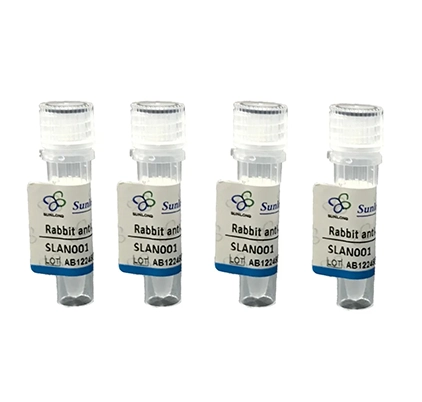
Rabbit Anti-CRYL1 antibody
CRY; CRYL 1; Crystallin lambda 1; GDH; Gul3DH; L gulonate 3 dehydrogenase; Lambda CRY; Lambda crystallin homolog; MGC149525; MGC149526.λ-crystallin; λ crystallin.
All categories
View History [Clear]
Details
Product Name CRYL1 Chinese Name 晶状体蛋白λ抗体 Alias CRY; CRYL 1; Crystallin lambda 1; GDH; Gul3DH; L gulonate 3 dehydrogenase; Lambda CRY; Lambda crystallin homolog; MGC149525; MGC149526. λ-crystallin; λ crystallin. Research Area Tumour Cell biology Neurobiology Signal transduction The new supersedes the old Immunogen Species Rabbit Clonality Polyclonal React Species (predicted: Human, Mouse, Rat, Dog, ) Applications IHC-P=1:100-500,IHC-F=1:100-500,ICC/IF=1:100-500,IF=1:100-500,ELISA=1:5000-10000 (Paraffin sections need antigen repair)
not yet tested in other applications.
optimal dilutions/concentrations should be determined by the end user.Theoretical molecular weight 35kDa Cellular localization cytoplasmic Form Liquid Concentration 1mg/ml immunogen KLH conjugated synthetic peptide derived from human CRYL1: 65-170/319 Lsotype IgG Purification affinity purified by Protein A Buffer Solution 1M TBS(pH7.4) with 1% BSA, 3% Proclin300 and 50% Glycerol. Storage Shipped at 4℃. Store at -20 °C for one year. Avoid repeated freeze/thaw cycles. Attention This product as supplied is intended for research use only, not for use in human, therapeutic or diagnostic applications. PubMed PubMed Product Detail The uronate cycle functions as an alternative glucose metabolic pathway, accounting for about 5% of daily glucose catabolism. The product of this gene catalyzes the dehydrogenation of L-gulonate into dehydro-L-gulonate in the uronate cycle. The enzyme requires NAD(H) as a coenzyme, and is inhibited by inorganic phosphate. A similar gene in the rabbit is thought to serve a structural role in the lens of the eye. [provided by RefSeq, Jul 2008]
Function:
CRYL1 is involved in the uronate cycle which functions as an alternative glucose metabolic pathway, accounting for about 5% of daily glucose catabolism. CRYL1 catalyzes the dehydrogenation of L-gulonate into dehydro-L-gulonate. The enzyme requires NAD(H) as a coenzyme, and is inhibited by inorganic phosphate.
Subcellular Location:
Cytoplasmic
Tissue Specificity:
Widely expressed, with highest levels in liver and kidney.
Similarity:
Belongs to the 3-hydroxyacyl-CoA dehydrogenase family.
SWISS:
Q9Y2S2
Gene ID:
51084
Database links:Entrez Gene: 51084 Human
Entrez Gene: 68631 Mouse
Omim: 609877 Human
SwissProt: Q9Y2S2 Human
SwissProt: Q99KP3 Mouse
Unigene: 370703 Human
Ordering & shipping
- Minimum order: 1 unit
- Lead time: varies with order quantity and specifications. Please consult your local distributor or our sales team for confirmation
- Payment: T/T 100% in advance; PayPal; Alibaba Trade Assurance
- Shipping: FedEx / DHL / UPS express; cold-chain packing available on request
- Price: USD, per unit (50ul / 100ul)
Partial purchase records(bought amounts latest6)
| Username | Quantity | bought time |
| Ad*** | 1 | 2026-08-13 |
| Vi*** | 1 | 2026-08-07 |
| Be*** | 1 | 2026-03-12 |
| Iv*** | 1 | 2026-02-25 |
| Pa*** | 1 | 2026-02-17 |
User Comment(Total0User Comment Num)
- No comment


 +86 571 56623320

 SUNLONG BIOTECH


