Rabbit Anti-DBNDD1 antibody
DBND1_HUMAN; Dbndd1; Dysbindin (dystrobrevin binding protein 1) domain containing 1; Dysbindin domain-containing protein 1; FLJ12582; MGC3101.
All categories
View History [Clear]
Details
Product Name DBNDD1 Chinese Name 肌养素Binding protein1/精神分裂症易感基因抗体 Alias DBND1_HUMAN; Dbndd1; Dysbindin (dystrobrevin binding protein 1) domain containing 1; Dysbindin domain-containing protein 1; FLJ12582; MGC3101. Research Area Cell biology Neurobiology Immunogen Species Rabbit Clonality Polyclonal React Species Mouse(predicted:Human,Rat) Applications IHC-P=1:100-500,IHC-F=1:100-500,IF=1:100-500 (Paraffin sections need antigen repair)
not yet tested in other applications.
optimal dilutions/concentrations should be determined by the end user.Theoretical molecular weight 17kDa Cellular localization cytoplasmic Form Liquid Concentration 1mg/ml immunogen KLH conjugated synthetic peptide derived from human DBNDD1: 61-158/158 Lsotype IgG Purification affinity purified by Protein A Buffer Solution 1M TBS(pH7.4) with 1% BSA, 3% Proclin300 and 50% Glycerol. Storage Shipped at 4℃. Store at -20 °C for one year. Avoid repeated freeze/thaw cycles. Attention This product as supplied is intended for research use only, not for use in human, therapeutic or diagnostic applications. PubMed PubMed Product Detail DBNDD1 is a 158 amino acid member of the dysbindin protein family. DBNDD1 is expressed as three isoforms that are produced by alternative splicing and are encoded by a gene mapping to human chromosome 16. Chromosome 16 encodes over 900 genes in approximately 90 million base pairs, makes up nearly 3% of human cellular DNA and is associated with a variety of genetic disorders. The GAN gene is located on chromosome 16 and, with mutation, may lead to giant axonal neuropathy, a nervous system disorder characterized by increasing malfunction with growth. The rare disorder Rubinstein-Taybi syndrome is also associated with chromosome 16, though through the CREBBP gene which encodes a critical CREB binding protein. Signs of Rubinstein-Taybi include mental retardation and predisposition to tumor growth and white blood cell neoplasias. Crohn's disease is a gastrointestinal inflammatory condition associated with chromosome 16 through the NOD2 gene. An association with systemic lupus erythematosis and a number of other autoimmune disorders with the pericentromeric region of chromosome 16 has led to the identification of SGLT-6 as a potential autoimmune modifier.
Similarity:
Belongs to the dysbindin family.
SWISS:
Q9H9R9
Gene ID:
79007
Database links:Entrez Gene: 79007 Human
SwissProt: Q9H9R9 Human
Unigene: 301394 Human
Product Picture 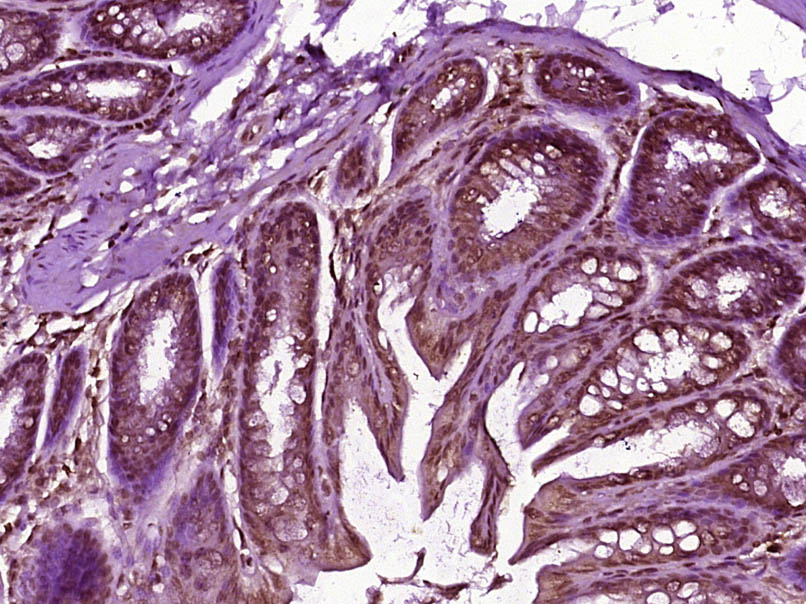 Paraformaldehyde-fixed, paraffin embedded (Mouse colon); Antigen retrieval by boiling in sodium citrate buffer (pH6.0) for 15min; Block endogenous peroxidase by 3% hydrogen peroxide for 20 minutes; Blocking buffer (normal goat serum) at 37°C for 30min; Antibody incubation with (DBNDD1) Polyclonal Antibody, Unconjugated (SL14202R) at 1:400 overnight at 4°C, followed by operating according to SP Kit(Rabbit) (sp-0023) instructionsand DAB staining.
Ordering & shipping
- Minimum order: 1 unit
- Lead time: varies with order quantity and specifications. Please consult your local distributor or our sales team for confirmation
- Payment: T/T 100% in advance; PayPal; Alibaba Trade Assurance
- Shipping: FedEx / DHL / UPS express; cold-chain packing available on request
- Price: USD, per unit (50ul / 100ul)
Partial purchase records(bought amounts latest6)
| Username | Quantity | bought time |
| Ha*** | 1 | 2026-07-05 |
| Xa*** | 1 | 2026-07-02 |
| Ca*** | 1 | 2026-06-06 |
| Ja*** | 1 | 2026-03-20 |
| Sa*** | 1 | 2026-03-08 |
User Comment(Total0User Comment Num)
- No comment


 +86 571 56623320

 SUNLONG BIOTECH


