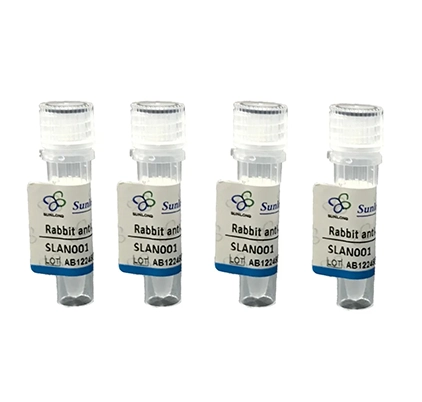
Rabbit Anti-BIN1 antibody
Amphiphysin like protein; AMPH 2; AMPH2; Amphiphysin 2; Amphiphysin II; Amphiphysin like protein; amphiphysin-like; AMPHL; Box Dependant MYC Interacting Protein 1; Bridging Integrator 1; DKFZp547F068; MGC10367; MGC105358; Myc box dependent interacting pro
All categories
View History [Clear]
Details
Product Name BIN1 Chinese Name 桥连整合因子蛋白抗体 Alias Amphiphysin like protein; AMPH 2; AMPH2; Amphiphysin 2; Amphiphysin II; Amphiphysin like protein; amphiphysin-like; AMPHL; Box Dependant MYC Interacting Protein 1; Bridging Integrator 1; DKFZp547F068; MGC10367; MGC105358; Myc box dependent interacting protein 1; SH3P9; BIN1_HUMAN. Research Area Tumour immunology Immunogen Species Rabbit Clonality Polyclonal React Species (predicted: Human, Mouse, Rat, Dog, Cow, Horse, ) Applications IHC-P=1:100-500,IHC-F=1:100-500,IF=1:100-500,ELISA=1:5000-10000 (Paraffin sections need antigen repair)
not yet tested in other applications.
optimal dilutions/concentrations should be determined by the end user.Theoretical molecular weight 65kDa Cellular localization The nucleus Form Liquid Concentration 1mg/ml immunogen KLH conjugated synthetic peptide derived from human BIN1: 101-200/593 Lsotype IgG Purification affinity purified by Protein A Buffer Solution 1M TBS(pH7.4) with 1% BSA, 3% Proclin300 and 50% Glycerol. Storage Shipped at 4℃. Store at -20 °C for one year. Avoid repeated freeze/thaw cycles. Attention This product as supplied is intended for research use only, not for use in human, therapeutic or diagnostic applications. PubMed PubMed Product Detail The identification and analysis of tumor suppressors is of major importance for improved diagnosis and treatment of tumors. Bin1 (Box-dependent myc interacting protein 1, also known as SH3P9, amphiphysin II and amphl/amphiphysin-like) is a novel protein that has features of a tumor suppressor. Bin1 interacts with and inhibits the oncogenic activity of the myc oncoprotein that has a major role in many human cancers. The loss of Bin1 may contribute to growth deregulation in cancer cells in carcinoma of the breast, colon, lung, cervix, prostate and liver. Bin1 also interacts with HCV NS5A through its SH3 domain.
Function:
May be involved in regulation of synaptic vesicle endocytosis. May act as a tumor suppressor and inhibits malignant cell transformation.
Subunit:
Heterodimer with AMPH. Binds SH3GLB1 (By similarity). Interacts (via SH3 domain) with SYNJ1. Interacts (via SH3 domain) with DNM1. Isoform IIA interacts with CLTC. Isoform IIB does not interact with CLTC. Isoform IIC1 does not interact with CLTC. Isoform IIC2 does not interact with CLTC. Interacts with AP2A2. Interacts with AP2B1. Interacts with MYC (via N-terminal transactivation domain); the interaction requires the integrity of the conserved MYC box regions 1 and 2. Interacts with BIN2. Interacts (SH3 domain) with HCV NS5A.
Subcellular Location:
Isoform BIN1: Nucleus.
Isoform IIA: Cytoplasm.
Tissue Specificity:
Ubiquitous. Highest expression in the brain and muscle. Isoform IIA is expressed only in the brain where it is concentrated in axon initial segments and nodes of Ranvier. Isoform BIN1 is widely expressed with highest expression in skeletal muscle.
Post-translational modifications:
Phosphorylated by protein kinase C.
DISEASE:
Myopathy, centronuclear, 2 (CNM2) [MIM:255200]: A congenital muscle disorder characterized by progressive muscular weakness and wasting involving mainly limb girdle, trunk, and neck muscles. It may also affect distal muscles. Weakness may be present during childhood or adolescence or may not become evident until the third decade of life. Ptosis is a frequent clinical feature. The most prominent histopathologic features include high frequency of centrally located nuclei in muscle fibers not secondary to regeneration, radial arrangement of sarcoplasmic strands around the central nuclei, and predominance and hypotrophy of type 1 fibers. Note=The disease is caused by mutations affecting the gene represented in this entry.
Similarity:
Contains 1 BAR domain.
Contains 1 SH3 domain.
SWISS:
O00499
Gene ID:
274
Database links:Entrez Gene: 274 Human
Entrez Gene: 30948 Mouse
Omim: 601248 Human
SwissProt: O00499 Human
SwissProt: O08539 Mouse
Unigene: 193163 Human
Unigene: 4383 Mouse
Unigene: 17098 Rat
Trafficking and Transport
BIN1protein(bridging integrator protein 1)是一种新发现的具有抑癌特性的c-myc连接protein.Ordering & shipping
- Minimum order: 1 unit
- Lead time: varies with order quantity and specifications. Please consult your local distributor or our sales team for confirmation
- Payment: T/T 100% in advance; PayPal; Alibaba Trade Assurance
- Shipping: FedEx / DHL / UPS express; cold-chain packing available on request
- Price: USD, per unit (50ul / 100ul)
Partial purchase records(bought amounts latest6)
| Username | Quantity | bought time |
| Le*** | 1 | 2026-08-17 |
| Xa*** | 1 | 2026-07-16 |
| La*** | 1 | 2026-05-24 |
| Is*** | 1 | 2026-04-09 |
| Wi*** | 1 | 2026-03-13 |
User Comment(Total0User Comment Num)
- No comment


 +86 571 56623320

 SUNLONG BIOTECH


