Rabbit Anti-EpCAM antibody
Adenocarcinoma associated antigen; CD326; CD326 antigen; Cell surface glycoprotein Trop 1; CO17 1A; EGP; EGP40; Ep CAM; Epithelial cell surface antigen; Epithelial cellular adhesion molecule; Epithelial glycoprotein; GA733 2; hEGP 2; KS 1/4 antigen; KSA;
All categories
View History [Clear]
Details
Product Name EpCAM Chinese Name epithelial cells粘附分子(CD326)抗体 Alias Adenocarcinoma associated antigen; CD326; CD326 antigen; Cell surface glycoprotein Trop 1; CO17 1A; EGP; EGP40; Ep CAM; Epithelial cell surface antigen; Epithelial cellular adhesion molecule; Epithelial glycoprotein; GA733 2; hEGP 2; KS 1/4 antigen; KSA; Lymphocyte antigen 74; M1S2; M4S1; Major gastrointestinal tumor associated protein GA733 2; MIC18; MK 1; TACD1; TACSTD1; TROP1; Tumor associated calcium signal transducer 1. literatures Research Area Tumour Cell biology immunology Cell adhesion molecule Cell Surface Molecule Immunogen Species Rabbit Clonality Polyclonal React Species Human (predicted: Mouse, Rat) Applications WB (1:500-2000)
Not yet tested in other applications.
Optimal working dilutions must be determined by the end user.Theoretical molecular weight 35kDa Cellular localization The cell membrane Form Liquid Concentration 1mg/ml immunogen KLH conjugated synthetic peptide derived from human EpCAM: 221-314/314 <Cytoplasmic> Lsotype IgG Purification affinity purified by Protein A Buffer Solution Human,Mouse,Rat1M TBS(pH7.4) with 1% BSA, Human,Mouse,Rat3% Proclin300 and 50% Glycerol. Storage Shipped at 4℃. Store at -20 °C for one year. Avoid repeated freeze/thaw cycles. Attention This product as supplied is intended for research use only, not for use in human, therapeutic or diagnostic applications. PubMed PubMed Product Detail This gene encodes a carcinoma-associated antigen and is a member of a family that includes at least two type I membrane proteins. This antigen is expressed on most normal epithelial cells and gastrointestinal carcinomas and functions as a homotypic calcium-independent cell adhesion molecule. The antigen is being used as a target for immunotherapy treatment of human carcinomas. Mutations in this gene result in congenital tufting enteropathy. [provided by RefSeq, Dec 2008]
Function:
May act as a physical homophilic interaction molecule between intestinal epithelial cells (IECs) and intraepithelial lymphocytes (IELs) at the mucosal epithelium for providing immunological barrier as a first line of defense against mucosal infection. Plays a role in embryonic stem cells proliferation and differentiation. Up-regulates the expression of FABP5, MYC and cyclins A and E.
Subunit:
Monomer. Interacts with phosphorylated CLDN7.
Subcellular Location:
Lateral cell membrane; Single-pass type I membrane protein. Cell junction, tight junction. Note=Co-localizes with CLDN7 at the lateral cell membrane and tight junction.
Tissue Specificity:
Highly and selectively expressed by undifferentiated rather than differentiated embryonic stem cells (ESC). Levels rapidly diminish as soon as ESC's differentiate (at protein levels). Expressed in almost all epithelial cell membranes but not on mesodermal or neural cell membranes. Found on the surface of adenocarcinoma.
Post-translational modifications:
Hyperglycosylated in carcinoma tissue as compared with autologous normal epithelia. Glycosylation at Asn-198 is crucial for protein stability.
DISEASE:
Defects in EPCAM are the cause of diarrhea type 5 (DIAR5) [MIM:613217]. It is an intractable diarrhea of infancy characterized by villous atrophy and absence of inflammation, with intestinal epithelial cell dysplasia manifesting as focal epithelial tufts in the duodenum and jejunum. Defects in EPCAM are a cause of hereditary non-polyposis colorectal cancer type 8 (HNPCC8) [MIM:613244]. HNPCC is a disease associated with marked increase in cancer susceptibility. It is characterized by a familial predisposition to early-onset colorectal carcinoma (CRC) and extra-colonic tumors of the gastrointestinal, urological and female reproductive tracts. HNPCC is reported to be the most common form of inherited colorectal cancer in the Western world. Clinically, HNPCC is often divided into two subgroups. Type I is characterized by hereditary predisposition to colorectal cancer, a young age of onset, and carcinoma observed in the proximal colon. Type II is characterized by increased risk for cancers in certain tissues such as the uterus, ovary, breast, stomach, small intestine, skin, and larynx in addition to the colon. Diagnosis of classical HNPCC is based on the Amsterdam criteria: 3 or more relatives affected by colorectal cancer, one a first degree relative of the other two; 2 or more generation affected; 1 or more colorectal cancers presenting before 50 years of age; exclusion of hereditary polyposis syndromes. The term 'suspected HNPCC' or 'incomplete HNPCC' can be used to describe families who do not or only partially fulfill the Amsterdam criteria, but in whom a genetic basis for colon cancer is strongly suspected. Note=HNPCC8 results from heterozygous deletion of 3-prime exons of EPCAM and intergenic regions directly upstream of MSH2, resulting in transcriptional read-through and epigenetic silencing of MSH2 in tissues expressing EPCAM.
Similarity:
Belongs to the EPCAM family.
Contains 1 thyroglobulin type-1 domain.
SWISS:
P16422
Gene ID:
4072
Database links:Entrez Gene: 4072 Human
Entrez Gene: 17075 Mouse
Omim: 185535 Human
SwissProt: P16422 Human
SwissProt: Q99JW5 Mouse
Unigene: 542050 Human
Unigene: 4259 Mouse
Unigene: 106481 Rat
Product Picture
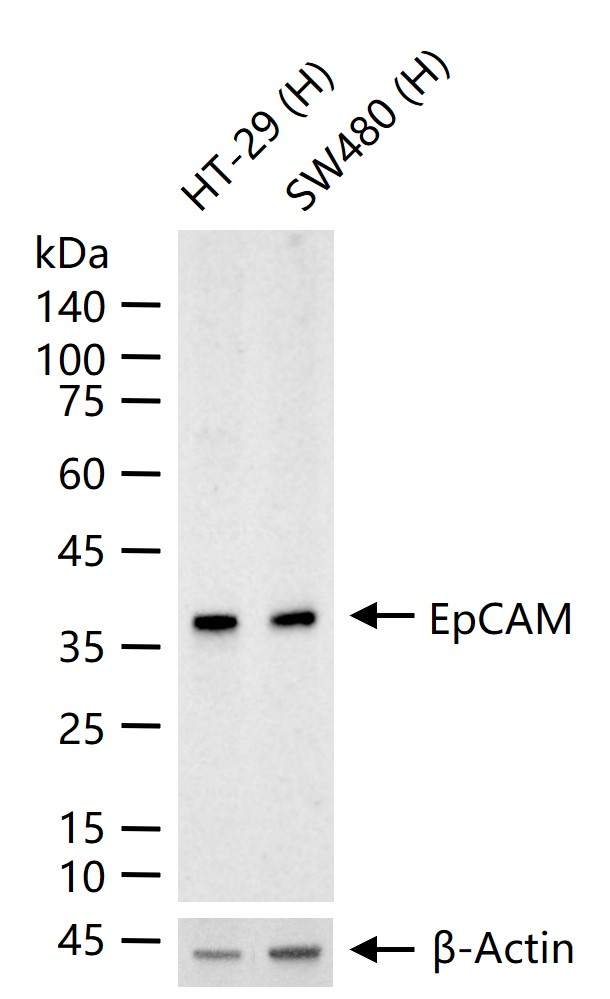
Figure 1. 25 ug total protein per lane of various lysates (see on figure) probed with EpCAM polyclonal antibody, unconjugated (SL1513R) at 1:1000 dilution and 4°C overnight incubation. Followed by conjugated secondary antibody incubation at r.t. for 60 min
Ordering & shipping
- Minimum order: 1 unit
- Lead time: varies with order quantity and specifications. Please consult your local distributor or our sales team for confirmation
- Payment: T/T 100% in advance; PayPal; Alibaba Trade Assurance
- Shipping: FedEx / DHL / UPS express; cold-chain packing available on request
- Price: USD, per unit (50ul / 100ul)
Partial purchase records(bought amounts latest6)
| Username | Quantity | bought time |
| Ra*** | 1 | 2026-09-09 |
| Et*** | 1 | 2026-07-29 |
| Ia*** | 1 | 2026-06-30 |
| Um*** | 1 | 2026-06-22 |
| Ya*** | 1 | 2026-05-21 |
User Comment(Total0User Comment Num)
- No comment


 +86 571 56623320

 SUNLONG BIOTECH


