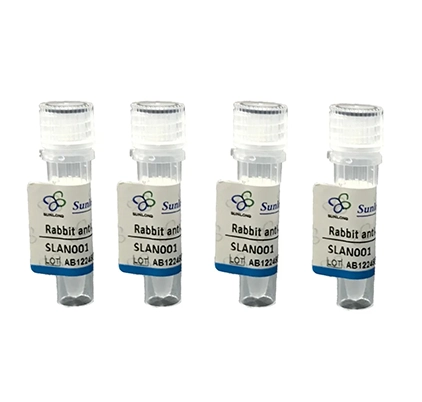
Rabbit Anti-E cadherin antibody
E-cadherin; anion exchanger protein 3; Arc 1; Cadherin 1; cadherin 1 type 1 E-cadherin; Cadherin1; CAM 120/80; CD 234; CD324; CD324 antigen; CDH1; CDHE; ECAD; Epithelial cadherin; epithelial calcium dependant adhesion protein; LCAM; Liver cell adhesion mo
All categories
View History [Clear]
Details
Product Name E cadherin Chinese Name 上皮钙粘附分子抗体 Alias E-cadherin; anion exchanger protein 3; Arc 1; Cadherin 1; cadherin 1 type 1 E-cadherin; Cadherin1; CAM 120/80; CD 234; CD324; CD324 antigen; CDH1; CDHE; ECAD; Epithelial cadherin; epithelial calcium dependant adhesion protein; LCAM; Liver cell adhesion molecule; UVO; Uvomorulin; CADH1_HUMAN. literatures Research Area Tumour Cell biology immunology Cell adhesion molecule Cell Surface Molecule epithelial cells Immunogen Species Rabbit Clonality Polyclonal React Species Human(predicted:Horse,Cow,Pig,Dog,Chicken,Rat,Mouse) Applications WB=1:500-2000,Flow-Cyt=1μg/Test (Paraffin sections need antigen repair)
not yet tested in other applications.
optimal dilutions/concentrations should be determined by the end user.Theoretical molecular weight 90/97kDa Cellular localization The cell membrane Form Liquid Concentration 1mg/ml immunogen KLH conjugated synthetic peptide derived from human E-cadherin: 841-882/882 <Cytoplasmic> Lsotype IgG Purification affinity purified by Protein A Buffer Solution Human(predicted:Horse,Cow,Pig,Dog,Chicken,Rat,Mouse)1M TBS(pH7.4) with 1% BSA, Human(predicted:Horse,Cow,Pig,Dog,Chicken,Rat,Mouse)3% Proclin300 and 50% Glycerol. Storage Shipped at 4℃. Store at -20 °C for one year. Avoid repeated freeze/thaw cycles. Attention This product as supplied is intended for research use only, not for use in human, therapeutic or diagnostic applications. PubMed PubMed Product Detail This gene encodes a classical cadherin of the cadherin superfamily. Alternative splicing results in multiple transcript variants, at least one of which encodes a preproprotein that is proteolytically processed to generate the mature glycoprotein. This calcium-dependent cell-cell adhesion protein is comprised of five extracellular cadherin repeats, a transmembrane region and a highly conserved cytoplasmic tail. Mutations in this gene are correlated with gastric, breast, colorectal, thyroid and ovarian cancer. Loss of function of this gene is thought to contribute to cancer progression by increasing proliferation, invasion, and/or metastasis. The ectodomain of this protein mediates bacterial adhesion to mammalian cells and the cytoplasmic domain is required for internalization. This gene is present in a gene cluster with other members of the cadherin family on chromosome 16. [provided by RefSeq, Nov 2015]
Function:
Cadherins are calcium-dependent cell adhesion proteins. They preferentially interact with themselves in a homophilic manner in connecting cells; cadherins may thus contribute to the sorting of heterogeneous cell types. CDH1 is involved in mechanisms regulating cell-cell adhesions, mobility and proliferation of epithelial cells. Has a potent invasive suppressor role. It is a ligand for integrin alpha-E/beta-7.
E-Cad/CTF2 promotes non-amyloidogenic degradation of Abeta precursors. Has a strong inhibitory effect on APP C99 and C83 production.
Subunit:
Homodimer.
Subcellular Location:
Cell junction. Cell membrane; Single-pass type I membrane protein.
Tissue Specificity:
Non-neural epithelial tissues.
Post-translational modifications:
During apoptosis or with calcium influx, cleaved by a membrane-bound metalloproteinase (ADAM10), PS1/gamma-secretase and caspase-3 to produce fragments of about 38 kDa (E-CAD/CTF1), 33 kDa (E-CAD/CTF2) and 29 kDa (E-CAD/CTF3), respectively. Processing by the metalloproteinase, induced by calcium influx, causes disruption of cell-cell adhesion and the subsequent release of beta-catenin into the cytoplasm. The residual membrane-tethered cleavage product is rapidly degraded via an intracellular proteolytic pathway. Cleavage by caspase-3 releases the cytoplasmic tail resulting in disintegration of the actin microfilament system. The gamma-secretase-mediated cleavage promotes disaaaembly of adherens junctions.
DISEASE:
Defects in CDH1 are involved in dysfunction of the cell-cell adhesion system, triggering cancer invasion (gastric, breast, ovary, endometrium and thyroid) and metastasis.
Defects in CDH1 are a cause of gastric cancer [MIM:137215]; also known as hereditary familial diffuse gastric cancer (HDGC).
Defects in CDH1 are a cause of susceptibility to endometrial cancer [MIM:608089].
Defects in CDH1 are associated with ovarian cancer [MIM:167000]. Ovarian cancer is the leading cause of death from gynecologic malignancy. It is characterized by advanced presentation with loco-regional dissemination in the peritoneal cavity and the rare incidence of visceral metastases. These typical features relate to the biology of the disease, which is a principal determinant of outcome.
Similarity:
Contains 5 cadherin domains.
SWISS:
P12830
Gene ID:
999
Database links:Entrez Gene: 999 Human
Entrez Gene: 12550 Mouse
Omim: 192090 Human
SwissProt: P12830 Human
SwissProt: P09803 Mouse
Unigene: 461086 Human
Unigene: 35605 Mouse
Unigene: 1303 Rat
Cell Adhesion Protein
E-chaherin是研究较多的同质粘附分子。E-cadherin的表达与恶性Tumour的differentiation程度、侵袭力、转移负相关与预后正相关,E-cadherin的低表达和不稳定表达可促进转移的发生。In recent years已成为Tumourcells侵袭和转移研究的热点之一。Product Picture
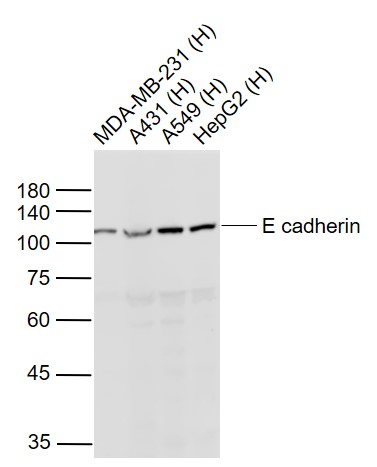
Figure 1. Sample: Lane 1: MDA-MB-231 (Human) Cell Lysate at 30 ug Lane 2: A431 (Human) Cell Lysate at 30 ug Lane 3: A549 (Human) Cell Lysate at 30 ug Lane 4: HepG2 (Human) Cell Lysate at 30 ug Primary: Anti- E cadherin (SL1519R) at 1/500 dilution Secondary: IRDye800CW Goat Anti-Rabbit IgG at 1/20000 dilution Predicted band size: 125 kD Observed band size: 120 kD
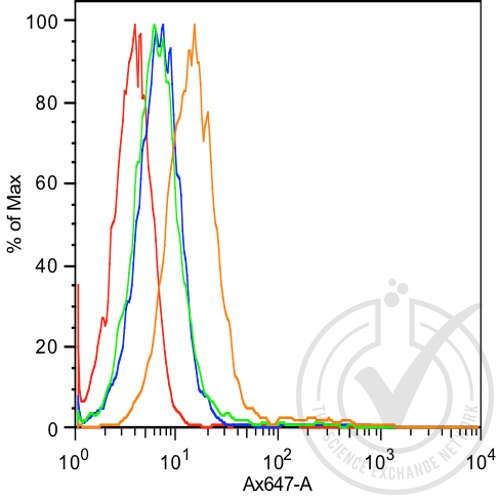
Figure 2. Histogram of MCF7 cells stained with anti-E-cadherin (orange), isotype control antibody (green), secondary antibody only (blue) and unstained (red)
Ordering & shipping
- Minimum order: 1 unit
- Lead time: varies with order quantity and specifications. Please consult your local distributor or our sales team for confirmation
- Payment: T/T 100% in advance; PayPal; Alibaba Trade Assurance
- Shipping: FedEx / DHL / UPS express; cold-chain packing available on request
- Price: USD, per unit (50ul / 100ul)
Partial purchase records(bought amounts latest5)
| Username | Quantity | bought time |
| Ge*** | 1 | 2026-09-10 |
| Fr*** | 1 | 2026-05-01 |
| Sa*** | 1 | 2026-04-08 |
| Ga*** | 1 | 2026-02-08 |
| No*** | 1 | 2026-02-01 |
User Comment(Total0User Comment Num)
- No comment


 +86 571 56623320

 SUNLONG BIOTECH


