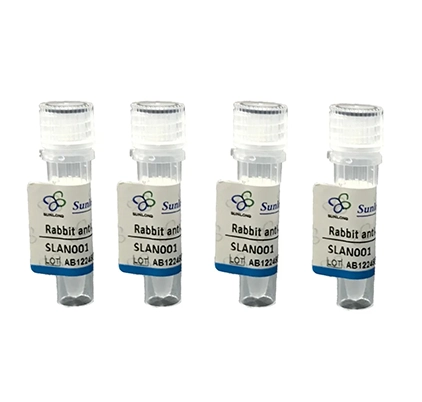
Rabbit Anti-GPR161 antibody
FLJ33952; G-protein coupled receptor 161; G-protein coupled receptor RE2; GP161; GPR161; RE2; GP161_HUMAN.
All categories
View History [Clear]
Details
Product Name GPR161 Chinese Name G protein-coupled receptorGPR161蛋白抗体 Alias FLJ33952; G-protein coupled receptor 161; G-protein coupled receptor RE2; GP161; GPR161; RE2; GP161_HUMAN. Research Area Cell biology immunology Signal transduction G protein-coupled receptor G protein signal Immunogen Species Rabbit Clonality Polyclonal React Species Human(predicted:Mouse,Rat,Dog,Pig,Cow,Horse,Sheep) Applications WB=1:500-2000 (Paraffin sections need antigen repair)
not yet tested in other applications.
optimal dilutions/concentrations should be determined by the end user.Theoretical molecular weight 59kDa Cellular localization The cell membrane Form Liquid Concentration 1mg/ml immunogen KLH conjugated synthetic peptide derived from human GPR161: 121-220/529 <Extracellular> Lsotype IgG Purification affinity purified by Protein A Buffer Solution 1M TBS(pH7.4) with 1% BSA, 3% Proclin300 and 50% Glycerol. Storage Shipped at 4℃. Store at -20 °C for one year. Avoid repeated freeze/thaw cycles. Attention This product as supplied is intended for research use only, not for use in human, therapeutic or diagnostic applications. PubMed PubMed Product Detail G protein-coupled receptors (GPRs), also known as seven transmembrane receptors, heptahelical receptors or 7TM receptors, comprise a superfamily of proteins that play a role in many different stimulus-response pathways. G-protein coupled receptors translate extracellular signals into intracellular signals (G-protein activation) and they respond to a variety of signaling molecules, such as hormones and neurotransmitters. GPR161 (G protein-coupled receptor 161), also known as RE2, is a 529 amino acid protein that belongs to the G-protein coupled receptor family. Localized to the cell membrane, GPR161 is a multi-pass membrane protein that functions as an orphan receptor, relaying extracellular signals to the intracellular environment. Two isoforms of GPR161 exist due to alternative splicing events.
Function:
Key negative regulator of Shh signaling, which promotes the processing of GLI3 into GLI3R during neural tube development. Recruited by TULP3 and the IFT-A complex to primary cilia and acts as a regulator of the PKA-dependent basal repression machinery in Shh signaling by increasing cAMP levels, leading to promote the PKA-dependent processing of GLI3 into GLI3R and repress the Shh signaling. In presence of SHH, it is removed from primary cilia and is internalized into recycling endosomes, preventing its activity and allowing activation of the Shh signaling. Its ligand is unknown (By similarity).
Subcellular Location:
Cell projection, cilium membrane; Multi-pass membrane protein (By similarity). Cell membrane; Multi-pass membrane protein (By similarity). Note=Mainly localizes to primary cilium in a TULP3 and IFT-A complex-dependent manner. In presence of SHH, it is removed from primary cilia and is internalized into recycling endosomes and is apparently not degraded (By similarity).
Similarity:
Belongs to the G-protein coupled receptor 1 family.
SWISS:
Q8N6U8
Gene ID:
23432
Database links:Entrez Gene: 23432 Human
Entrez Gene: 240888 Mouse
SwissProt: Q8N6U8 Human
SwissProt: B2RPY5 Mouse
Unigene: 271809 Human
Unigene: 329929 Mouse
Product Picture 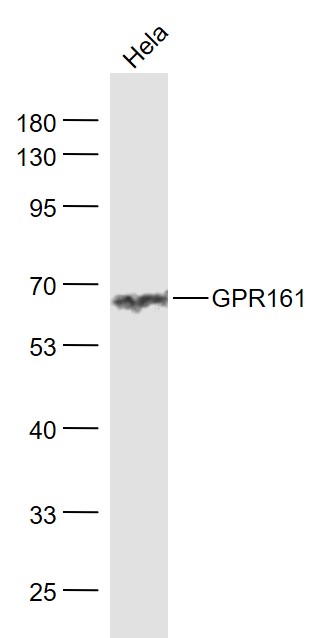 Sample:
Hela (Human)cell Lysate at 30 ug
Primary: Anti- GPR161 (SL15385R) at 1/1000 dilution
Secondary: IRDye800CW Goat Anti-Rabbit IgG at 1/20000 dilution
Predicted band size: 59 kD
Observed band size: 65 kD
Ordering & shipping
- Minimum order: 1 unit
- Lead time: varies with order quantity and specifications. Please consult your local distributor or our sales team for confirmation
- Payment: T/T 100% in advance; PayPal; Alibaba Trade Assurance
- Shipping: FedEx / DHL / UPS express; cold-chain packing available on request
- Price: USD, per unit (50ul / 100ul)
Partial purchase records(bought amounts latest3)
| Username | Quantity | bought time |
| Ia*** | 1 | 2026-06-05 |
| Ad*** | 1 | 2026-04-14 |
| Be*** | 1 | 2026-03-12 |
User Comment(Total0User Comment Num)
- No comment


 +86 571 56623320

 SUNLONG BIOTECH


