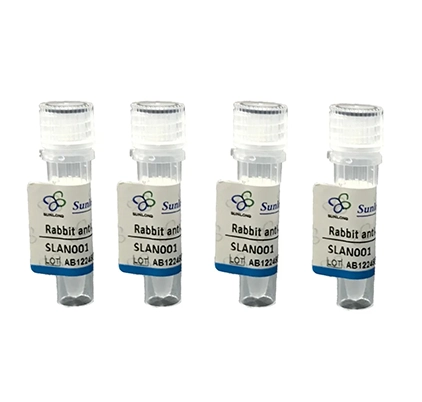
Rabbit Anti-APOBEC3G antibody
DNA dC->dU-editing enzyme APOBEC-3G; APOBEC-related cytidine deaminase; APOBEC-related protein; ARCD; APOBEC-related protein 9; ARP-9; CEM15; CEM-15; Deoxycytidine deaminase; ABC3G_HUMAN.
All categories
View History [Clear]
Details
Product Name APOBEC3G Chinese Name 脱氧胞苷脱氨酶蛋白抗体 Alias DNA dC->dU-editing enzyme APOBEC-3G; APOBEC-related cytidine deaminase; APOBEC-related protein; ARCD; APOBEC-related protein 9; ARP-9; CEM15; CEM-15; Deoxycytidine deaminase; ABC3G_HUMAN. literatures Research Area Cell biology immunology Immunogen Species Rabbit Clonality Polyclonal React Species Human Applications WB=1:500-2000 (Paraffin sections need antigen repair)
not yet tested in other applications.
optimal dilutions/concentrations should be determined by the end user.Theoretical molecular weight 46kDa Cellular localization The nucleus cytoplasmic Form Liquid Concentration 1mg/ml immunogen KLH conjugated synthetic peptide derived from human APOBEC3G: 201-300/384 Lsotype IgG Purification affinity purified by Protein A Buffer Solution 1M TBS(pH7.4) with 1% BSA, 3% Proclin300 and 50% Glycerol. Storage Shipped at 4℃. Store at -20 °C for one year. Avoid repeated freeze/thaw cycles. Attention This product as supplied is intended for research use only, not for use in human, therapeutic or diagnostic applications. PubMed PubMed Product Detail APOBEC3G is a member of a family of enzymes that have potent DNA mutator activity. APOBEC3G deaminates deoxycytosine to deoxyuracil in the minus strand of HIV-1 DNA, resulting in G to A hypermutation in the plus strand of DNA. Thus, APOBEC3G provides a mechanism for innate immunity to retroviruses and also likely contributes to sequence variation observed in many viruses. Viral infectivity factor (Vif) imparts APOBEC3G resistance to HIV through impaired translation of APOBEC3G mRNA and accel-erated posttranslational degradation of APOBEC3G by the 26S proteasome. Inter-estingly, HIV-1 Vif cannot form a complex with APOBEC3G of mouse origin as it does with the human protein, and thus mouse APOBEC3G functions as a potent inhibitor of wild type HIV-1 replication, where human APOBEC3G is only able to inhibit Vif-deficient HIV-1 replication. This implies that induction of APOBEC3G activity or a method of blocking its interaction with Vif may provide a method for therapeutic intervention. CEM15 is a 429 amino acid mouse protein that is thought to function as an ortholog of human APOBEC3G.
Function:
DNA deaminase (cytidine deaminase) which acts as an inhibitor of retrovirus replication and retrotransposon mobility via deaminase-dependent and -independent mechanisms. Exhibits potent antiviral activity against vif-deficient HIV-1. After the penetration of retroviral nucleocapsids into target cells of infection and the initiation of reverse transcription, it can induce the conversion of cytosine to uracil in the minus-sense single-strand viral DNA, leading to G-to-A hypermutations in the subsequent plus-strand viral DNA. The resultant detrimental levels of mutations in the proviral genome, along with a deamination-independent mechanism that works prior to the proviral integration, together exert efficient antiretroviral effects in infected target cells. Selectively targets single-stranded DNA and does not deaminate double-stranded DNA or single-or double-stranded RNA. Exhibits antiviral activity also against simian immunodeficiency viruses (SIVs), hepatitis B virus (HBV), equine infectious anemia virus (EIAV), xenotropic MuLV-related virus (XMRV) and simian foamy virus (SFV). May inhibit the mobility of LTR and non-LTR retrotransposons.
Subunit:
Homodimer. Homooligomer. Can bind RNA to form ribonucleoprotein complexes of high-molecular-mass (HMM) or low-molecular-mass (LMM). HMM is inactive and heterogeneous in protein composition because of binding nonselectively to cellular RNAs, which in turn are associated with variety of cellular proteins. The LMM form which is enzymatically active has few or no RNAs associated. Its ability to form homooligomer is distinct from its ability to assemble into HMM. Interacts with APOBEC3B, APOBEC3F, MOV10, EIF2C2/AGO2, EIF4E, EIF4ENIF1, DCP2 and DDX6 in an RNA-dependent manner. Interacts with EIF2C1/AGO1, EIF2C3/AGO3 and PKA/PRKACA. Interacts with HIV-1 VIF and reverse transcriptase/ribonuclease H. Interacts with hepatitis B virus capsid protein.
Subcellular Location:
Cytoplasm. Nucleus. Cytoplasm, P-body. Note=Mainly cytoplasmic. Small amount are found in the nucleus. During HIV-1 infection, virion-encapsidated in absence of HIV-1 VIF.
Tissue Specificity:
Expressed in spleen, testes, ovary and peripheral blood leukocytes and CD4+ lymphocytes. Also expressed in non-permissive peripheral blood mononuclear cells, and several tumor cell lines; no expression detected in permissive lymphoid and non-lymphoid cell lines. Exists only in the LMM form in peripheral blood-derived resting CD4 T-cells and monocytes, both of which are refractory to HIV-1 infection. LMM is converted to a HMM complex when resting CD4 T cells are activated or when monocytes are induced to differentiate into macrophages. This change correlates with increased susceptibility of these cells to HIV-1 infection.
Post-translational modifications:
Ubiquitinated in the presence of HIV-1 VIF. Association with VIF targets the protein for proteolysis by the ubiquitin-dependent proteasome pathway.
Phosphorylation at Thr-32 reduces its binding to HIV-1 VIF and subsequent ubiquitination and degradation thus promoting its antiviral activity.
Similarity:
Belongs to the cytidine and deoxycytidylate deaminase family.
Contains 2 CMP/dCMP deaminase zinc-binding domains.
SWISS:
Q9HC16
Gene ID:
200316
Database links:Entrez Gene: 200316 Human
Entrez Gene: 60489 Human
Omim: 607113 Human
SwissProt: Q9HC16 Human
Unigene: 659809 Human
Unigene: 660143 Human
Product Picture 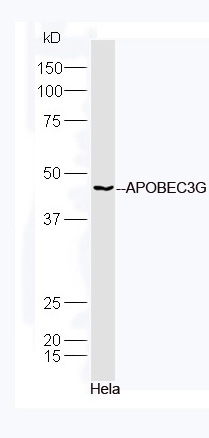 Protein: Hela(human)cell lysate at 40ug;
Primary: rabbit Anti-APOBEC3G (SL15407R) at 1:300;
Secondary: HRP conjugated Goat-Anti-rabbit IgG(SL0295G-HRP) at 1: 5000;
Predicted band size: 46 kD
Observed band size: 46 kDOrdering & shipping
- Minimum order: 1 unit
- Lead time: varies with order quantity and specifications. Please consult your local distributor or our sales team for confirmation
- Payment: T/T 100% in advance; PayPal; Alibaba Trade Assurance
- Shipping: FedEx / DHL / UPS express; cold-chain packing available on request
- Price: USD, per unit (50ul / 100ul)
Partial purchase records(bought amounts latest5)
| Username | Quantity | bought time |
| Al*** | 1 | 2026-09-02 |
| Ch*** | 1 | 2026-06-05 |
| Na*** | 1 | 2026-03-28 |
| Et*** | 1 | 2026-03-05 |
| Xa*** | 1 | 2026-01-03 |
User Comment(Total0User Comment Num)
- No comment


 +86 571 56623320

 SUNLONG BIOTECH


