Details
Product Name Shh Chinese Name ShhSignal transduction通路膜蛋白受体抗体 Alias Sonic hedgehog; Vhh-1; Sonic hedgehog protein; SHH; HHG 1; HHG1; HLP 3; HLP3; Holoprosencephaly 3; HPE 3; HPE3; MCOPCB5; SMMC I; SMMCI; Sonic Hedgehog (Drosophila) homolog; sonic hedgehog homolog (Drosophila); Sonic hedgehog homolog; Sonic hedgehog protein; TPT; TPTPS; Sonic hedgehog protein N-product; SHH_HUMAN. literatures Research Area Tumour Cell biology Developmental biology Signal transduction The cell membraneReceptor glycoprotein Immunogen Species Rabbit Clonality Polyclonal React Species Mouse,Rat(predicted:Human,Chicken,Cow,Horse,Rabbit) Applications WB=1:500-2000,IHC-P=1:100-500,IHC-F=1:100-500,IF=1:100-500 (Paraffin sections need antigen repair)
not yet tested in other applications.
optimal dilutions/concentrations should be determined by the end user.Theoretical molecular weight 19/47kDa Cellular localization The cell membrane Extracellular matrix Secretory protein Form Liquid Concentration 1mg/ml immunogen KLH conjugated synthetic peptide derived from human Shh: 21-120/462 Lsotype IgG Purification affinity purified by Protein A Buffer Solution 1M TBS(pH7.4) with 1% BSA, 3% Proclin300 and 50% Glycerol. Storage Shipped at 4℃. Store at -20 °C for one year. Avoid repeated freeze/thaw cycles. Attention This product as supplied is intended for research use only, not for use in human, therapeutic or diagnostic applications. PubMed PubMed Product Detail SHH binds to the patched (PTC) receptor, which functions in association with smoothened (SMO), to activate the transcription of target genes. In the absence of SHH, PTC represses the constitutive signaling activity of SMO. Also regulates another target, the gli oncogene. Intercellular signal essential for a variety of patterning events during development: signal produced by the notochord that induces ventral cell fate in the neural tube and somites, and the polarizing signal for patterning of the anterior-posterior axis of the developing limb bud. Displays both floor plate- and motor neuron-inducing activity. The threshold concentration of N-product required for motor neuron induction is 5-fold lower than that required for floor plate induction (By similarity).
Function:
Binds to the patched (PTC) receptor, which functions in association with smoothened (SMO), to activate the transcription of target genes. In the absence of SHH, PTC represses the constitutive signaling activity of SMO. Also regulates another target, the gli oncogene. Intercellular signal essential for a variety of patterning events during development: signal produced by the notochord that induces ventral cell fate in the neural tube and somites, and the polarizing signal for patterning of the anterior-posterior axis of the developing limb bud. Displays both floor plate- and motor neuron-inducing activity. The threshold concentration of N-product required for motor neuron induction is 5-fold lower than that required for floor plate induction (By similarity).
Subunit:
Interacts with HHATL/GUP1 which negatively regulates HHAT-mediated palmitoylation of the SHH N-terminus. N-product is active as a multimer.
Subcellular Location:
Sonic hedgehog protein C-product: Secreted, extracellular space. Note=The C-terminal peptide diffuses from the cell. Sonic hedgehog protein N-product: Cell membrane; Lipid-anchor. Note=The N-product either remains associated with lipid rafts at the cell surface, or forms freely diffusible active multimers with its hydrophobic lipid-modified N- and C-termini buried inside.
Tissue Specificity:
Expressed in fetal intestine, liver, lung, and kidney. Not expressed in adult tissues.
Post-translational modifications:
The C-terminal domain displays an autoproteolysis activity and a cholesterol transferase activity. Both activities result in the cleavage of the full-length protein and covalent attachment of a cholesterol moiety to the C-terminal of the newly generated N-terminal fragment (N-product). The N-product is the active species in both local and long-range signaling, whereas the C-product has no signaling activity.
Cholesterylation is required for N-product targeting to lipid rafts and multimerization (By similarity).
N-palmitoylation of Cys-24 by HHAT is required for N-product multimerization and full activity (By similarity).
DISEASE:
Defects in SHH are the cause of microphthalmia isolated with coloboma type 5 (MCOPCB5) [MIM:611638]. Microphthalmia is a clinically heterogeneous disorder of eye formation, ranging from small size of a single eye to complete bilateral absence of ocular tissues. Ocular abnormalities like opacities of the cornea and lens, scaring of the retina and choroid, cataract and other abnormalities like cataract may also be present. Ocular colobomas are a set of malformations resulting from abnormal morphogenesis of the optic cup and stalk, and the fusion of the fetal fissure (optic fissure).
Defects in SHH are the cause of holoprosencephaly type 3 (HPE3) [MIM:142945]. Holoprosencephaly (HPE) [MIM:236100] is the most common structural anomaly of the brain, in which the developing forebrain fails to correctly separate into right and left hemispheres. Holoprosencephaly is genetically heterogeneous and associated with several distinct facies and phenotypic variability. The majority of HPE3 cases are apparently sporadic, although clear examples of autosomal dominant inheritance have been described. Interestingly, up to 30% of obligate carriers of HPE3 gene in autosomal dominant pedigrees are clinically unaffected.
Defects in SHH are a cause of solitary median maxillary central incisor (SMMCI) [MIM:147250]. SMMCI is a rare dental anomaly characterized by the congenital absence of one maxillary central incisor.
Defects in SHH are the cause of triphalangeal thumb-polysyndactyly syndrome (TPTPS) [MIM:174500]. TPTPS is an autosomal dominant syndrome characterized by a wide spectrum of pre- and post-axial abnormalities due to altered SHH expression pattern during limb development. TPTPS mutations have been mapped to the 7q36 locus in the LMBR1 gene which contains in its intron 5 a long-range cis-regulatory element of SHH expression.
Similarity:
Belongs to the hedgehog family.
SWISS:
Q15465
Gene ID:
6469
Database links:Entrez Gene: 6469 Human
Omim: 600725 Human
SwissProt: Q15465 Human
Unigene: 164537 Human
Shhis a secreted signaling glycoprotein in the Hedgehog (Hh) Signal transduction pathway, and is also an important factor in regulating the differentiation and development of embryonic tissues, with high conservation.Product Picture
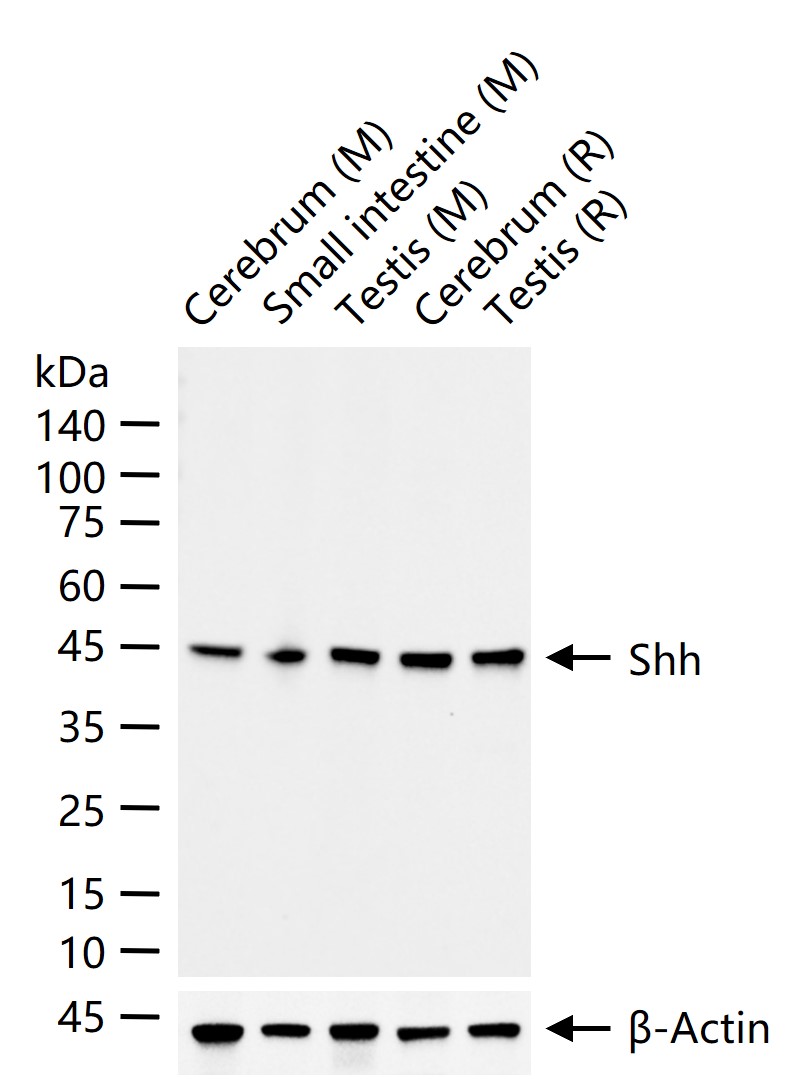
Figure 1. 25 ug total protein per lane of various lysates (see on figure) probed with Shh polyclonal antibody, unconjugated (SL1544R) at 1:1000 dilution and 4°C overnight incubation. Followed by conjugated secondary antibody incubation at r.t. for 60 min
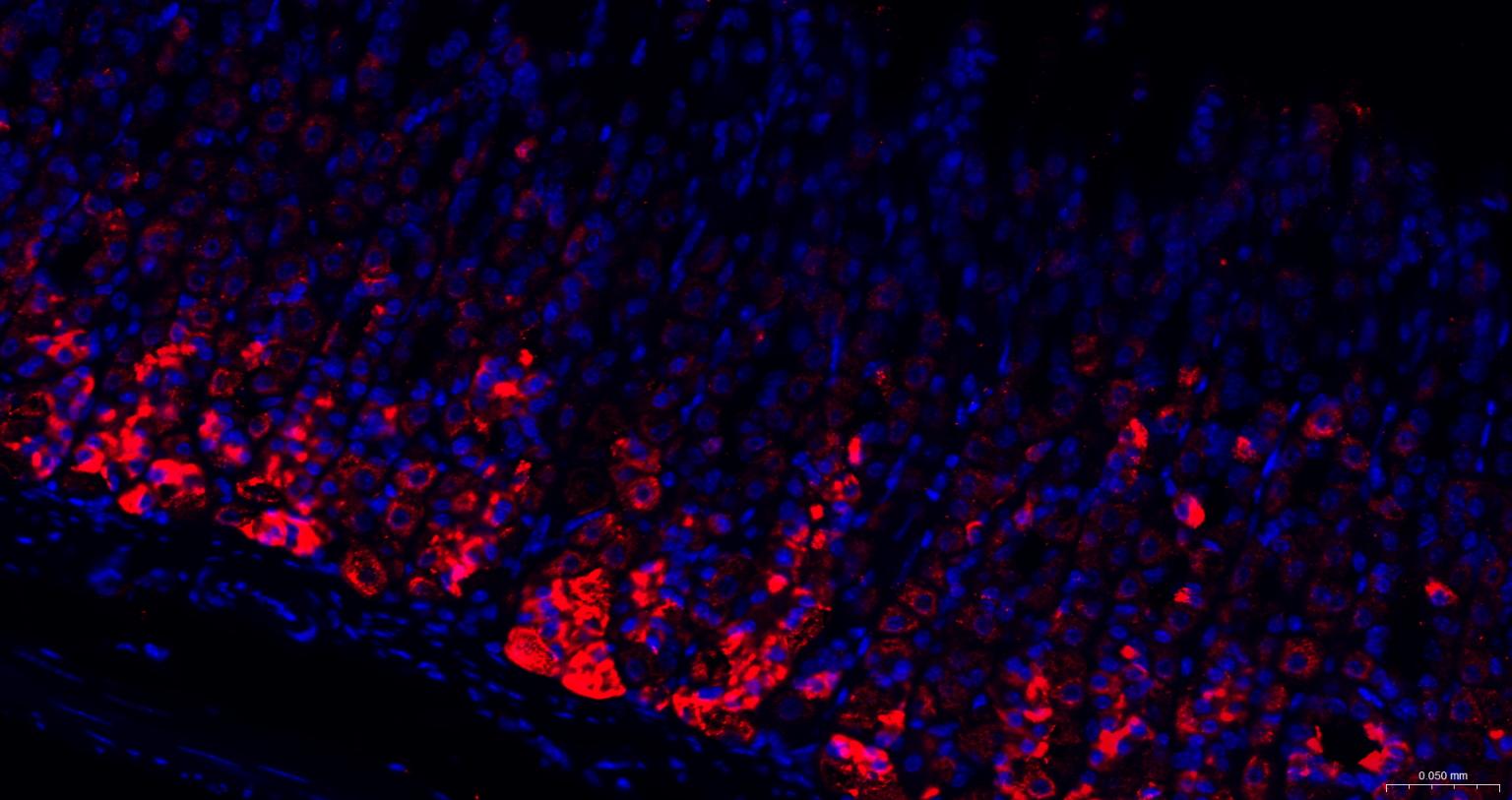
Figure 2. Paraformaldehyde-fixed, paraffin embedded Mouse Stomach; Antigen retrieval by boiling in sodium citrate buffer (pH6.0) for 15 min; The section was incubated with Shh Polyclonal Antibody, Unconjugated (SL1544R) at 1:200 overnight at 4°C. Followed by conjugated Goat Anti-Rabbit IgG antibody (Red, SL0295G-BF594), DAPI (blue, C02-04002) was used to stain the cell nuclei
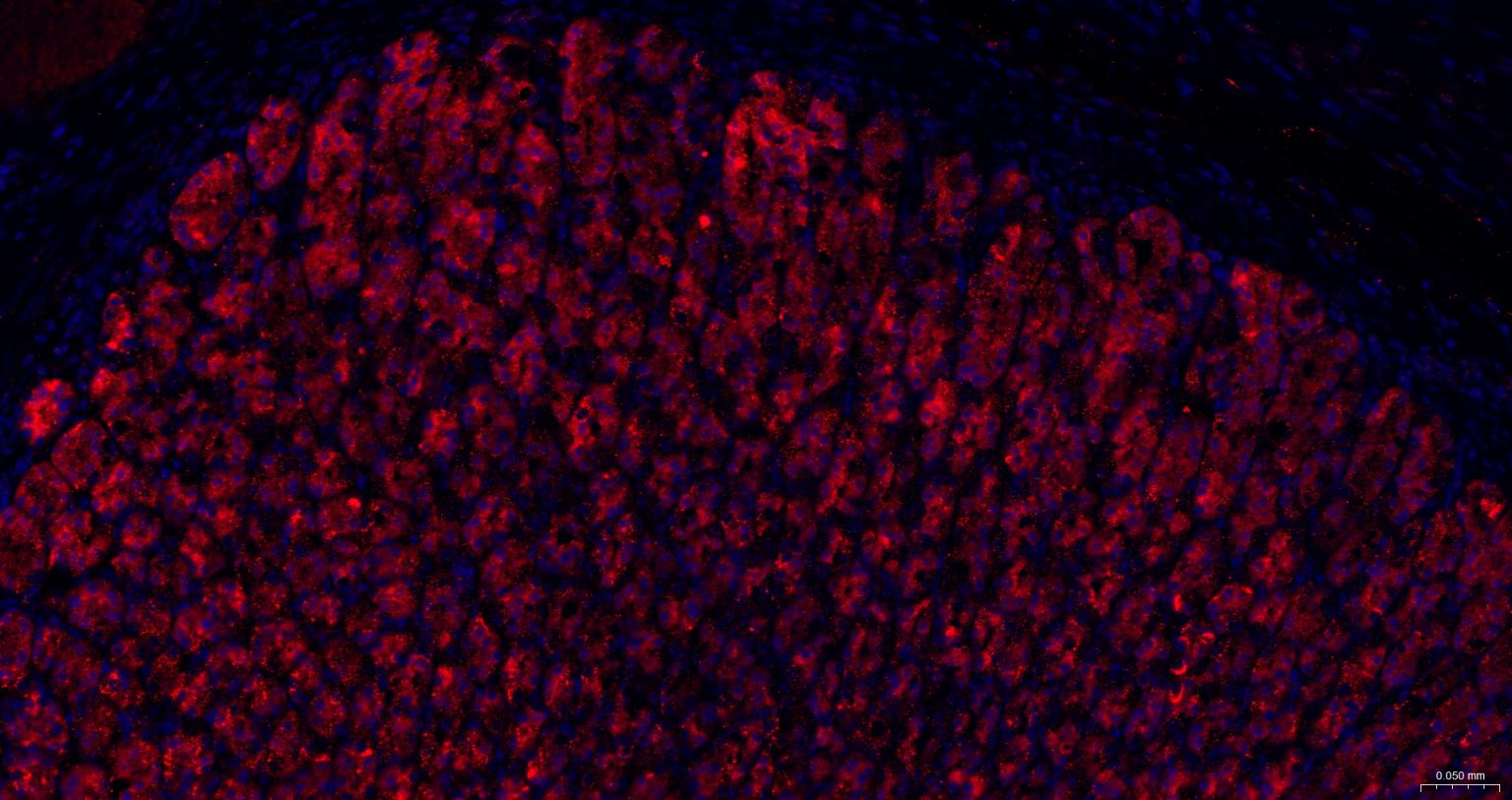
Figure 3. Paraformaldehyde-fixed, paraffin embedded Rat Stomach; Antigen retrieval by boiling in sodium citrate buffer (pH6.0) for 15 min; The section was incubated with Shh Polyclonal Antibody, Unconjugated (SL1544R) at 1:200 overnight at 4°C. Followed by conjugated Goat Anti-Rabbit IgG antibody (Red, SL0295G-BF594), DAPI (blue, C02-04002) was used to stain the cell nuclei
Ordering & shipping
- Minimum order: 1 unit
- Lead time: varies with order quantity and specifications. Please consult your local distributor or our sales team for confirmation
- Payment: T/T 100% in advance; PayPal; Alibaba Trade Assurance
- Shipping: FedEx / DHL / UPS express; cold-chain packing available on request
- Price: USD, per unit (50ul / 100ul)
Partial purchase records(bought amounts latest3)
| Username | Quantity | bought time |
| So*** | 1 | 2026-08-09 |
| Fi*** | 1 | 2026-07-13 |
| Be*** | 1 | 2026-01-17 |
User Comment(Total0User Comment Num)
- No comment


 +86 571 56623320

 SUNLONG BIOTECH


