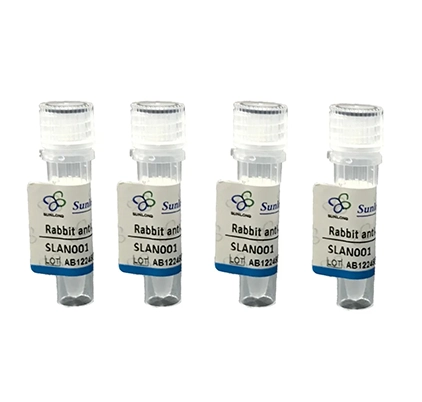
Rabbit Anti-HIC1 antibody
Hic 1; Hic-1; Hic1; HIC1_HUMAN; Hypermethylated in cancer 1; Hypermethylated in cancer 1 protein; ZBTB29; Zinc finger and BTB domain-containing protein 29; ZNF901.
All categories
View History [Clear]
Details
Product Name HIC1 Chinese Name Tumour异常甲基化蛋白1抗体 Alias Hic 1; Hic-1; Hic1; HIC1_HUMAN; Hypermethylated in cancer 1; Hypermethylated in cancer 1 protein; ZBTB29; Zinc finger and BTB domain-containing protein 29; ZNF901. literatures Research Area Chromatin and nuclear signals Epigenetics Immunogen Species Rabbit Clonality Polyclonal React Species Mouse(predicted:Human,Rat,Chicken,Dog,Pig,Cow,Horse) Applications WB=1:500-2000 (Paraffin sections need antigen repair)
not yet tested in other applications.
optimal dilutions/concentrations should be determined by the end user.Theoretical molecular weight 76kDa Cellular localization The nucleus Form Liquid Concentration 1mg/ml immunogen KLH conjugated synthetic peptide derived from human HIC1: 501-650/733 Lsotype IgG Purification affinity purified by Protein A Buffer Solution 1M TBS(pH7.4) with 1% BSA, 3% Proclin300 and 50% Glycerol. Storage Shipped at 4℃. Store at -20 °C for one year. Avoid repeated freeze/thaw cycles. Attention This product as supplied is intended for research use only, not for use in human, therapeutic or diagnostic applications. PubMed PubMed Product Detail Hypermethylated in cancer (HIC-1) was originally identified as a target of p53-induced gene expression. HIC-1 is deleted in the genetic disorder Miller-Dieker syndrome (MDS), and the expression of HIC-1 is also frequently suppressed in leukemia and various cancers due to the hypermethylation of specific DNA regions and the resulting transcriptional silencing. These and other studies indicate that HIC-1 acts as a putative tumor suppressor protein that mediates transcriptional repression. HIC-1 is ubiquitously expressed in adult tissues and its structure is defined by five zinc fingers and an N-terminal broad complex POZ (or BTB) domain. In several BTB/POZ containing proteins, including BCL-6 and the promyelocytic leukemia zinc-finger (PLZF) oncoprotein, this domain interacts with the SMRT/N-CoR-mSin3A HDAC complex and is directly involved in repressing and silencing gene transcription. When this domain is deleted, as with the oncogenic PLZF-RAR chimera of promyelocytic leukemias, this transcriptional repression is attenuated. Conversely, HIC-1 does not interact with components of the HDAC complex, suggesting that HIC-1-induced transcriptional repression is unassociated with the POZ/BTB domain.
Function:
Transcriptional repressor. Recognizes and binds to the consensus sequence '5-[CG]NG[CG]GGGCA[CA]CC-3'. May act as a tumor suppressor. May be involved in development of head, face, limbs and ventral body wall. Involved in down-regulation of SIRT1 and thereby is involved in regulation of p53/TP53-dependent apoptotic DNA-damage responses. The specific target gene promoter association seems to be depend on corepressors, such as CTBP1 or CTBP2 and MTA1. The regulation of SIRT1 transcription in response to nutrient deprivation seems to involve CTBP1. In cooperation with MTA1 (indicative for an association with the NuRD complex) represses transcription from CCND1/cyclin-D1 and CDKN1C/p57Kip2 specifically in quiescent cells. Involved in regulation of the Wnt signaling pathway probably by association with TCF7L2 and preventing TCF7L2 and CTNNB1 association with promoters of TCF-responsive genes. Seems to repress transcription from E2F1 and ATOH1 which involves ARID1A, indicative for the participation of a distinct SWI/SNF-type chromatin-remodeling complex. Probably represses transcription from CXCR7, FGFBP1 and EFNA1.
Subunit:
Self-associates. Interacts with HIC2. Interacts with CTBP1 and CTBP2. Interacts with TCF7L2 and ARID1A. Interacts with MTA1 and MBD3; indicative for an association with the NuRD complex.
Subcellular Location:
Nucleus.
Tissue Specificity:
Ubiquitously expressed with highest levels found in lung, colon, prostate, thymus, testis and ovary. Expression is absent or decreased in many tumor cells.
Post-translational modifications:
Acetylated on several residues, including Lys-333. Lys-333 is deacetylated by SIRT1.
Sumoylated on Lys-333 by a PIAS family member, which enhances interaction with MTA1, positively regulates transcriptional repression activity and is enhanced by HDAC4.
Similarity:
Belongs to the krueppel C2H2-type zinc-finger protein family. Hic subfamily.
Contains 1 BTB (POZ) domain.
Contains 5 C2H2-type zinc fingers.
SWISS:
Q14526
Gene ID:
3090
Database links:Entrez Gene: 3090 Human
Omim: 603825 Human
SwissProt: Q14526 Human
Unigene: 695682 Human
Unigene: 72956 Human
Product Picture 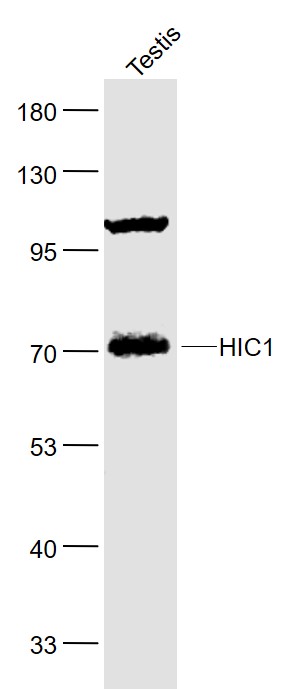 Sample:
Testis (Mouse) Lysate at 40 ug
Primary: Anti-HIC1 (SL15485R) at 1/1000 dilution
Secondary: IRDye800CW Goat Anti-Rabbit IgG at 1/20000 dilution
Predicted band size: 76 kD
Observed band size: 72 kD
Ordering & shipping
- Minimum order: 1 unit
- Lead time: varies with order quantity and specifications. Please consult your local distributor or our sales team for confirmation
- Payment: T/T 100% in advance; PayPal; Alibaba Trade Assurance
- Shipping: FedEx / DHL / UPS express; cold-chain packing available on request
- Price: USD, per unit (50ul / 100ul)
Partial purchase records(bought amounts latest5)
| Username | Quantity | bought time |
| Di*** | 1 | 2026-09-16 |
| Le*** | 1 | 2026-05-25 |
| Sa*** | 1 | 2026-04-22 |
| Qu*** | 1 | 2026-03-02 |
| Na*** | 1 | 2026-01-13 |
User Comment(Total0User Comment Num)
- No comment


 +86 571 56623320

 SUNLONG BIOTECH


