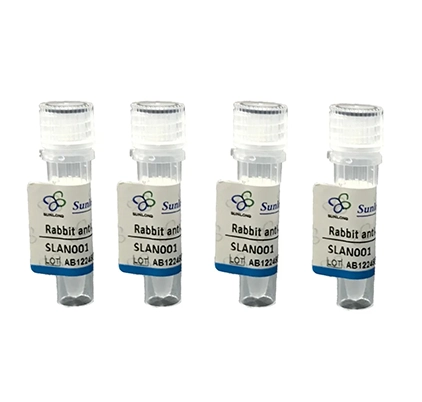
Rabbit Anti-Sumo2 antibody
Small ubiquitin-related modifier 2; SUMO-2; Sumo 2; HSMT3; SMT3 homolog 2; SUMO-3; Sentrin-2; Ubiquitin-like protein SMT3A; Smt3A; SUMO2_HUMAN.
All categories
View History [Clear]
Details
Product Name Sumo2 Chinese Name Ubiquitin样蛋白Sumo2抗体 Alias Small ubiquitin-related modifier 2; SUMO-2; Sumo 2; HSMT3; SMT3 homolog 2; SUMO-3; Sentrin-2; Ubiquitin-like protein SMT3A; Smt3A; SUMO2_HUMAN. Research Area Cell biology immunology Apoptosis Ubiquitin Immunogen Species Rabbit Clonality Polyclonal React Species Human,Mouse(predicted:Rat,Pig,Cow,Rabbit) Applications IHC-P=1:100-500,IHC-F=1:100-500,IF=1:100-500 (Paraffin sections need antigen repair)
not yet tested in other applications.
optimal dilutions/concentrations should be determined by the end user.Theoretical molecular weight 10.9kDa Cellular localization The nucleus cytoplasmic Form Liquid Concentration 1mg/ml immunogen KLH conjugated synthetic peptide derived from human Sumo2: 1-80/95 Lsotype IgG Purification affinity purified by Protein A Buffer Solution 1M TBS(pH7.4) with 1% BSA, 3% Proclin300 and 50% Glycerol. Storage Shipped at 4℃. Store at -20 °C for one year. Avoid repeated freeze/thaw cycles. Attention This product as supplied is intended for research use only, not for use in human, therapeutic or diagnostic applications. PubMed PubMed Product Detail The small ubiquitin-related modifier (SUMO) proteins, which include SUMO-1, SUMO-2 and SUMO-3, belong to the ubiquitin-like protein family. Like ubiquitin, the SUMO proteins are synthesized as precursor proteins that undergo processing before conjugation to target proteins. Also, both utilize the E1, E2, and E3 cascade enzymes for conjugation. However, SUMO and ubiquitin differ with respect to targeting. Ubiquitination predominantly targets proteins for degradation, whereas sumoylation targets proteins to a variety of cellular processing, including nuclear transport, transcriptional regulation, apoptosis and protein stability. The unconjugated SUMO-1, SUMO-2 and SUMO-3 proteins localize to the nuclear membrane, nuclear bodies and cytoplasm, respectively. SUMO-1 utilizes Ubc9 for conjugation to several target proteins, which include IkBa, MDM2, p53, PML and Ran GAP1. SUMO-2 and SUMO-3 contribute to a greater percentage of protein modification than does SUMO-1, and unlike SUMO-1, they can form polymeric chains. In addition, SUMO-3 regulates b-Amyloid generation and may be critical in the onset or progression of Alzheimer’s disease
Function:
Ubiquitin-like protein that can be covalently attached to proteins as a monomer or as a lysine-linked polymer. Covalent attachment via an isopeptide bond to its substrates requires prior activation by the E1 complex SAE1-SAE2 and linkage to the E2 enzyme UBE2I, and can be promoted by an E3 ligase such as PIAS1-4, RANBP2 or CBX4. This post-translational modification on lysine residues of proteins plays a crucial role in a number of cellular processes such as nuclear transport, DNA replication and repair, mitosis and signal transduction. Polymeric SUMO2 chains are also susceptible to polyubiquitination which functions as a signal for proteasomal degradation of modified proteins.
Subunit:
Homotrimer (Potential). Crystal packing analysis suggests a possible trimeric assembly, of which the biological significance remains to be determined. Interacts with SAE2 and UBE2I. Covalently attached to a number of proteins. Interacts with PELP1. Interacts with USP25; the interaction sumoylates USP25. Interacts with SIMC1, CASP8AP2, RNF111 AND SOBP (via SIM domains).
Subcellular Location:
Nucleus. Nucleus, PML body.
Tissue Specificity:
Broadly expressed.
Post-translational modifications:
Polymeric chains can be formed through Lys-11 cross-linking. Polymeric SUMO2 chains undergo 'Lys-6'-, 'Lys-11'-, 'Lys-48'- and 'Lys-63'-linked polyubiquitination by RNF4.
Cleavage of precursor form by SENP1 or SENP2 is necessary for function.
Similarity:
Belongs to the ubiquitin family. SUMO subfamily.
Contains 1 ubiquitin-like domain.
SWISS:
P61956
Gene ID:
6613
Database links:Entrez Gene: 6612 Human
Entrez Gene: 6613 Human
Entrez Gene: 170930 Mouse
Entrez Gene: 20610 Mouse
Omim: 602231 Human
Omim: 603042 Human
SwissProt: P55854 Human
SwissProt: P61956 Human
SwissProt: P61957 Mouse
SwissProt: Q9Z172 Mouse
Ordering & shipping
- Minimum order: 1 unit
- Lead time: varies with order quantity and specifications. Please consult your local distributor or our sales team for confirmation
- Payment: T/T 100% in advance; PayPal; Alibaba Trade Assurance
- Shipping: FedEx / DHL / UPS express; cold-chain packing available on request
- Price: USD, per unit (50ul / 100ul)
Partial purchase records(bought amounts latest1)
| Username | Quantity | bought time |
| Re*** | 1 | 2026-05-08 |
User Comment(Total0User Comment Num)
- No comment


 +86 571 56623320

 SUNLONG BIOTECH


