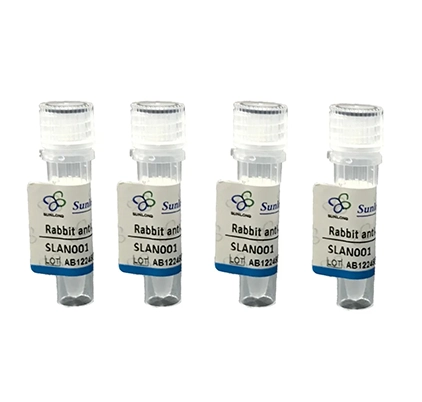
Rabbit Anti-CLCA4 antibody
CaCC-2; Calcium-activated chloride channel family member 4; Calcium-activated chloride channel protein 2; Calcium-activated chloride channel regulator 4; Clca4; CLCA4_HUMAN; hCaCC-2; hCLCA4; calcium-activated chloride channel regulator 4 precursor; Partur
All categories
View History [Clear]
Details
Product Name CLCA4 Chinese Name 钙激活氯离子通道4蛋白抗体 Alias CaCC-2; Calcium-activated chloride channel family member 4; Calcium-activated chloride channel protein 2; Calcium-activated chloride channel regulator 4; Clca4; CLCA4_HUMAN; hCaCC-2; hCLCA4; calcium-activated chloride channel regulator 4 precursor; Parturition-related protein PRP3; Clca6; Prp3. Research Area Cell biology immunology Signal transduction The new supersedes the old Immunogen Species Rabbit Clonality Polyclonal React Species Rat(predicted:Human,Mouse,Dog,Pig,Cow,Horse,Sheep) Applications IHC-P=1:100-500,IHC-F=1:100-500,IF=1:100-500 (Paraffin sections need antigen repair)
not yet tested in other applications.
optimal dilutions/concentrations should be determined by the end user.Theoretical molecular weight 99、101kDa Cellular localization The cell membrane Secretory protein Form Liquid Concentration 1mg/ml immunogen KLH conjugated synthetic peptide derived from human CLCA4: 221-320/919 Lsotype IgG Purification affinity purified by Protein A Buffer Solution 1M TBS(pH7.4) with 1% BSA, 3% Proclin300 and 50% Glycerol. Storage Shipped at 4℃. Store at -20 °C for one year. Avoid repeated freeze/thaw cycles. Attention This product as supplied is intended for research use only, not for use in human, therapeutic or diagnostic applications. PubMed PubMed Product Detail The protein encoded by this gene belongs to the calcium sensitive chloride conductance protein family. To date, all members of this gene family map to the same site on chromosome 1p31-p22 and share high degrees of homology in size, sequence and predicted structure, but differ significantly in their tissue distributions. Alternative splicing results in multiple transcript variants, only one of which is thought to be protein coding. [provided by RefSeq, Dec 2008].
Function:
May be involved in mediating calcium-activated chloride conductance.
Subcellular Location:
Cell membrane; Single-pass membrane protein. Apical cell membrane. Secreted. Note=The C-terminus 30 kDa form is anchored to the membrane. The N-terminus 110 kDa form is released from the membrane triggered by an unknown stimulus. Associated with the microvilli of non-goblet cell enterocytes in the small and large intestine. Co-localizes with CFTR.
Tissue Specificity:
Expressed in the non-goblet intestinal cells. High levels in intestine and stomach, and lower levels in eye, liver and spleen. Increasing expression from the duodenum to the ilium, and decreasing expression to the colon. Isoform 2 is expressed in intestine and stomach but at lower levels than isoform 1.
Post-translational modifications:
N-Glycosylated.
Processed at a monobasic residue to yield a larger N-terminal and a smaller C-terminal cleavage products of 90 to 110 and 30 to 35 kDa, respectively.
Similarity:
Belongs to the CLCR family.
Contains 1 VWFA domain.
SWISS:
Q14CN2
Gene ID:
22802
Database links:Entrez Gene: 22802 Human
SwissProt: Q14CN2 Human
Unigene: 567422 Human
Product Picture 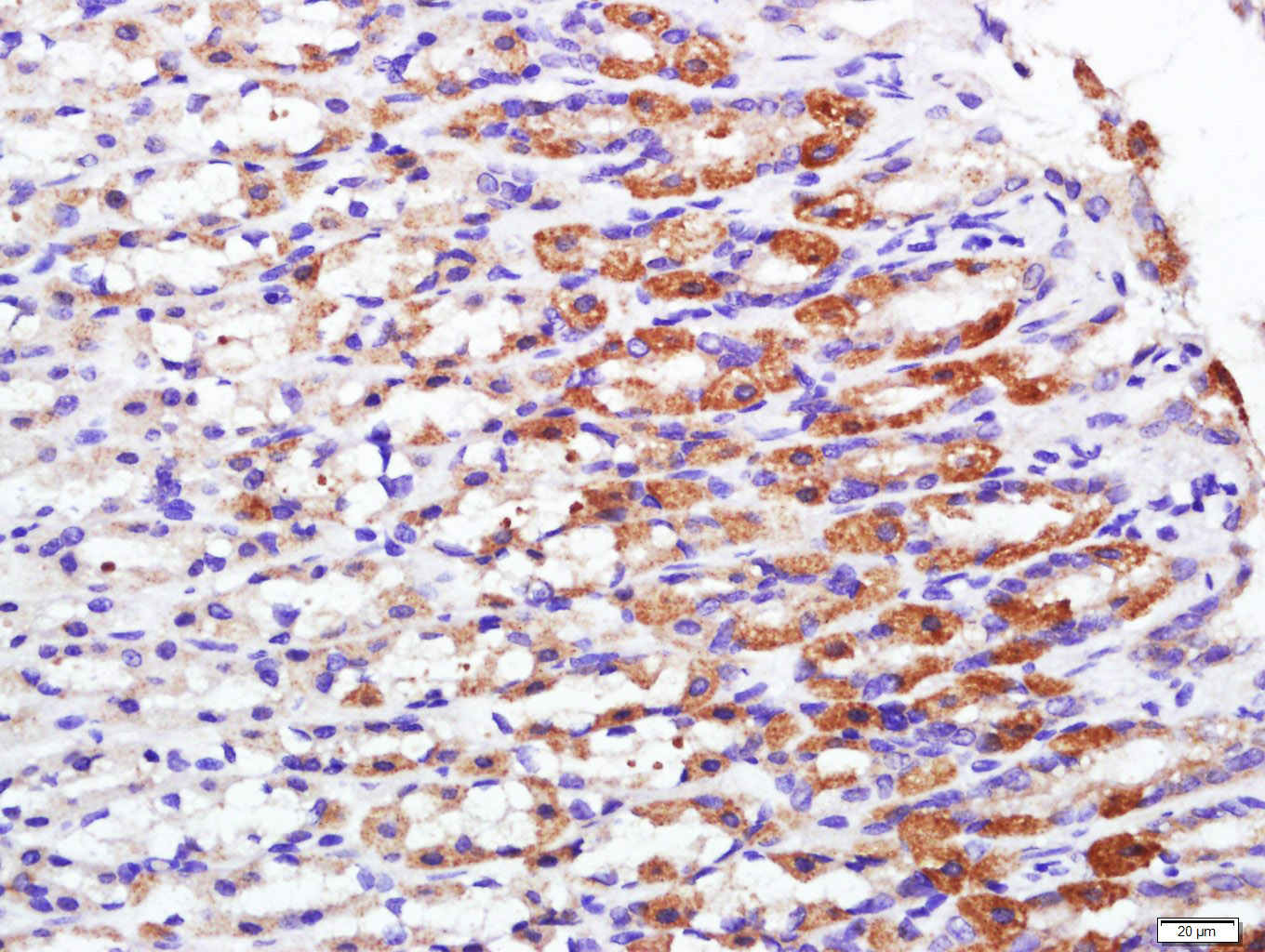 Tissue/cell: Rat stomach tissue; 4% Paraformaldehyde-fixed and paraffin-embedded;
Antigen retrieval: citrate buffer ( 1M, pH 6.0 ), Boiling bathing for 15min; Block endogenous peroxidase by 3% Hydrogen peroxide for 30min; Blocking buffer (normal goat serum,C-0005) at 37℃ for 20 min;
Incubation: Anti-CLCA4 Polyclonal Antibody, Unconjugated(SL15511R) 1:500, overnight at 4°C, followed by conjugation to the secondary antibody(SP-0023) and DAB(C-0010) staining
Ordering & shipping
- Minimum order: 1 unit
- Lead time: varies with order quantity and specifications. Please consult your local distributor or our sales team for confirmation
- Payment: T/T 100% in advance; PayPal; Alibaba Trade Assurance
- Shipping: FedEx / DHL / UPS express; cold-chain packing available on request
- Price: USD, per unit (50ul / 100ul)
Partial purchase records(bought amounts latest1)
| Username | Quantity | bought time |
| Vi*** | 1 | 2026-07-03 |
User Comment(Total0User Comment Num)
- No comment


 +86 571 56623320

 SUNLONG BIOTECH


