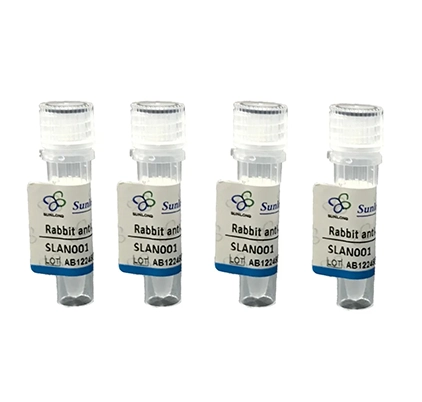
Rabbit Anti-FBN3 antibody
Fibrillin 3; FBN3_HUMAN; KIAA1776.
All categories
View History [Clear]
Details
Product Name FBN3 Chinese Name FBN3蛋白抗体 Alias Fibrillin 3; FBN3_HUMAN; KIAA1776. Research Area Cell biology Signal transduction Binding protein Immunogen Species Rabbit Clonality Polyclonal React Species (predicted: Human, ) Applications IHC-P=1:100-500,IHC-F=1:100-500,ICC/IF=1:100-500,IF=1:100-500,ELISA=1:5000-10000 (Paraffin sections need antigen repair)
not yet tested in other applications.
optimal dilutions/concentrations should be determined by the end user.Theoretical molecular weight 297kDa Cellular localization cytoplasmic Form Liquid Concentration 1mg/ml immunogen KLH conjugated synthetic peptide derived from human FBN3: 2701-2809/2809 Lsotype IgG Purification affinity purified by Protein A Buffer Solution 1M TBS(pH7.4) with 1% BSA, 3% Proclin300 and 50% Glycerol. Storage Shipped at 4℃. Store at -20 °C for one year. Avoid repeated freeze/thaw cycles. Attention This product as supplied is intended for research use only, not for use in human, therapeutic or diagnostic applications. PubMed PubMed Product Detail This gene encodes a protein that belongs to the fibrillin gene family. Fibrillins are extracellular matrix molecules that assemble into microfibrils in many connective tissues. This gene is most highly expressed in fetal tissues and its protein product is localized to extracellular microfibrils of developing skeletal elements, skin, lung, kidney, and skeletal muscle. This gene is potentially involved in Weill-Marchesani syndrome. While several transcript variants may exist for this gene, their full-length natures have not been described to date. [provided by RefSeq, Jul 2008]
Function:
Fibrillins are structural components of 10-12 nm extracellular calcium-binding microfibrils, which occur either in association with elastin or in elastin-free bundles. Fibrillin-containing microfibrils provide long-term force bearing structural support.
Subcellular Location:
Secreted; extracellular space; extracellular matrix.
Tissue Specificity:
Predominantly expressed in connective tissues such as skeletal muscle, tendon, skin, perichondrium and periosteum. Highly expressed in fetal lung, brain, kidney. Expressed at low level in prostate, testis, mammary gland, uterus, ovary, placenta, bladder, adrenal gland, thyroid, fetal thymus, fetal liver, liver, fetal heart and heart.
Post-translational modifications:
Probably forms intermolecular disulfide bonds either with other FBN3 molecules or with other components of the microfibrils (By similarity).
Similarity:
Belongs to the fibrillin family.
Contains 44 EGF-like domains.
Contains 9 TB (TGF-beta binding) domains.
SWISS:
Q75N90
Gene ID:
84467
Database links:Entrez Gene: 84467 Human
Omim: 608529 Human
SwissProt: Q75N90 Human
Unigene: 370362 Human
Ordering & shipping
- Minimum order: 1 unit
- Lead time: varies with order quantity and specifications. Please consult your local distributor or our sales team for confirmation
- Payment: T/T 100% in advance; PayPal; Alibaba Trade Assurance
- Shipping: FedEx / DHL / UPS express; cold-chain packing available on request
- Price: USD, per unit (50ul / 100ul)
Partial purchase records(bought amounts latest2)
| Username | Quantity | bought time |
| Za*** | 1 | 2026-07-23 |
| Ya*** | 1 | 2026-03-09 |
User Comment(Total0User Comment Num)
- No comment


 +86 571 56623320

 SUNLONG BIOTECH


