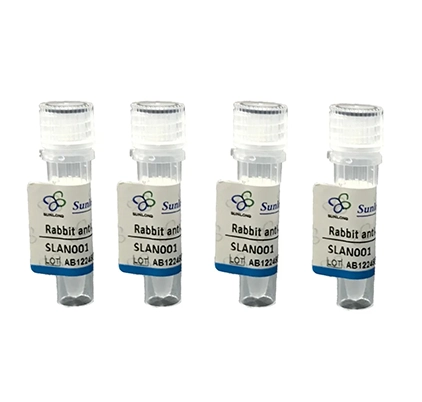
Rabbit Anti-GIPC3 antibody
C19orf64; DKFZp686J1198; FLJ40925; GIPC 3; GIPC3_HUMAN ; GIPC PDZ domain containing family member 3; PDZ domain containing protein GIPC 3; PDZ domain containing protein GIPC3; PDZ domain protein GIPC 3; PDZ domain protein GIPC3.
All categories
View History [Clear]
Details
Product Name GIPC3 Chinese Name 19号染色体开放阅读框64/C19orf64抗体 Alias C19orf64; DKFZp686J1198; FLJ40925; GIPC 3; GIPC3_HUMAN ; GIPC PDZ domain containing family member 3; PDZ domain containing protein GIPC 3; PDZ domain containing protein GIPC3; PDZ domain protein GIPC 3; PDZ domain protein GIPC3. Research Area Tumour Cell biology Signal transduction G protein signal Immunogen Species Rabbit Clonality Polyclonal React Species Human(predicted:Mouse,Rat,Dog,Cow) Applications WB=1:500-2000 (Paraffin sections need antigen repair)
not yet tested in other applications.
optimal dilutions/concentrations should be determined by the end user.Theoretical molecular weight 34kDa Cellular localization cytoplasmic Form Liquid Concentration 1mg/ml immunogen KLH conjugated synthetic peptide derived from human GIPC3: 151-250/312 Lsotype IgG Purification affinity purified by Protein A Buffer Solution 1M TBS(pH7.4) with 1% BSA, 3% Proclin300 and 50% Glycerol. Storage Shipped at 4℃. Store at -20 °C for one year. Avoid repeated freeze/thaw cycles. Attention This product as supplied is intended for research use only, not for use in human, therapeutic or diagnostic applications. PubMed PubMed Product Detail The protein encoded by this gene belongs to the GIPC family. Studies in mice suggest that this gene is required for postnatal maturation of the hair bundle and long-term survival of hair cells and spiral ganglion in the ear. Mutations in this gene are associated with autosomal recessive deafness. [provided by RefSeq, Dec 2011]
Function:
GIPC3 is widely expressed in adult and fetal tissues. Highest levels are found in jejunum, lymph node, parietal lobe, fetal spleen and fetal thymus. It is expressed in cervical, melanoma, chronic myelogenous and gastric cancer cell lines.
Tissue Specificity:
Widely expressed in adult and fetal tissues. Highest levels are found in jejunum, lymph node, parietal lobe, fetal spleen and fetal thymus. Expressed in cervical, melanoma, chronic myelogenous and gastric cancer cell lines.
DISEASE:
Deafness, autosomal recessive, 15 (DFNB15) [MIM:601869]: A form of non-syndromic sensorineural hearing loss with prelingual onset. Sensorineural deafness results from damage to the neural receptors of the inner ear, the nerve pathways to the brain, or the area of the brain that receives sound information. Note=The disease is caused by mutations affecting the gene represented in this entry.
Similarity:
Belongs to the GIPC family.
Contains 1 PDZ (DHR) domain.
SWISS:
Q8TF64
Gene ID:
126326
Database links:Entrez Gene: 126326 Human
Omim: 608792 Human
SwissProt: Q8TF64 Human
Unigene: 266873 Human
Product Picture 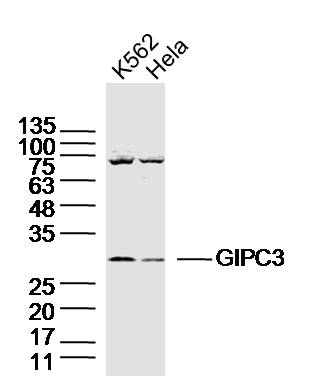 Sample:
K562 (Human)Cell Lysate at 40 ug
Hela(Human) Cell Lysate at 40 ug
Primary: Anti-GIPC3(SL16246R)at 1/300 dilution
Secondary: IRDye800CW Goat Anti-RabbitIgG at 1/20000 dilution
Predicted band size: 34kD
Observed band size: 30kD
Ordering & shipping
- Minimum order: 1 unit
- Lead time: varies with order quantity and specifications. Please consult your local distributor or our sales team for confirmation
- Payment: T/T 100% in advance; PayPal; Alibaba Trade Assurance
- Shipping: FedEx / DHL / UPS express; cold-chain packing available on request
- Price: USD, per unit (50ul / 100ul)
Partial purchase records(bought amounts latest4)
| Username | Quantity | bought time |
| Um*** | 1 | 2026-07-05 |
| Di*** | 1 | 2026-06-30 |
| Ni*** | 1 | 2026-04-28 |
| Fe*** | 1 | 2026-04-22 |
User Comment(Total0User Comment Num)
- No comment


 +86 571 56623320

 SUNLONG BIOTECH


