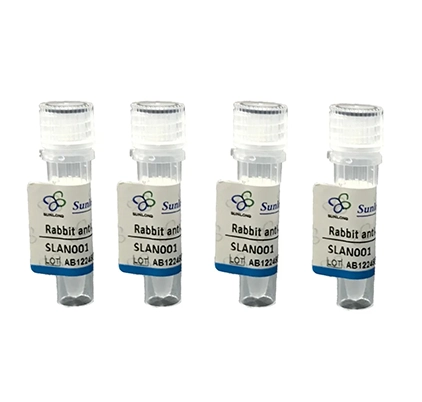
Rabbit Anti-SIRT1 antibody
SIR2L1; NAD-dependent protein deacetylase sirtuin-1; EC:2.3.1.286; hSIRT1; NAD-dependent protein deacylase sirtuin-1; Regulatory protein SIR2 homolog 1; SIR2-like protein 1 (hSIR2); SirtT1 75 kDa fragment; SIR1_HUMAN;
All categories
View History [Clear]
Details
Product Name SIRT1 Chinese Name 沉默调节蛋白1抗体 Alias SIR2L1; NAD-dependent protein deacetylase sirtuin-1; EC:2.3.1.286; hSIRT1; NAD-dependent protein deacylase sirtuin-1; Regulatory protein SIR2 homolog 1; SIR2-like protein 1 (hSIR2); SirtT1 75 kDa fragment; SIR1_HUMAN; literatures Research Area Cell biology immunology Chromatin and nuclear signals Microbiology Signal transduction The new supersedes the old Epigenetics Immunogen Species Rabbit Clonality Polyclonal React Species Human,Mouse (predicted:Dog,Pig,Horse,Rabbit) Applications WB=1:500-2000,IHC-P=1:100-500,IHC-F=1:100-500,IF=1:100-500,Flow-Cyt=1ug/Test (Paraffin sections need antigen repair)
not yet tested in other applications.
optimal dilutions/concentrations should be determined by the end user.Theoretical molecular weight 81kDa Cellular localization The nucleus cytoplasmic Form Liquid Concentration 1mg/ml immunogen KLH conjugated synthetic peptide derived from human SIRT1: 551-650/747 Lsotype IgG Purification affinity purified by Protein A Buffer Solution 1M TBS(pH7.4) with 1% BSA, 3% Proclin300 and 50% Glycerol. Storage Shipped at 4℃. Store at -20 °C for one year. Avoid repeated freeze/thaw cycles. Attention This product as supplied is intended for research use only, not for use in human, therapeutic or diagnostic applications. PubMed PubMed Product Detail This gene encodes a member of the sirtuin family of proteins, homologs to the yeast Sir2 protein. Members of the sirtuin family are characterized by a sirtuin core domain and grouped into four classes. The functions of human sirtuins have not yet been determined; however, yeast sirtuin proteins are known to regulate epigenetic gene silencing and suppress recombination of rDNA. Studies suggest that the human sirtuins may function as intracellular regulatory proteins with mono-ADP-ribosyltransferase activity. The protein encoded by this gene is included in class I of the sirtuin family. Alternative splicing results in multiple transcript variants.
Function:
SirtT1 75 kDa fragment: catalytically inactive 75SirT1 may be involved in regulation of apoptosis. May be involved in protecting chondrocytes from apoptotic death by associating with cytochrome C and interfering with apoptosome assembly.
Subunit:
Found in a complex with PCAF and MYOD1. Component of the eNoSC complex, composed of SIRT1, SUV39H1 and RRP8. Interacts with HES1, HEY2 and PML. Interacts with RPS19BP1/AROS. Interacts with KIAA1967/DBC1 (via N-terminus); the interaction disrupts the interaction between SIRT1 and p53/TP53. Interacts with SETD7; the interaction induces the dissociation of SIRT1 from p53/TP53 and increases p53/TP53 activity. Interacts with MYCN, NR1I2, CREBZF, TSC2, TLE1, FOS, JUN, NR0B2, PPARG, NCOR, IRS1, IRS2 and NMNAT1. Interacts with HNF1A; the interaction occurs under nutrient restriction. Interacts with SUZ12; the interaction mediates the association with the PRC4 histone methylation complex which is specific as an association with PCR2 and PCR3 complex variants is not found. Interacts with HIV-1 tat.
Subcellular Location:
Nucleus, PML body. Cytoplasm. Note=Recruited to the nuclear bodies via its interaction with PML. Colocalized with APEX1 in the nucleus. May be found in nucleolus, nuclear euchromatin, heterochromatin and inner membrane. Shuttles between nucleus and cytoplasm.
SirtT1 75 kDa fragment: Cytoplasm. Mitochondrion.
Tissue Specificity:
Widely expressed.
Post-translational modifications:
Methylated on multiple lysine residues; methylation is enhanced after DNA damage and is dispensable for deacetylase activity toward p53/TP53.
Phosphorylated. Phosphorylated by STK4/MST1, resulting in inhibition of SIRT1-mediated p53/TP53 deacetylation. Phosphorylation by MAPK8/JNK1 at Ser-27, Ser-47, and Thr-530 leads to increased nuclear localization and enzymatic activity. Phosphorylation at Thr-530 by DYRK1A and DYRK3 acivates deacetylase activity and promotes cell survival. Phosphorylation by mammalian target of rapamycin complex 1 (mTORC1) at Ser-47 inhibits deacetylation activity. Phosphorylated by CaMK2, leading to increased p53/TP53 and NF-kappa-B p65/RELA deacetylation activity (By similarity). Phosphorylation at Ser-27 implicating MAPK9 is linked to protein stability. There is some ambiguity for some phosphosites: Ser-159/Ser-162 and Thr-544/Ser-545.
Proteolytically cleaved by cathepsin B upon TNF-alpha treatment to yield catalytic inactive but stable SirtT1 75 kDa fragment (75SirT1).
S-nitrosylated by GAPDH, leading to inhibit the NAD-dependent protein deacetylase activity (By similarity).
Similarity:
Belongs to the sirtuin family.
Contains 1 deacetylase sirtuin-type domain.
SWISS:
Q96EB6
Gene ID:
23411
Database links:Entrez Gene: 23411 Human
Entrez Gene: 93759 Mouse
Omim: 604479 Human
SwissProt: Q96EB6 Human
SwissProt: Q923E4 Mouse
Unigene: 369779 Human
Unigene: 351459 Mouse
In the Sirtuin protein family, sirtuin 1 (silent information regulator) participates in various The new supersedes the old activities, including DNA self-protection and repair, inhibition of lipid peroxidation accumulation, inhibition of the expression of other Apoptosis-related genes, and activities related to cell lifespan. Caloric restriction can enhance SIRT1 expression, thereby extending lifespan. SIRT proteins have become regulators of multiple biological processes and also participate in the regulation of aging. Among the most studied SIRT proteins, SIRT1 interacts with various non-histone proteins or transcription factors, including p53, FOXO proteins, p300, NFkB, and MyoD. Sirtuins can participate in processes such as apoptosis, cell survival, transcription, and metabolism. Drugs targeting sirtuins may be useful in treating aging, cancer, Diabetes, and neurodegenerative diseases.Product Picture 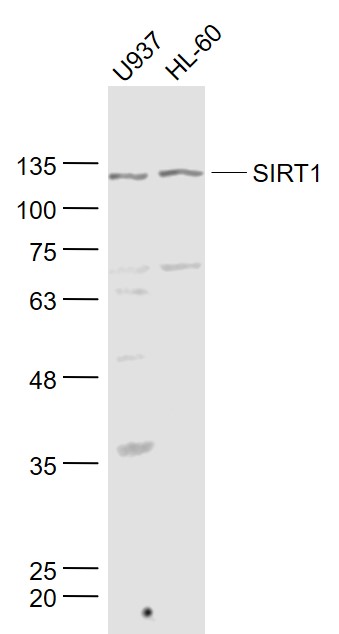 Sample:
U937(Human) Cell Lysate at 30 ug
HL-60(Human) Cell Lysate at 30 ug
Primary: Anti- SIRT1 (SL2257R) at 1/1000 dilution
Secondary: IRDye800CW Goat Anti-Rabbit IgG at 1/20000 dilution
Predicted band size: 81 kD
Observed band size: 120 kD
 Sample:
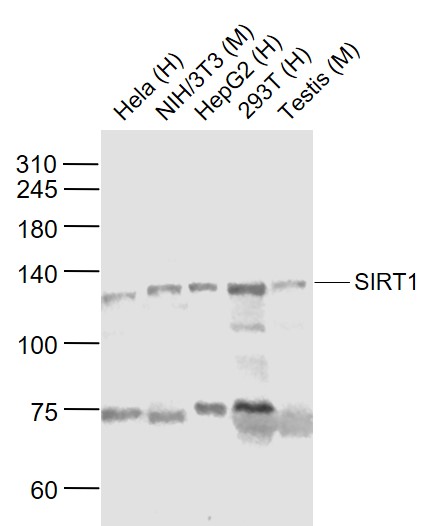
Lane 1: Hela (Human) Cell Lysate at 30 ug
Lane 2: NIH/3T3 (Mouse) Cell Lysate at 30 ug
Lane 3: HepG2 (Human) Cell Lysate at 30 ug
Lane 4: 293T (Human) Cell Lysate at 30 ug
Lane 5: Testis (Mouse) Lysate at 40 ug
Primary: Anti-SIRT1 (SL2257R) at 1/1000 dilution
Secondary: IRDye800CW Goat Anti-Rabbit IgG at 1/20000 dilution
Predicted band size: 116/95 kD
Observed band size: 116 kD
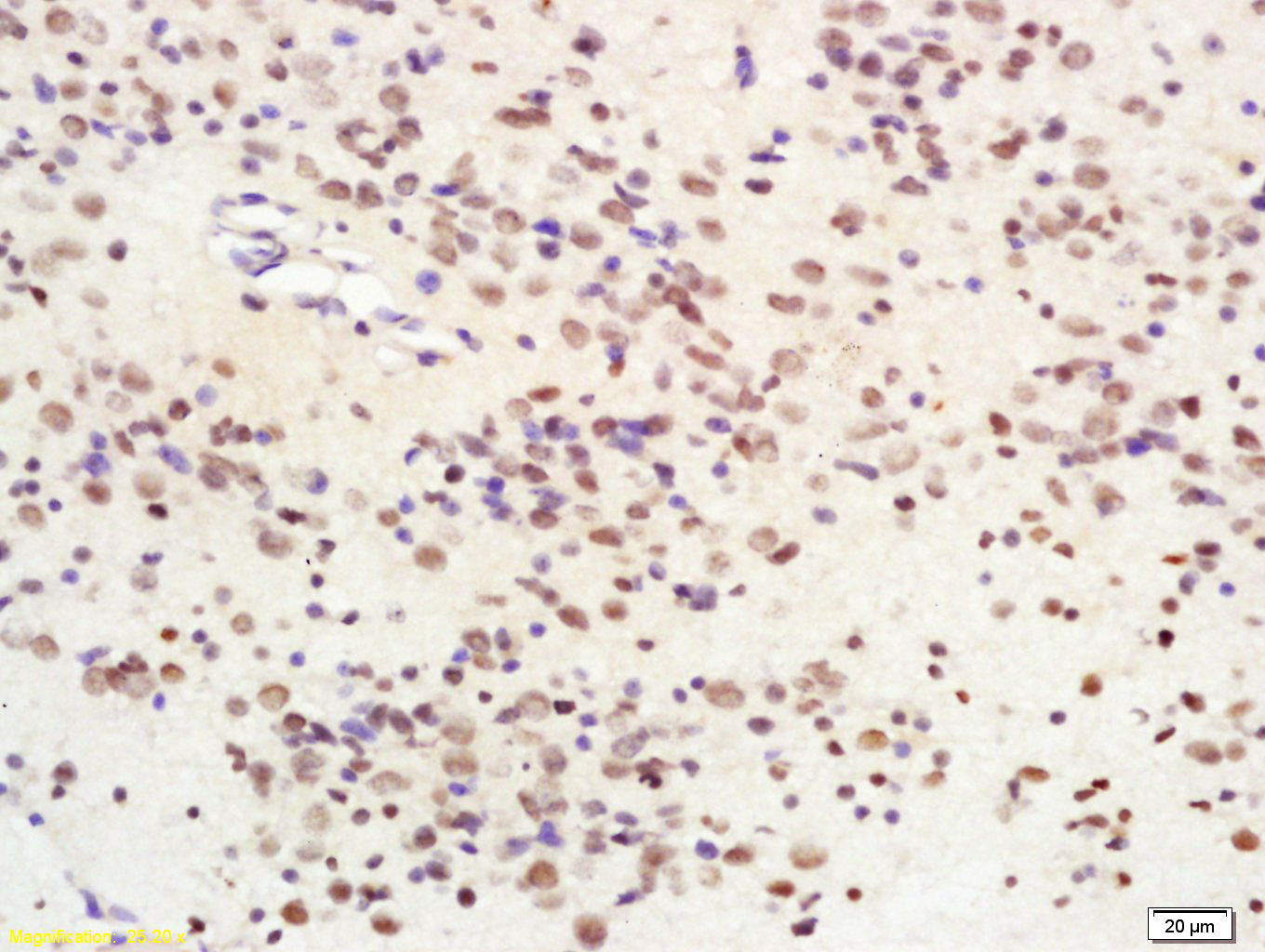 Tissue/cell: human glioma tissue; 4% Paraformaldehyde-fixed and paraffin-embedded;
Antigen retrieval: citrate buffer ( 1M, pH 6.0 ), Boiling bathing for 15min; Block endogenous peroxidase by 3% Hydrogen peroxide for 30min; Blocking buffer (normal goat serum,C-0005) at 37℃ for 20 min;
Incubation: Anti-SIRT1/sirtuin 1 Polyclonal Antibody, Unconjugated(SL2257R) 1:200, overnight at 4°C, followed by conjugation to the secondary antibody(SP-0023) and DAB(C-0010) staining
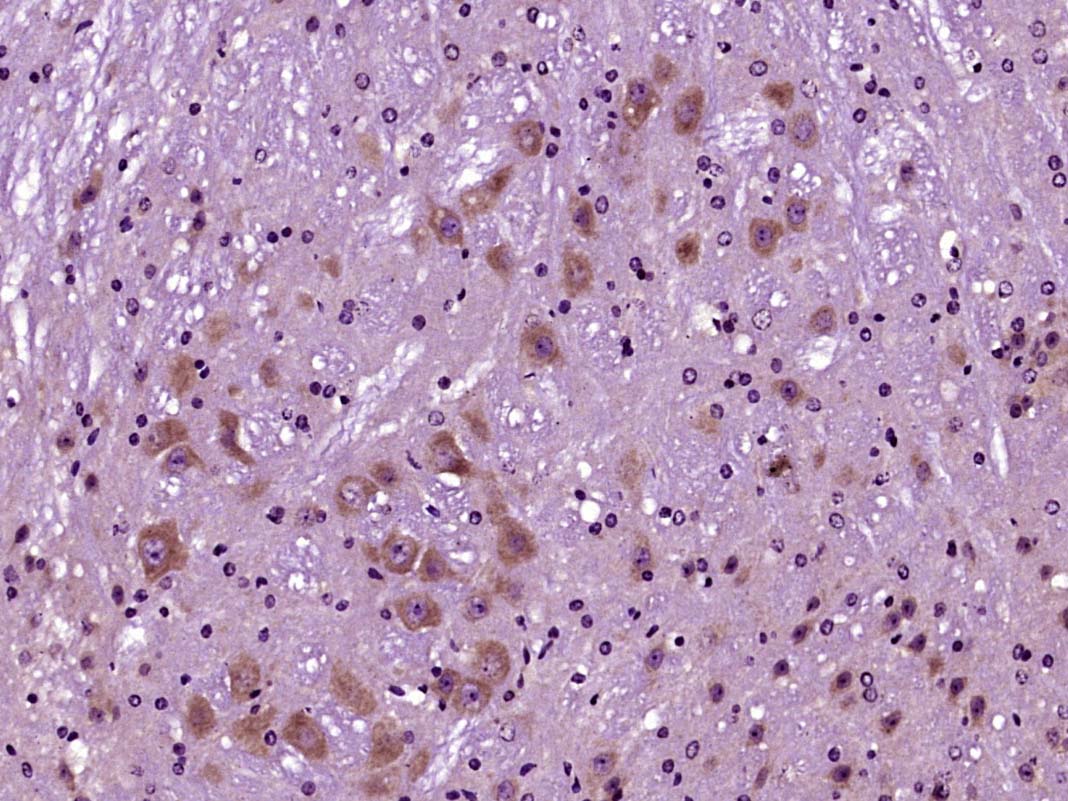 Paraformaldehyde-fixed, paraffin embedded (Mouse brain); Antigen retrieval by boiling in sodium citrate buffer (pH6.0) for 15min; Block endogenous peroxidase by 3% hydrogen peroxide for 20 minutes; Blocking buffer (normal goat serum) at 37°C for 30min; Antibody incubation with (SIRT1) Polyclonal Antibody, Unconjugated (SL2257R) at 1:400 overnight at 4°C, followed by operating according to SP Kit(Rabbit) (sp-0023) instructionsand DAB staining.
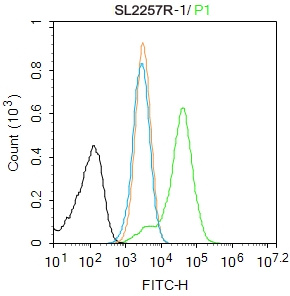 Blank control:HL-60.
Primary Antibody (green line): Rabbit Anti-SIRT1 antibody (SL2257R)
Dilution: 1μg /10^6 cells;
Isotype Control Antibody (orange line): Rabbit IgG .
Secondary Antibody : Goat anti-rabbit IgG-AF488
Dilution: 1μg /test.
Protocol
The cells were fixed with 4% PFA (10min at room temperature)and then permeabilized with 0.1% PBST for 20 min at room temperature. The cells were then incubated in 5%BSA to block non-specific protein-protein interactions for 30 min at room temperature .Cells stained with Primary Antibody for 30 min at room temperature. The secondary antibody used for 40 min at room temperature. Acquisition of 20,000 events was performed.Ordering & shipping
- Minimum order: 1 unit
- Lead time: varies with order quantity and specifications. Please consult your local distributor or our sales team for confirmation
- Payment: T/T 100% in advance; PayPal; Alibaba Trade Assurance
- Shipping: FedEx / DHL / UPS express; cold-chain packing available on request
- Price: USD, per unit (50ul / 100ul)
Partial purchase records(bought amounts latest1)
| Username | Quantity | bought time |
| Ya*** | 1 | 2026-09-12 |
User Comment(Total0User Comment Num)
- No comment


 +86 571 56623320

 SUNLONG BIOTECH


