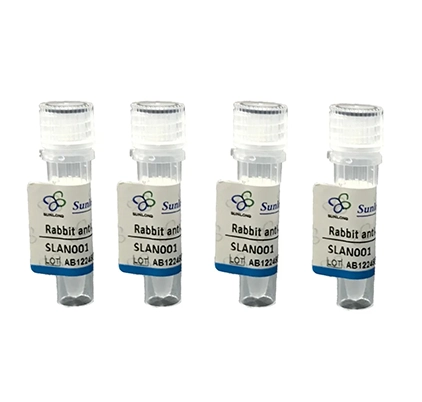
Details
Product Name PYY Chinese Name 酪酪肽抗体 Alias PYY_HUMAN; Peptide YY; PYY-I; Peptide tyrosine tyrosine; Peptide YY(3-36); PYY-II; PYY1; literatures Research Area Cardiovascular immunology Neurobiology Growth factors and hormones Diabetes Endocrinopathy Immunogen Species Rabbit Clonality Polyclonal React Species (predicted: Human, ) Applications IHC-P=1:100-500,IHC-F=1:100-500,IF=1:100-500,ELISA=1:5000-10000 (Paraffin sections need antigen repair)
not yet tested in other applications.
optimal dilutions/concentrations should be determined by the end user.Theoretical molecular weight 4.4kDa Cellular localization Secretory protein Form Liquid Concentration 1mg/ml immunogen KLH conjugated synthetic peptide human Peptide YY: 29-64/97 Lsotype IgG Purification affinity purified by Protein A Buffer Solution 1M TBS(pH7.4) with 1% BSA, 3% Proclin300 and 50% Glycerol. Storage Shipped at 4℃. Store at -20 °C for one year. Avoid repeated freeze/thaw cycles. Attention This product as supplied is intended for research use only, not for use in human, therapeutic or diagnostic applications. PubMed PubMed Product Detail Peptide tyrosine tyrosine (PYY) was originally isolated from porcine gut, which exhibits striking sequence homology with members of the pancreatic polypeptide family, including neuropeptide tyrosine (NPY). The peptide is localized to enteroglucagon containing (L/EG) and pancreatic (A) cells in many mammalian and non-mammalian species. PYY gene expression is upregulated by various growth factors, including growth hormone and insulin-like growth factor and the physiological effects of PYY are mediated by G-protein (G alpha i2) coupled Y-type receptors (‘Y2 receptors of a PYY preferring subtype’). Various actions have been reported for PYY, including the inhibition of upper intestinal and exocrine pancreatic secretion, small intestinal water flux and as the mediator for the fat-induced ileal brake. Recently, the infusion of normal postprandial concentrations of PYY[3-36] into human volunteers has been shown to significantly decrease appetite and reduce food intake, possibly via Y2R in the arcuate nucleus. Immunohistochemical studies on mice have shown that PYY is the earliest detectable peptide in both pancreatic islets and colonic endocrine cells which suggest that PYY may be a useful marker for endocrine progenitor cells.
This gene encodes a member of the neuropeptide Y (NPY) family of peptides. The encoded preproprotein is proteolytically processed to generate two alternative peptide products that differ in length by three amino acids. These peptides, secreted by endocrine cells in the gut, exhibit different binding affinities for each of the neuropeptide Y receptors. Binding of the encoded peptides to these receptors mediates regulation of pancreatic secretion, gut mobility and energy homeostasis. Rare variations in this gene could increase susceptibility to obesity and elevated serum levels of the encoded peptides may be associated with anorexia nervosa. [provided by RefSeq, Feb 2016]
PYY1-36(human):
Tyr-Pro-Ile-Lys-Pro-Glu-Ala-Pro-Gly-Glu-Asp-Ala-Ser-Pro-Glu-Glu-Leu-Asn-Arg-Tyr-Tyr-Ala-Ser-Leu-Arg-His-Tyr-Leu-Asn-Leu-Val-Thr-Arg-Gln-Arg-Tyr-NH2
CAS Number: 118997-30-1; Empirical Formula (Hill Notation): C194H295N55O57; Molecular Weight: 4309.75
Function:
This gut peptide inhibits exocrine pancreatic secretion, has a vasoconstrictory action and inhibitis jejunal and colonic mobility.
Subcellular Location:
Secreted.
Similarity:
Belongs to the NPY family.
SWISS:
P10082
Gene ID:
5697
Database links:Entrez Gene: 5697 Human
Entrez Gene: 217212 Mouse
Omim: 600781 Human
SwissProt: P10082 Human
SwissProt: Q9EPS2 Mouse
SwissProt: Q9TR93 Rabbit
Unigene: 169249 Human
Unigene: 46248 Mouse
Unigene: 13173 Rat
Peptide YY introduction
Peptide YY (PYY), also known as gut-derived hormone peptide YY, belongs to the pancreatic polypeptide family. It is known for its ability to induce satiety and reduce food intake and body weight. With further in-depth research, it has been found to have multiple biological functions.
1、 PYY的protein结构:PYYIt has high sequence homology with pancreatic polypeptide (PP) and neuropeptide Y (NPY), so it is considered to belong to the pancreatic polypeptide family. PYY is a peptide substance with an amidated carboxyl terminus and is a linear polypeptide; its molecular structure consists of 36 amino acids condensed together, and the amino acid residues at the amino and carboxyl termini of this peptide are both tyrosine(Tyrosine,Tyr)。In the circulatory system,PYY以PYY1-36 和PYY3-36两种形式存在 。
2、 PYY的分泌及影响因素: PYY is mainly secreted by L cells in the colon and rectum in both endocrine and paracrine manners;
a. Initially, PYY is produced by endocrine cells in the colon, and this hormone has a certain relationship with the formation and development of the gastrointestinal tract.
b. PYY can also be secreted by endocrine cells in the stomach and pancreas, and is present in neurons of the central nervous system (hypothalamus, brainstem, medulla, pons, and spinal cord) and the peripheral nervous system.
c. In the pancreas, PYY is mainly co-expressed with glucagon in the α cells of the islets. The expression of PYY in early islet cell precursors indicates that it plays an important role in the differentiation, proliferation, and development of the pancreas. A PYY has also been isolated from amphibian skin, called S-PYY.
3、PYYrole:
a. Inhibition of insulin secretion: In in vivo and in vitro experiments, PYY can inhibit insulin secretion. PYY indirectly affects insulin secretion by reducing the action of glucagon. Since both insulin and PYY are secreted by β cells of the islets, PYY may regulate insulin secretion via a paracrine manner, but whether glucagon and PYY are secreted together requires further research.
b. PYY can also inhibit insulin secretion by acting on the central nervous system. PYY may bind to Y1 and Y2 receptors in the brainstem to regulate the vagus nerve and affect feeding function, which includes regulating insulin secretion.
c. Inhibition of gastric acid secretion: PYY can inhibit gastric acid secretion induced by pentagastrin, cholinergic agonists, vagal stimulation, and histamine, as well as reduce pepsin content, while also increasing the concentration of PYY in the blood.
d. Regulation of feeding behavior by PYY: The concentration of PYY decreases before feeding and increases after feeding, indicating that PYY is a satiety signal that regulates feeding.
Ordering & shipping
- Minimum order: 1 unit
- Lead time: varies with order quantity and specifications. Please consult your local distributor or our sales team for confirmation
- Payment: T/T 100% in advance; PayPal; Alibaba Trade Assurance
- Shipping: FedEx / DHL / UPS express; cold-chain packing available on request
- Price: USD, per unit (50ul / 100ul)
Partial purchase records(bought amounts latest4)
| Username | Quantity | bought time |
| Ca*** | 1 | 2026-05-18 |
| Um*** | 1 | 2026-05-11 |
| Ya*** | 1 | 2026-03-31 |
| Ja*** | 1 | 2026-03-04 |
User Comment(Total0User Comment Num)
- No comment


 +86 571 56623320

 SUNLONG BIOTECH


