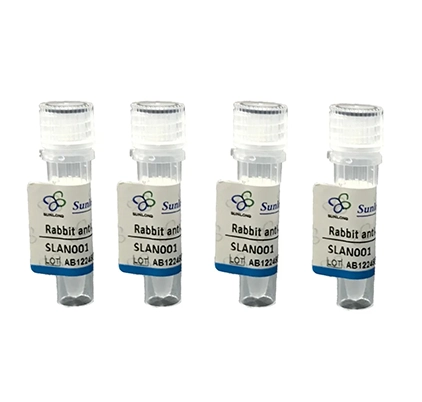
Rabbit Anti-ZNF423 antibody
Early B cell factor associated zinc finger protein; Ebfaz; hOAZ; Nur12; OAZ; OLF 1/EBF associated zinc finger; OLF1/EBF associated zinc finger protein; Olf1/EBF-associated zinc finger protein; Roaz; Smad and Olf interacting zinc finger protein; Smad- and
All categories
View History [Clear]
Details
Product Name ZNF423 Chinese Name Zinc finger protein423抗体 Alias Early B cell factor associated zinc finger protein; Ebfaz; hOAZ; Nur12; OAZ; OLF 1/EBF associated zinc finger; OLF1/EBF associated zinc finger protein; Olf1/EBF-associated zinc finger protein; Roaz; Smad and Olf interacting zinc finger protein; Smad- and Olf-interacting zinc finger protein; Zfp104; ZFP423; zinc finger protein 423, mouse, homolog of; Zinc finger protein 423; ZN423_HUMAN; ZNF423; ZNF423 zinc finger protein 423. Research Area Cell biology Neurobiology Signal transduction Growth factors and hormones transcriptional regulatory factor Cell differentiation Zinc finger protein Epigenetics Immunogen Species Rabbit Clonality Polyclonal React Species Human,Mouse,Rat(predicted:Chicken,Dog,Pig,Cow,Horse,Rabbit) Applications WB=1:500-2000 (Paraffin sections need antigen repair)
not yet tested in other applications.
optimal dilutions/concentrations should be determined by the end user.Theoretical molecular weight 145kDa Cellular localization The nucleus Form Liquid Concentration 1mg/ml immunogen KLH conjugated synthetic peptide derived from human ZNF423 : 191-290/1284 Lsotype IgG Purification affinity purified by Protein A Buffer Solution 1M TBS(pH7.4) with 1% BSA, 3% Proclin300 and 50% Glycerol. Storage Shipped at 4℃. Store at -20 °C for one year. Avoid repeated freeze/thaw cycles. Attention This product as supplied is intended for research use only, not for use in human, therapeutic or diagnostic applications. PubMed PubMed Product Detail OAZ is a 30-zinc finger, DNA-binding factor that associates with members of the Smad family of transcription factors in response to BMP2 activation. Bone morphogenic proteins (BMPs), are the largest group within the TGF∫ growth factors superfamily and are involved in embryonic development, specifically the formation of left-right asymmetry, neurogenesis, organogenesis and skeletal development. BMPs bind to surface receptors, which then phosphorylate serine residues of specific Smad proteins to induce Smad translocation to the nucleus and transcriptional activation of BMP targeted genes. OAZ specifically cooperates with the BMP-activated Smads, namely Smad1, 5 and 8, in binding to the CAGAC and TGGAGC boxes within the BRE, or BMP response element, and activating transcription. OAZ contains a BMP signaling module formed by two clusters of fingers that individually associate with either the Smads or the BMP response element. Distinct regions of OAZ, separate from the modules involved in BMP regulation, also enable OAZ to function as a transcriptional partner of Olf-1/EBF in olfactory epithelium and lymphocyte development, indicating that, as a multi–zinc finger protein, OAZ may have dual roles in signal transduction during development.
Function:
Transcription factor that can both act as an activator or a repressor depending on the context. Plays a central role in BMP signaling and olfactory neurogenesis. Associates with SMADs in response to BMP2 leading to activate transcription of BMP target genes. Acts as a transcriptional repressor via its interaction with EBF1, a transcription factor involved in terminal olfactory receptor neurons differentiation; this interaction preventing EBF1 to bind DNA and activate olfactory-specific genes. Involved in olfactory neurogenesis by participating in a developmental switch that regulates the transition from differentiation to maturation in olfactory receptor neurons. Controls proliferation and differentiation of neural precursors in cerebellar vermis formation.
Subunit:
Homodimer (By similarity). Interacts with EBF1 (By similarity). Interacts with SMAD1 and SMAD4. Interacts with PARP1. Interacts with CEP290.
Subcellular Location:
Nucleus.
Tissue Specificity:
Expressed in brain, lung, skeletal muscle, heart, pancreas and kidney but not liver or placenta. Also expressed in aorta, ovary, pituitary, small intestine, fetal brain, fetal kidney and, within the adult brain, in the substantia nigra, medulla, amygdala, thalamus and cerebellum.
DISEASE:
Note=Defects in ZNF423 can be a cause of nephronophthisis-related ciliopathies (NPHP-RC), a group of recessive diseases that affect kidney, retina and brain. ZNF423 mutations have been found in patients with nephronophthisis, cerebellar vermis hypoplasia and situs inversus, and Joubert syndrome.
Similarity:
Belongs to the krueppel C2H2-type zinc-finger protein family.
Contains 30 C2H2-type zinc fingers.
SWISS:
Q2M1K9
Gene ID:
23090
Database links:Entrez Gene: 23090 Human
Entrez Gene: 94187 Mouse
Omim: 604557 Human
SwissProt: Q2M1K9 Human
SwissProt: Q80TS5 Mouse
Unigene: 530930 Human
Unigene: 23452 Mouse
Unigene: 472447 Mouse
Unigene: 9981 Rat
Product Picture
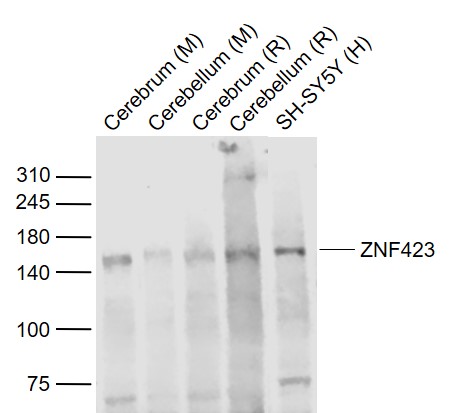
Figure 1. Sample: Lane 1: Cerebrum (Mouse) Lysate at 40 ug Lane 2: Cerebellum (Mouse) Lysate at 40 ug Lane 3: Cerebrum (Rat) Lysate at 40 ug Lane 4: Cerebellum (Rat) Lysate at 40 ug Lane 5: SH-SY5Y (Human) Cell Lysate at 30 ug Primary: Anti-ZNF423 (SL22985R) at 1/1000 dilution Secondary: IRDye800CW Goat Anti-Rabbit IgG at 1/20000 dilution Predicted band size: 145/138 kD Observed band size: 145 kD
Ordering & shipping
- Minimum order: 1 unit
- Lead time: varies with order quantity and specifications. Please consult your local distributor or our sales team for confirmation
- Payment: T/T 100% in advance; PayPal; Alibaba Trade Assurance
- Shipping: FedEx / DHL / UPS express; cold-chain packing available on request
- Price: USD, per unit (50ul / 100ul)
Partial purchase records(bought amounts latest1)
| Username | Quantity | bought time |
| Be*** | 1 | 2026-02-14 |
User Comment(Total0User Comment Num)
- No comment


 +86 571 56623320

 SUNLONG BIOTECH


