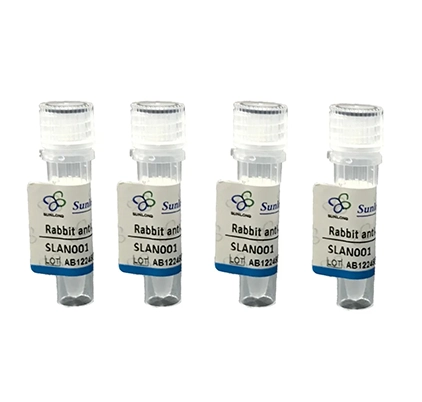
Rabbit Anti-PPV VP2 antibody
PPV-VP2; Porcine parvovirus VP2; PPV Isoform VP2 (P18546-2); Capsid protein VP1; CAPSD_PAVPN.
All categories
View History [Clear]
Details
Product Name PPV VP2 Chinese Name 猪细小病毒VP2抗体 Alias PPV-VP2; Porcine parvovirus VP2; PPV Isoform VP2 (P18546-2); Capsid protein VP1; CAPSD_PAVPN. Research Area immunology Bacteria and viruses Immunogen Species Rabbit Clonality Polyclonal React Species (predicted:Porcine parvovirus) Applications ELISA=1:5000-10000
not yet tested in other applications.
optimal dilutions/concentrations should be determined by the end user.Theoretical molecular weight 64kDa Form Liquid Concentration 1mg/ml immunogen Recombinant Porcine Parvovirus VP2 protein Lsotype IgG Purification affinity purified by Protein A Buffer Solution (predicted:Porcine parvovirus)1M TBS(pH7.4) with 1% BSA, (predicted:Porcine parvovirus)3% Proclin300 and 50% Glycerol. Storage Shipped at 4℃. Store at -20 °C for one year. Avoid repeated freeze/thaw cycles. Attention This product as supplied is intended for research use only, not for use in human, therapeutic or diagnostic applications. PubMed PubMed Product Detail Porcine Parvovirus Infection (PPV) is the most common and important cause of infectious infertility. Porcine parvovirus is a fairly tough virus that multiplies normally in the intestine of the pig without causing clinical signs. It is world-wide in its distribution. If you test for it in your pig herd it is almost certain it will be present unless your herd is less than 100 sows when it might have died out. It is therefore an infection you have to live with and manage. Whereas most viruses do not survive outside the host for any great period of time PPV is unusual in that it can persist outside the pig for many months and it is resistant to most disinfectants. This perhaps explains why it is so widespread and so difficult to remove from the pig environment.
Function:
Capsid protein self-assembles to form an icosahedral capsid with a T=1 symmetry, about 22 nm in diameter, and consisting of 60 copies of two size variants of the capsid proteins, VP1 and VP2, which differ by the presence of an N-terminal extension in the minor protein VP1. The capsid encapsulates the genomic ssDNA. Capsid proteins are responsible for the attachment to host cell receptors. This attachment induces virion internalization predominantly through clathrin-dependent endocytosis. Binding to the host receptors also induces capsid rearrangements leading to surface exposure of VP1 N-terminus, specifically its phospholipase A2-like region and putative nuclear localization signal(s). VP1 N-terminus might serve as a lipolytic enzyme to breach the endosomal membrane during entry into host cell and might contribute to virus transport to the nucleus (By similarity).
SWISS:
P18546
Gene ID:
N/A
Porcine parvovirus (PPV) is an important viral infectious disease that causes reproductive disorders in pigs. The main route of infection is through the oral, nasal and other mucosal membranes. After infection, pregnant sows can transmit the virus through the placenta, causing abortion, stillbirth, mummified fetuses and death of newborn piglets. Because the disease has a wide epidemic range and causes serious harm, it brings major economic losses to the pig industry. The PPV genome encodes 3 structural proteins, namely VP1, VP2 and VP3, among which VP2 is the main capsid protein constituting the viral particle, accounting for about 80% of the total viral capsid protein. The VP2 protein carries the main antigenic determinants and can induce the body to produce neutralizing antibodies. VP2 also plays a key role in viral infection and pathogenicity. Therefore, PPV-VP2 protein is of great significance in PPV diagnosis and immune prevention and control.Ordering & shipping
- Minimum order: 1 unit
- Lead time: varies with order quantity and specifications. Please consult your local distributor or our sales team for confirmation
- Payment: T/T 100% in advance; PayPal; Alibaba Trade Assurance
- Shipping: FedEx / DHL / UPS express; cold-chain packing available on request
- Price: USD, per unit (50ul / 100ul)
Partial purchase records(bought amounts latest2)
| Username | Quantity | bought time |
| Ra*** | 1 | 2026-03-13 |
| We*** | 1 | 2026-02-09 |
User Comment(Total0User Comment Num)
- No comment


 +86 571 56623320

 SUNLONG BIOTECH


