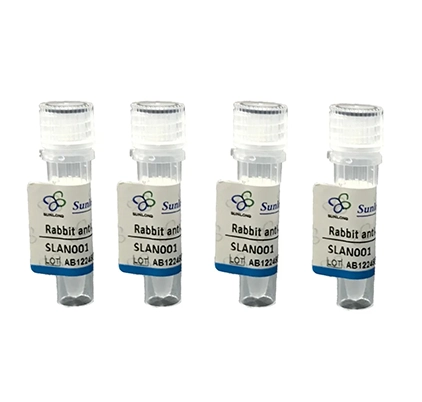
Rabbit Anti-FGF23 antibody
ADHR; FGF-23; Fgf23; FGF 23; FGF23_HUMAN; Fibroblast growth factor 23; Fibroblast growth factor 23 N-terminal peptide; Fibroblast growth factor 23 precursor; HPDR2; HYPF; Phosphatonin; PHPTC; Tumor derived hypophosphatemia inducing factor; Tumor-derived h
All categories
View History [Clear]
Details
Product Name FGF23 Chinese Name 成纤维细胞生长因子23抗体 Alias ADHR; FGF-23; Fgf23; FGF 23; FGF23_HUMAN; Fibroblast growth factor 23; Fibroblast growth factor 23 N-terminal peptide; Fibroblast growth factor 23 precursor; HPDR2; HYPF; Phosphatonin; PHPTC; Tumor derived hypophosphatemia inducing factor; Tumor-derived hypophosphatemia-inducing factor. Research Area Tumour Cell biology immunology Signal transduction Stem cells Growth factors and hormones Immunogen Species Rabbit Clonality Polyclonal React Species Mouse(predicted:Rat) Applications WB=1:500-2000 (Paraffin sections need antigen repair)
not yet tested in other applications.
optimal dilutions/concentrations should be determined by the end user.Theoretical molecular weight 27kDa Cellular localization Secretory protein Form Liquid Concentration 1mg/ml immunogen KLH conjugated synthetic peptide derived from mouse FGF23: 81-180/251 Lsotype IgG Purification affinity purified by Protein A Buffer Solution 1M TBS(pH7.4) with 1% BSA, 3% Proclin300 and 50% Glycerol. Storage Shipped at 4℃. Store at -20 °C for one year. Avoid repeated freeze/thaw cycles. Attention This product as supplied is intended for research use only, not for use in human, therapeutic or diagnostic applications. PubMed PubMed Product Detail This gene encodes a member of the fibroblast growth factor family of proteins, which possess broad mitogenic and cell survival activities and are involved in a variety of biological processes. The product of this gene regulates phosphate homeostasis and transport in the kidney. The full-length, functional protein may be deactivated via cleavage into N-terminal and C-terminal chains. Mutation of this cleavage site causes autosomal dominant hypophosphatemic rickets (ADHR). Mutations in this gene are also associated with hyperphosphatemic familial tumoral calcinosis (HFTC). [provided by RefSeq, Feb 2013]
Function:
Regulator of phosphate homeostasis. Inhibits renal tubular phosphate transport by reducing SLC34A1 levels. Upregulates EGR1 expression in the presence of KL. Acts directly on the parathyroid to decrease PTH secretion. Regulator of vitamin-D metabolism. Negatively regulates osteoblast differentiation and matrix mineralization.
Subunit:
Interacts with FGFR1, FGFR2, FGFR3 and FGFR4. Affinity between fibroblast growth factors (FGFs) and their receptors is increased by KL and heparan sulfate glycosaminoglycans that function as coreceptors.
Subcellular Location:
Secreted. Note=Secretion is dependent on O-glycosylation.
Tissue Specificity:
Expressed in osteogenic cells particularly during phases of active bone remodeling. In adult trabecular bone, expressed in osteocytes and flattened bone-lining cells (inactive osteoblasts).
Post-translational modifications:
Following secretion this protein is inactivated by cleavage into a N-terminal fragment and a C-terminal fragment. The processing is effected by proprotein convertases. O-glycosylated by GALT3. Glycosylation is necessary for secretion; it blocks processing by proprotein convertases when the O-glycan is alpha 2,6-sialylated. Competition between proprotein convertase cleavage and block of cleavage by O-glycosylation determines the level of secreted active FGF23.
DISEASE:
Defects in FGF23 are the cause of autosomal dominant hypophosphataemic rickets (ADHR) [MIM:193100]. ADHR is characterized by low serum phosphorus concentrations, rickets, osteomalacia, leg deformities, short stature, bone pain and dental abscesses. Defects in FGF23 are a cause of hyperphosphatemic familial tumoral calcinosis (HFTC) [MIM:211900]. HFTC is a severe autosomal recessive metabolic disorder that manifests with hyperphosphatemia and massive calcium deposits in the skin and subcutaneous tissues.
Similarity:
Belongs to the heparin-binding growth factors family.
SWISS:
Q9EPC2
Gene ID:
64654
Database links:Entrez Gene: 8074 Human
Omim: 605380 Human
SwissProt: Q9GZV9 Human
Unigene: 287370 Human
Product Picture 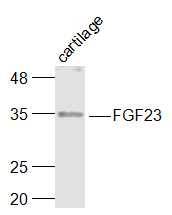 Sample:
Cartilage (Mouse) Lysate at 40 ug
Primary: Anti-FGF23 (SL23556R) at 1/1000 dilution
Secondary: IRDye800CW Goat Anti-Rabbit IgG at 1/20000 dilution
Predicted band size: 27 kD
Observed band size: 32 kD
Ordering & shipping
- Minimum order: 1 unit
- Lead time: varies with order quantity and specifications. Please consult your local distributor or our sales team for confirmation
- Payment: T/T 100% in advance; PayPal; Alibaba Trade Assurance
- Shipping: FedEx / DHL / UPS express; cold-chain packing available on request
- Price: USD, per unit (50ul / 100ul)
Partial purchase records(bought amounts latest5)
| Username | Quantity | bought time |
| Bo*** | 1 | 2026-06-12 |
| Iv*** | 1 | 2026-04-27 |
| He*** | 1 | 2026-03-24 |
| Be*** | 1 | 2026-03-08 |
| Um*** | 1 | 2026-01-29 |
User Comment(Total0User Comment Num)
- No comment


 +86 571 56623320

 SUNLONG BIOTECH


